Trade Show Marketing isn’t complicated. It can be reduced to three simple rules. Everything else is a business decision. Here’s the difference: Buying a 10 ft. portable vs. 20 ft. custom island — that’s a business decision. Staying at the Hilton vs. the Quality Inn — that’s a business decision. Getting a professional presenter for the booth — that’s a marketing decision.
Confused? Here’s ALL YOU NEED TO KNOW about trade show marketing to be successful.
Rule #1. Problem and Solution.
Your message must state a problem and a solution, either explicitly or implicitly. Attendees are there to find solutions. They may not know they have a problem until you provide the solution. When Chrysler introduced the minivan back in the 80’s, their marketing focused on showing families that their vehicle was either too big or too small. In an attempt to be clever or creative, we forget we’re selling something. Selling is all about identifying needs and pains… and then providing the right solution.
Rule #2. Get Noticed.
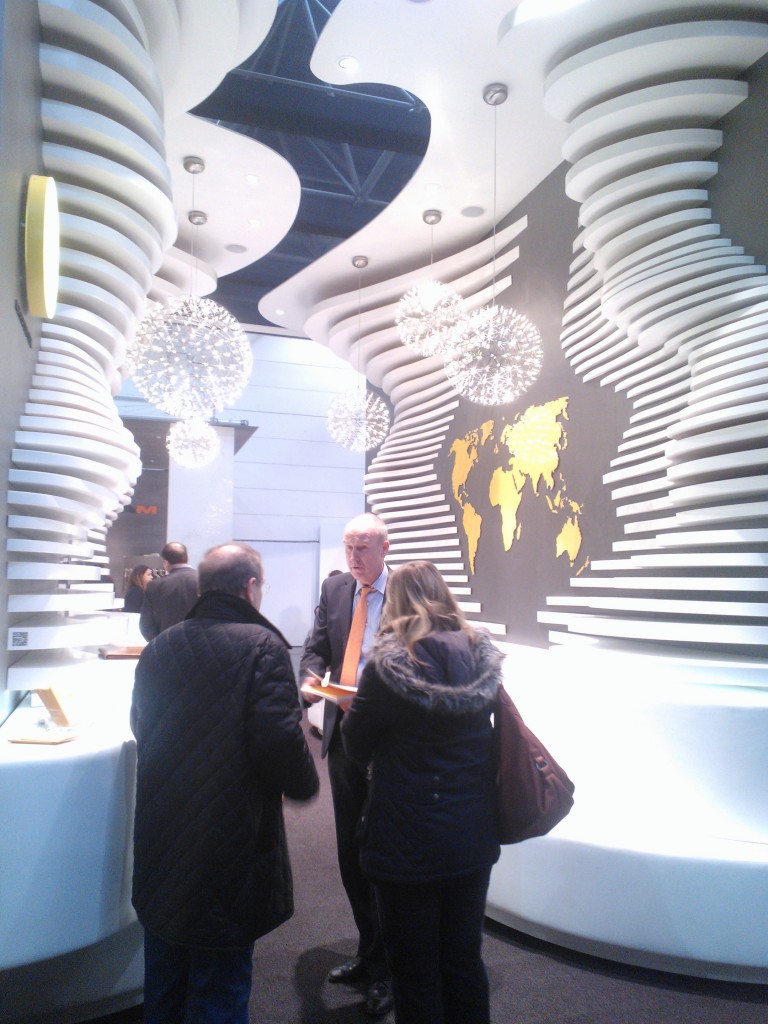
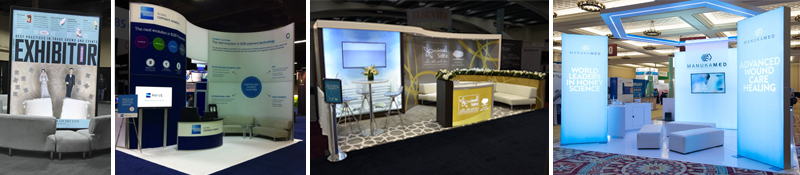
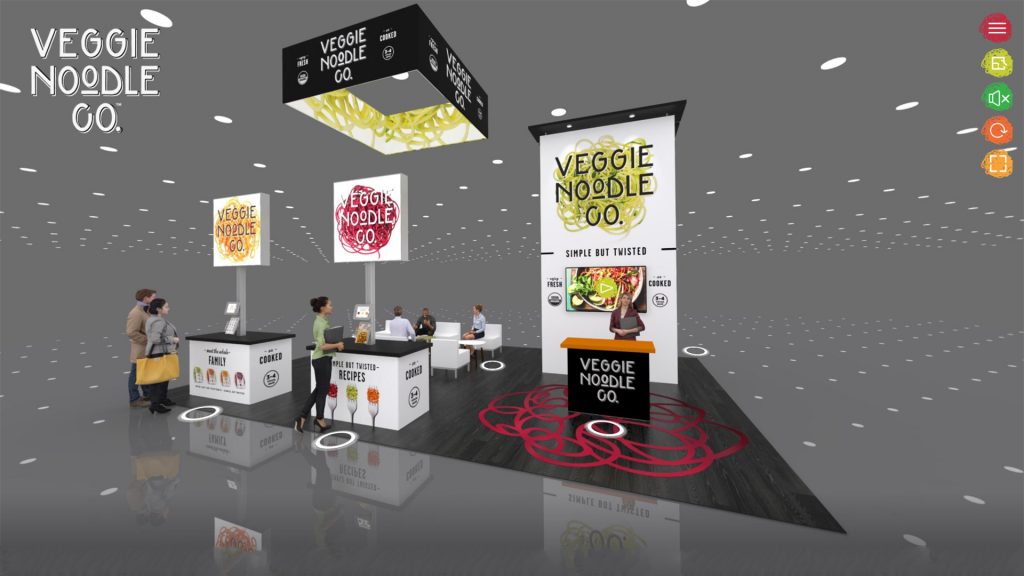
It’s called a “show” for a reason. You spent money to be seen at the show. BE SEEN! Does that mean dressing in a clown suit and standing in a booth made of balloons? No, unless that’s your culture (or you are selling balloons). Most companies approach trade show exhibits and graphics like they’re buying a mid-priced sedan: “I’d like a Honda Accord in silver.” Take a chance. You want to be different. That doesn’t mean it shouldn’t be practical and contain everything you need to showcase your product or service. Even Melba Toast doesn’t have to be Melba Toast at a trade show.
Does your product lend itself to a professional presenter? That’s one way to get noticed.
Pre-show marketing. There’s no better way of getting seen than by developing a pre-show campaign that drives attendees to your booth. In today’s Internet-driven, social media-focused market, getting someone’s attention before the show is as important, if not more important, than being seen at the show.
Rule #3. The Right People.
If you bring ten people to the show, at least six are the wrong ones. Why?
They don’t know the products and services
They don’t have charismatic people skills
They are not personally invested in the show results
They did not participte in the pre- or post-show planning.
Two out of four doesn’t cut it. A trade show isn’t a vacation. It’s a strategic investment.
You’ll often hear that 80% of trade show leads are wasted. I don’t know if that’s true, but I do know that bringing the right employees to the show solves that problem. The right employees won’t let a lead sit on someone’s desk or be forgotten on a jump drive. They’re relentless about post-show follow-up because they understand how much time, effort, and money went into planning and participating in the trade show.
Want to be a trades how star? Focus on these three rules. Everything else, while important to your bottom line, your ego, or your HR Department, is just a business decision.
Based in Portland, Oregon, Classic Exhibits Inc. designs and manufacturers portable, modular, and custom-hybrid exhibit solutions. Classic Exhibits products are represented by an extensive distributor network in North America and in select International markets. For more information, contact us at 866-652-2100 or www.classicexhibits.com
If you’ve ever attended a trade show, you have an opinion about trade shows, trade show marketing, or exhibit design. I won’t try to dispel every myth, but here are 10 Common Myths about Trade Shows.
1. Trade Show Marketing is Marketing.
Yes and no. If you are a skilled marketer, you will grasp the nuances of trade show marketing, but it will take time. Most marketing managers gravitate to their strengths by focusing on the structure, the graphics, or the show promotion and planning. Intellectually, they know these are interconnected, but they may not know how to maximize their results. Work with professionals, whether it’s a graphic designer, an exhibit consultant, or a certified trade show manager. Trade show exhibit marketing is a craft learned the hard way through trial and error. It’s easy to burn through a lot of money before you figure out what works and what doesn’t. Don’t stumble through a year or two of mistakes when exhibit experts can save you time, money, and embarrassment.
2. Trade Show Labor is Hostile, Incompetent, and Expensive.
10 Common Trade Show Myths
Again, yes and no. No one will dispute that trade show I&D can be expensive, particularly in certain well-known venues. However, most I&D contractors are very competent. They can solve almost any last minute trade show display crisis. You may disagree with the show hall rules regarding labor regulations, but the actual laborers in your booth didn’t write them. If you disagree with the rules, don’t take it out on the person assembling your display. Contact your I&D labor provider or show management.
This is a sad but true fact regarding show labor at most trade shows. If three people are assigned to your booth, one person will be a star, one person will be average, and one person will be a zombie. Hire nine people and you are guaranteed to have three stars and three zombies. Sometimes you get lucky, and the ratio works in your favor. Sometimes not.
You have the power to control your labor costs, beginning with exhibit design. Consider assembly and packaging during the design phase. Are the components labeled, can it be packed without relying on a 20 page manual, and are the packaging materials reusable?
3. Anyone Can Staff a Booth.
Too often, companies send the wrong folks to work the trade show booth. Even worse, they don’t train them. Not everyone has the temperament, the knowledge, or the discipline for a trade show. Here’s my rule: Find those employees with previous retail sales experience who love assisting customers with product or service solutions. It doesn’t matter if they are in Sales, Marketing, Engineering, or Production. What matters is their attitude and their knowledge.
Want to know who not to send? “Joe.” Every company has a “Joe.” He drinks too much, he gambles too much, and he wanders around too much. About a half a dozen times a day, you’ll wonder what happened to Joe. Five minutes ago he was sucking down his third espresso, leaning on the counter, and ogling anything with two X chromosomes. Suddenly he’s gone . . . AGAIN!
4. Trade Shows are One Big Party.
For some companies, that is true. They wine and dine customers to excess, party until daylight, and don’t attend any show sponsored events.
Inevitably, those are the same companies that grumble about their trade show ROI. They spent “X” but can only measure “Y” sales from the show. When you ask them about their pre-show promotions, their lead qualification, their client meetings at the show, and their follow up with prospective customers, you get a big “DHuh?” They didn’t plan their trade show marketing program, and now it shows.
5. Trade Shows are a Waste of Time.
If you love sitting in a cubicle all day creating spreadsheets, then trade shows make not make sense to you. You fly to desirable locations like Las Vegas, San Francisco, Orlando, New York, New Orleans, or Chicago. You have to meet people, listen to their needs, talk about your company, stand on your feet, and generally be helpful, pleasant, and knowledgeable. Even worse, you may have to join clients for breakfast, socialize with them after show hours, mingle with potential suppliers, and attend educational seminars about your industry. That’s really tough
You either embrace the opportunity to build sales and learn something new, or you grumble about the airport, the food, the hotel, and the hassle of time away from the office. It’s all about your attitude.
6. Trade Show Displays are Expensive (Part 1).
Very true, but so is almost any investment in capital equipment or advertising. Let’s explore this from another perspective. Let’s say your company purchased an $18,000 inline display (10 x 20). Then, let’s assume your company participates in four trade shows a year and you expect the booth to last five years. Now, take the average cost per show including show space, literature, airfare, hotels, meals, entertainment, transportation, and labor. If you are frugal, you’ll spend:
$25,000 per show
Multiply that by 20 shows (4 shows x 5 years) = $500,000
Then divide the booth cost $18,000 by the $500,000 in expenses
= 4.3% which is the display cost to total expenses
Let’s take it to the next step. Your company takes trade show marketing seriously (and you should). You conduct pre-show promotions, you send the right folks to the show, and you aggressively follow up on all leads. You expect the show to generate sales (or you wouldn’t be participating). On average, you demand $150,000 in new sales from each show. $150,000 x 20 shows = $3,000,000 in sales.
Based on those numbers:
$500,000/$3,000,000 = 16% trade show cost to sales
$18,000/$3,000,000 = 0.6% display cost to sales
I don’t know about you, but those numbers look pretty good to me. And unlike magazine, television, or direct mail advertising, they’re measurable if you put the right metrics in place.
7. Trade Show Displays are Expensive (Part 2).
Probably 60 percent of all trade show displays never go to large, industry shows in Las Vegas, Orlando, or Chicago. The owners take them to Chamber of Commerce mixers, local business shows, corporate events, regional industry shows, and hiring and recruitment fairs.
At these shows, you won’t see island exhibits, but you will see pop ups, table tops, banner stands, and lightweight hybrids. These displays range in price from under $200 for a basic banner stand with graphics to $8000 for an upscale portable hybrid. Considering the cost of most advertising, buying a trade show display is a bargain that you’ll use for years and years.
8. All Shows are the Same.
Really? If your experience has been that “all shows are the same,” you may be approaching every show EXACTLY the SAME. Not every show has the same audience. There may be similarities, but the attendees vary even in shows focusing on the same industry.
If you are serious about trade show marketing, then contact show management and request attendee and exhibitor data. Have them describe the goals, mission, and audience of the show. Then go to the next step and ask for exhibitors who have been loyal to that trade show for many years. Assuming they are not competitors, contact the Marketing Manager or Trade Show Coordinator. Ask them why they attend, how they tailor their message to the audience, and how that message differs from other shows. And then do what professional marketers do . . . create a message, design appropriate graphics, and plan a pre-show, show, and post-show campaign.
9. Trade Show Leads are a Waste of Time.
Leads can be a waste of time if: a) You collect business cards in a fishbowl for a cool product giveaway like an iPad, b) You don’t qualify the attendees who visit your booth (or jot down their needs), and c) You don’t contact them until a month or two after the show.
More than anything else you do at a trade show, your lead quality is a byproduct of your pre-show planning, booth staff training, and timely post-show follow-up. There is a direct correlation. A trade show is a salesperson’s nirvana, namely a captive audience that spent money to see you.
Now, you may get lucky and acquire a game-changing customer while sipping coffee, clipping your fingernails, and chatting with co-workers. But that’s rare. Finding good customers takes time, enthusiasm, knowledge, and patience. You have to be at your best because they can (and will) walk down the aisle and find another solution.
10. Virtual Trade Shows will Replace Real Trade Shows.
There is a place for virtual trade shows just as there is a place for dating websites. But at some point, you have to meet in person. And unless you’re looking for a mail order spouse, you’re not going to get any action unless you shake hands, look one another in the eye, and share your story face-to-face.
Want to learn more about trade shows, trade show marketing, and displays? Click here for more than 80 expert articles.
Perhaps no industry has been impacted by COVID more than trade shows and events. Restaurants switched to carry out and deliveries. Hotels and airlines still operated but with fewer customers. Trade shows and events came to a complete halt. This disruption impacted every segment of the trade show/event industry and the sales and marketing plans of tens of thousands of companies that attend or participate in face-to-face marketing.
The return of trade shows and exhibitions has meant new safety and health guidelines, not only for show organizers and convention centers but also for exhibitors. At Classic Exhibits, our 3D exhibit designers have created trade show booth designs that address those safety concerns by implementing greater physical distance, traffic flow patterns, plex barriers, and easy-to-clean surfaces.
6 Modern Trade Show Booth Design Tips for Safety
No one knows precisely what to expect about trade show design guidelines, such as whether show organizers and convention halls will have specific requirements for exhibitors or if standard North American Regulations will be revised. But you don’t need a weatherman to know which way the wind is blowing. Here are some commonsense suggestions.
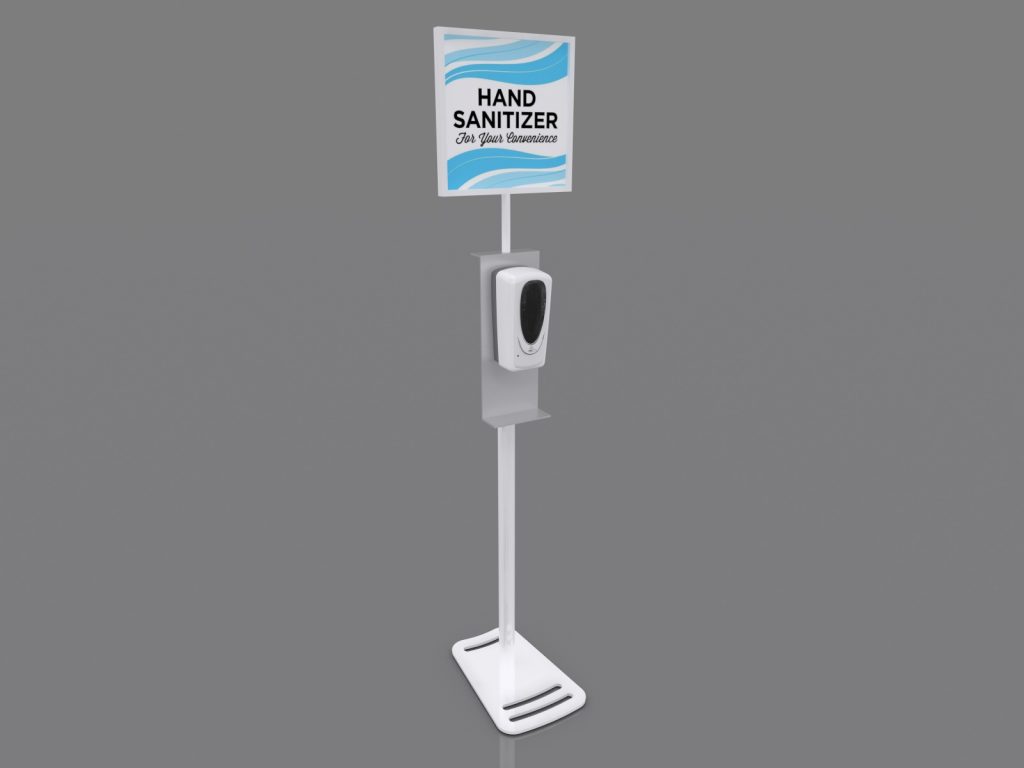
1. Hand Sanitizer: Let’s start with the easy one. Yes, there will be hand sanitizer solutions both in the exhibit hall and in booths. Regardless of the booth size. However, you still have choices other than sticking an off-the-shelf stand in your booth. Consider how it can be integrated into the overall exhibit flow and graphics. While it needs to be there (and conveniently located), it doesn’t need to be a visual focus.
Tip: Consider jazzing up your sanitizers with custom colors, vinyl graphics, and counter-mounted dispensers.
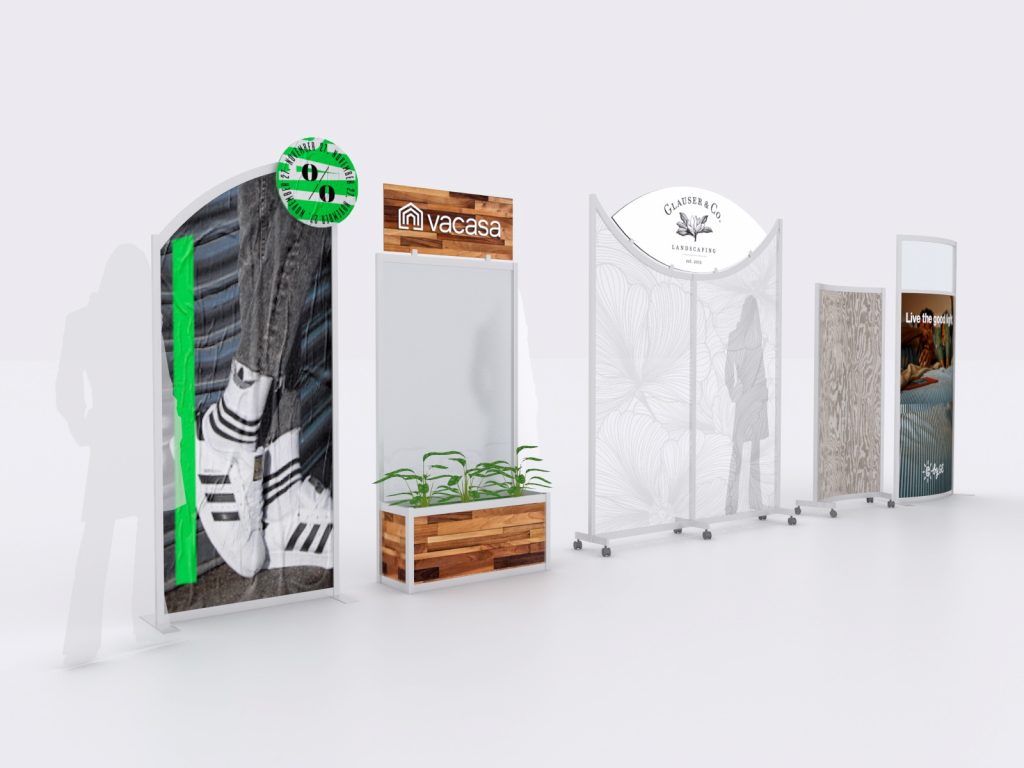
2. Social Distancing: This topic is complicated. For your exhibit designer, it will affect every decision in your booth. How does the designer position meeting rooms, presentation areas, and demonstration spaces to be both effective and safe? Will the exhibit have seating? If so, how far apart do you need to place the furniture? Some areas may require dividers, such as acrylic partitions. Some exhibitors may decide on a larger space to ensure social distancing. Others may elect to remove items like counters, workstations, and storage.
Tip: Schedule demos and presentations by appointment only. You’ll be able to manage the flow and create a buzz before the show even opens.
3. Traffic Flow: Even before COVID-19, exhibit designers obsessed about traffic flow and the efficient use of space. Layer on safety and it’s gotten more complicated. Post-COVID exhibit designs may require more area segmentation allowing booth staff to meet with attendees away from other attendees. Think multiple workstations or counters with similar/duplicate information and functionality.
Tip: Consider a designated entrance and exit to your inline and island booth with one-way traffic flow.
4.Storage: We love to touch surfaces, fabric, and screens. That’s not about to change. And for many exhibitors the ability for customers to touch products or navigate through self-guided presentations is critical. However, those items will need to be sanitized throughout the show. Convenient storage of disinfectant sprays and wipes will make that easier and minimize visual clutter in the booth.
Tip: Just as important as cleaning supplies are waste baskets. Discuss with your designer how to integrate them into the look of your booth.
5. Technology: Expect QR codes, scanners, augmented reality, motion sensors, and LED screens to be more common in trade show booths. These technologies limit or eliminate touching a surface and many, like QR codes, allow attendees to use their own devices to gather information. How about printed media such as brochures, product sheets, and catalogs? Those will be exclusively digital, and the smarter exhibitors will have solutions to present and send that information in real-time.
Tip: Most lead retrieval systems are designed to do much more than just capture an attendee’s basic information. You probably already knew that… but may not have tapped into those capabilities in the past.
6. Hybrid Design Solutions: For the first time, exhibitors and designers will need to consider both a physical and a virtual booth. Should they be identical? Not necessarily. It’s much more important that there’s a clear marketing plan that addresses your goals. For most exhibitors, the virtual and physical goals will be the same so the branding, media, presentations, etc. will be identical. However, other exhibitors may decide to present a different message or experience for their virtual attendee vs. physical one.
Tip: Want to save time and money? Treat your Exhibit Designer like a member of your team. The more information they have, the greater the likelihood they’ll hit the mark designing your virtual and physical booths.
Trade Show Booth Design: COVID-19 Preparedness & Safety Plan
Most large convention centers are now GBAC STAR Accredited. The GBAC STAR Accreditation Program is performance-based and designed to help facilities establish a comprehensive program for healthy spaces. This includes strategies for infection prevention and cleaning for health that promotes wellness for building occupants, visitors, staff, and their community.
The GBAC STAR Accreditation program relies on a 20-element quality management program, which encourages a system based on science. Supporting the use of proper protocols, correct disinfection techniques, and cleaning for health best practices.
An accredited facility has committed to having:
Established and sustained a cleaning program to enhance occupant health.
The proper cleaning protocols, disinfection techniques, and work practices to nurture occupant health and meet any biosafety challenges.
Knowledgeable cleaning professionals who are trained to uphold the highest standards of cleaning and building maintenance.
These facilities often mandate those same protocols for vendors, exhibitors, and attendees. Exhibitors would be wise to consider the GBAC protocols when designing their booth, working with vendors like show labor, and training their staff for the show.
6 Safety-Conscious Booth Display Ideas & Examples
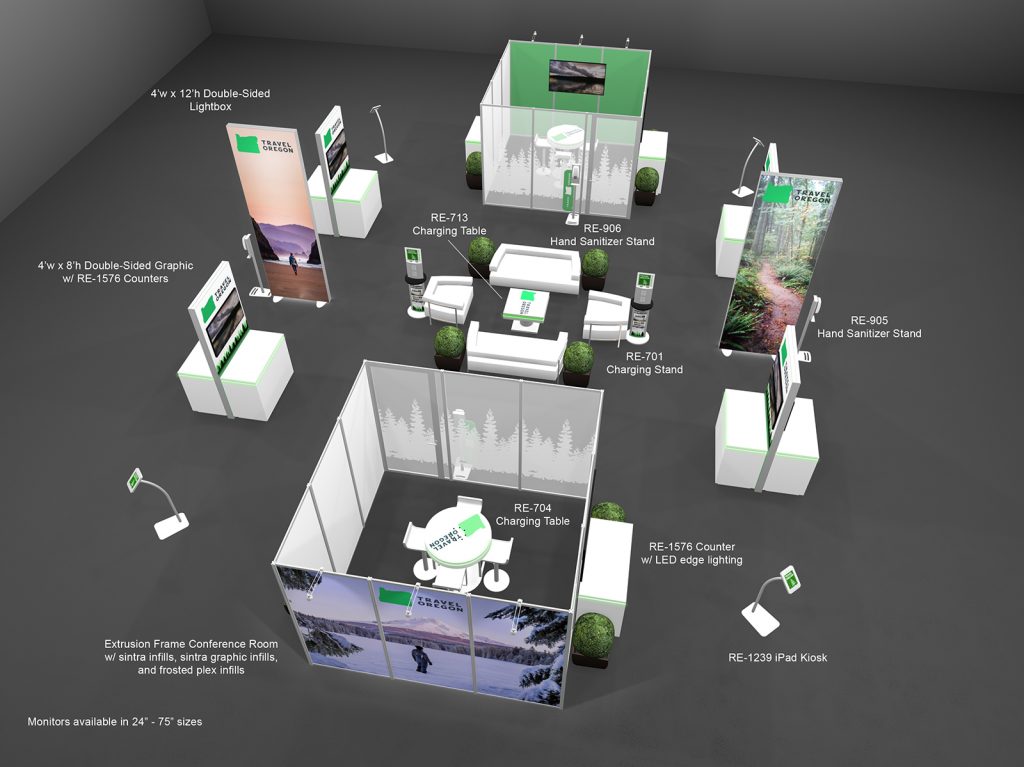
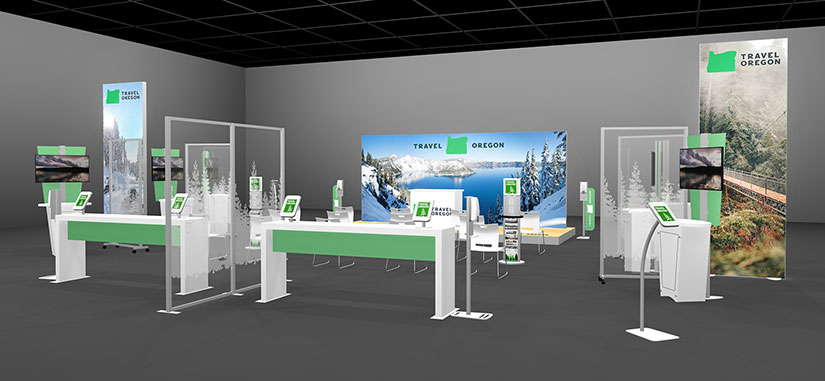
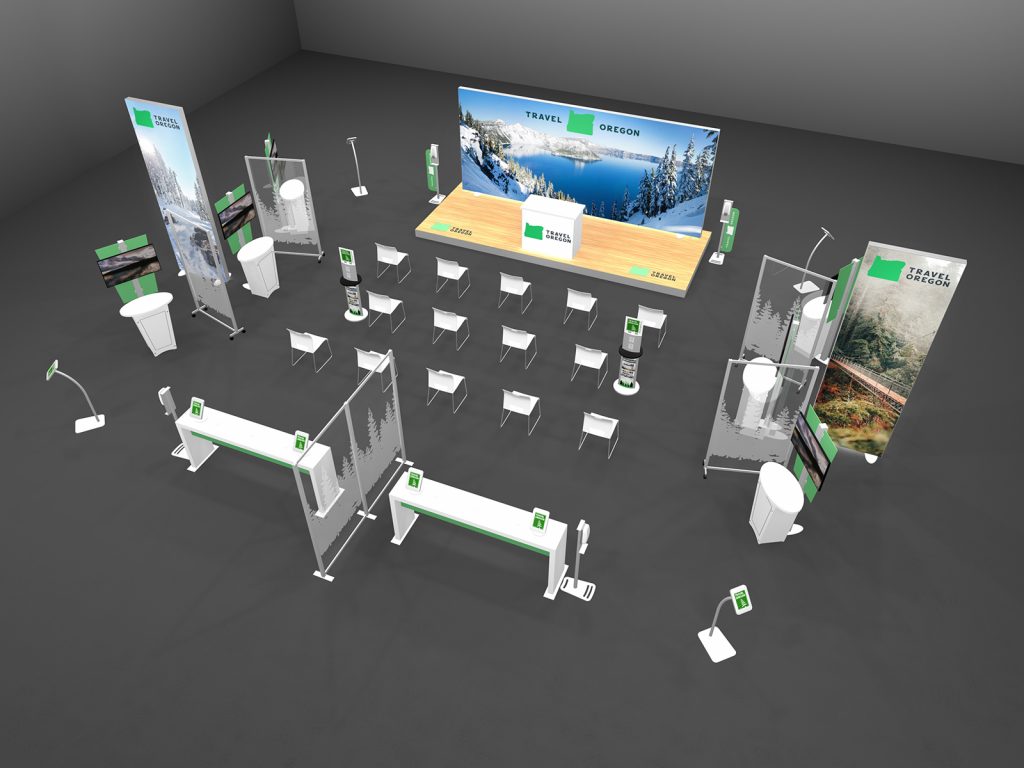
1. Rental Option A. Corporate events or meetings typically don’t have the same space limitations as trade show exhibits. Rental Option A is segmented into three functional spaces: stage/presentation, demos using monitors, and self-service genius bars with iPad tablets.
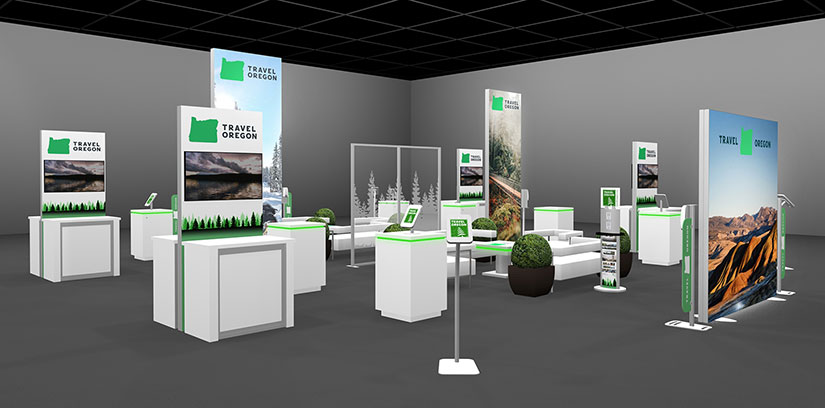
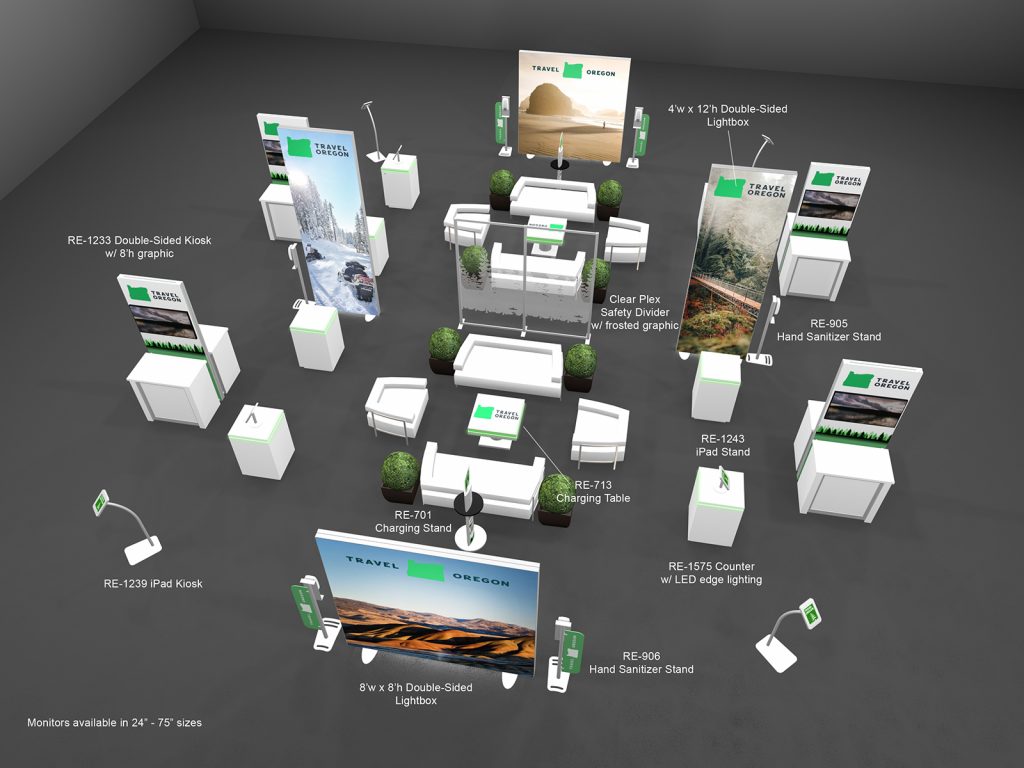
2. Rental Option B. Option B balances seating, demos, branding, and workstations while using the space efficiently. The graphics are large without being intrusive and allow for movement and privacy.
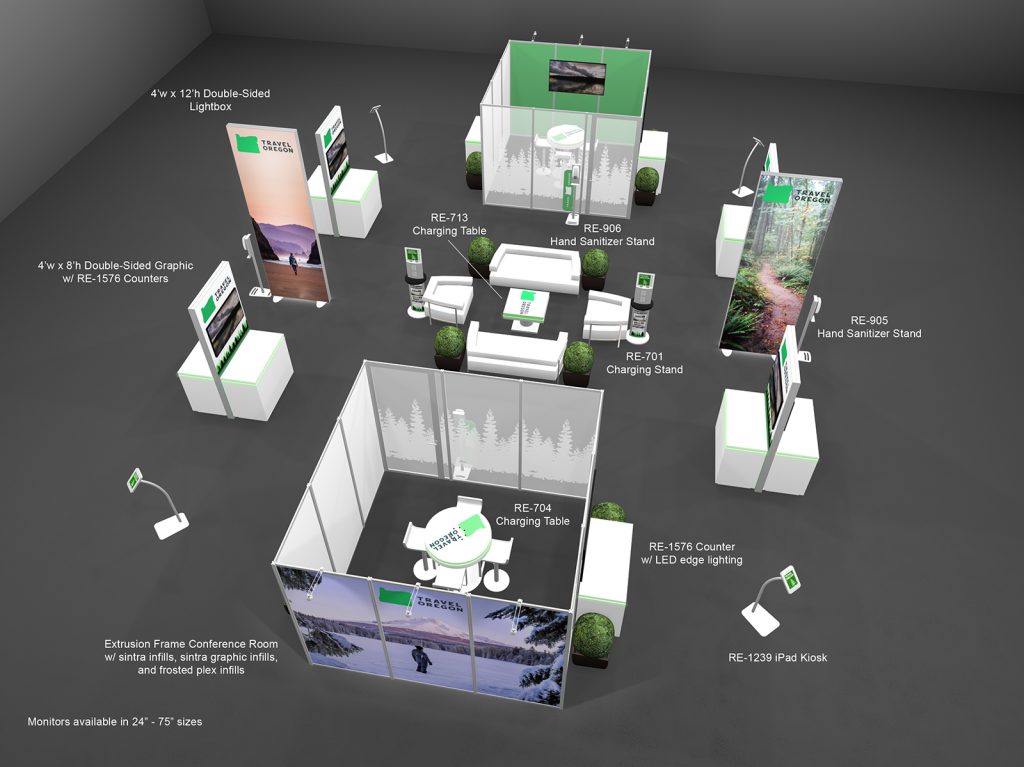
3. Rental Option C. For many companies, private meeting space is essential. Option C includes two large meeting rooms, along with a comfortable central waiting area. There are also (4) double-sided workstations for individual presentations.
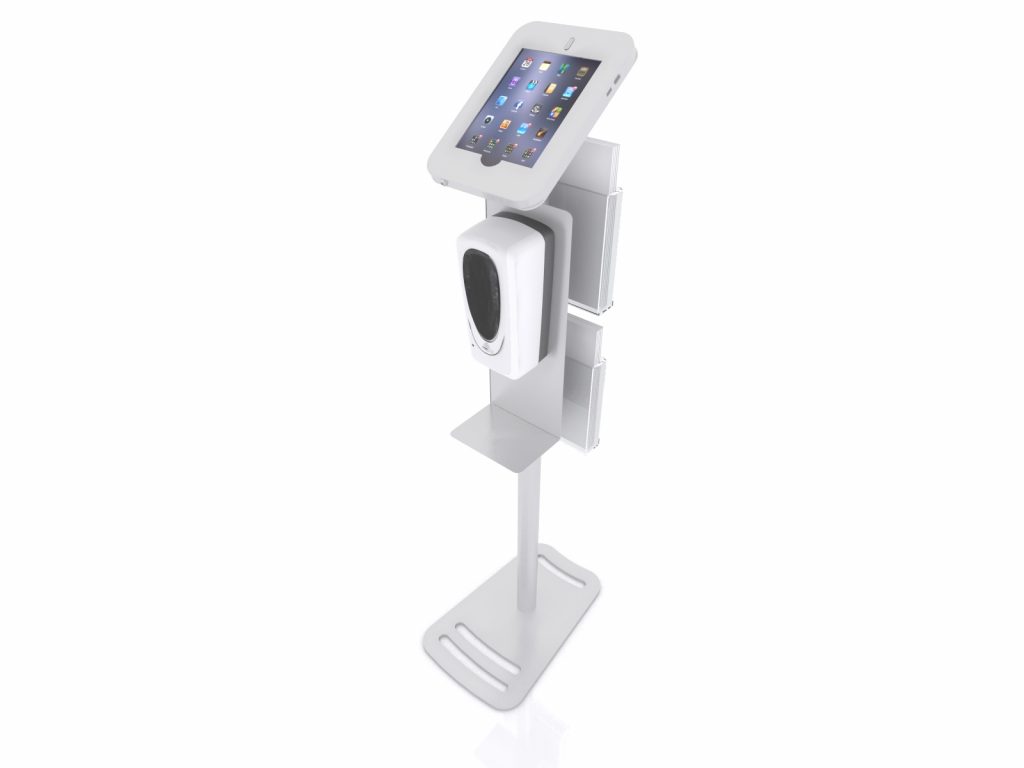
4. MOD-1377 | Sanitizer / iPad Stand. Unlike the previous corporate meeting spaces, trade show exhibitors must maximize their booth. The MOD-1377 combines a hand sanitizer with an iPad stand and literature holders. This 3-in-1 approach makes it ideal for both inlines and islands.
5. MOD-9002 Hand Sanitizer Stand w/ Graphic. A hand sanitizer without branding is like pie with ice cream. It’s OK but it’s so much better with both. The MOD-9002 has a small footprint and switching graphics couldn’t be easier.
6. MOD-8036 | Flat Safety Dividers. Frankly, most safety dividers are ugly and fragile. Not the MOD-8036. The silver anodized frame along with etching and/or vinyl graphics elevates a simple divider into a tasteful barrier.
Buy or Rent aModern Trade Show Booth with Classic Exhibits
Classic Exhibits has been designing and building trade show solutions since 1993. We’ve worked hard to win many design awards and love to challenge our team with new and innovative designs. We take great pride in keeping our team, customers, and community safe and look forward to helping you design a modern trade show booth that not only prioritizes safety but helps you exceed your trade show goals.
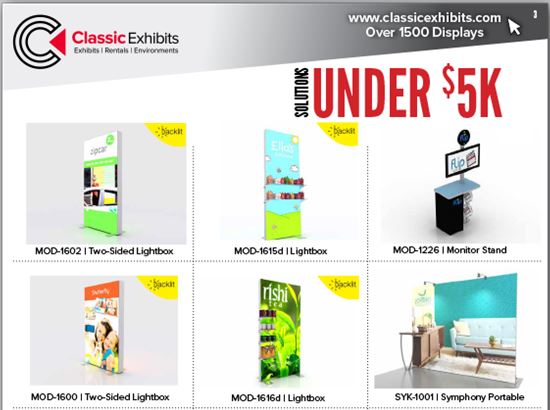
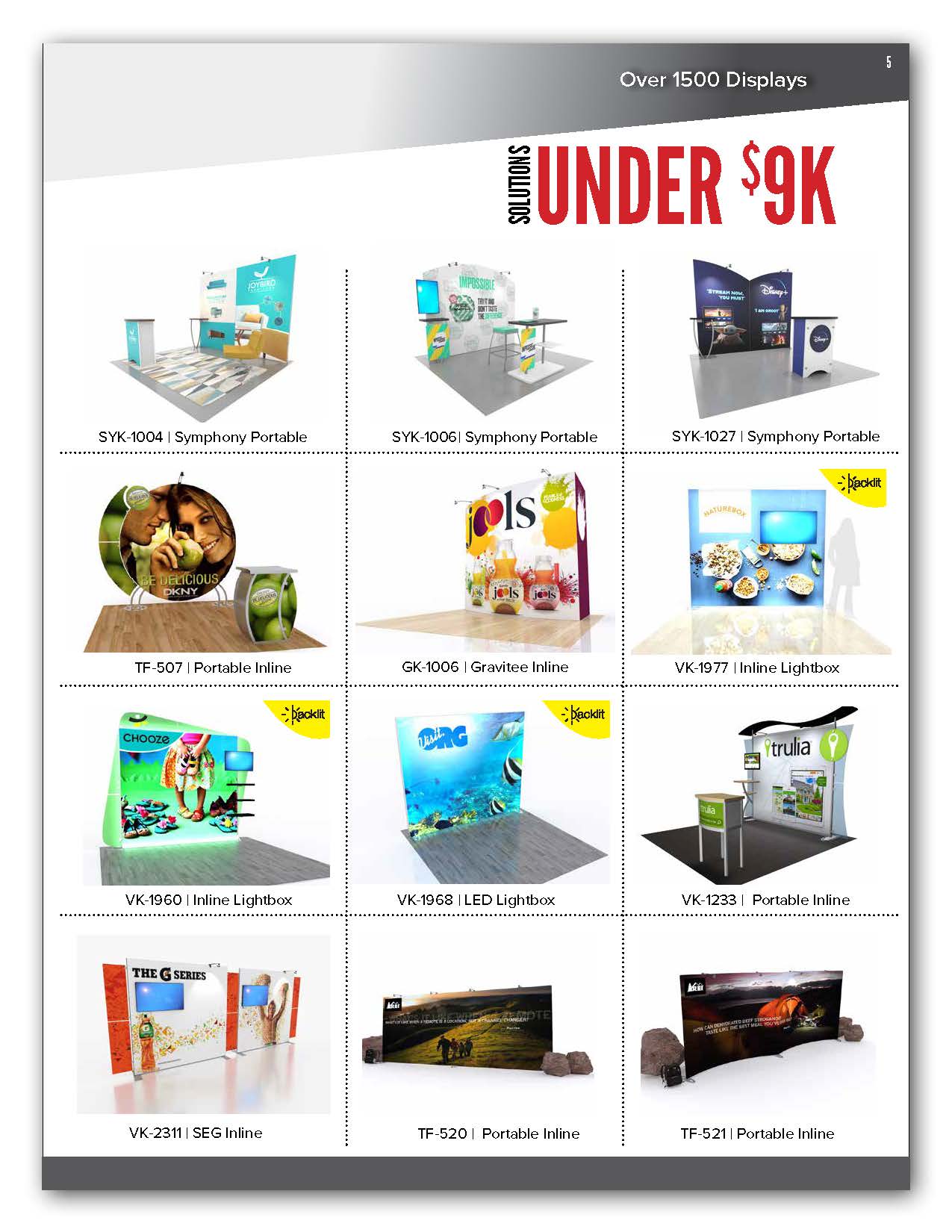
With over 1500 designs, Exhibit Design Search can be intimidating for many exhibitors when searching for a new display. So we’ve created a convenient first step with our Under Sheets. These sheets feature 168 trade show exhibit designs from Under $3000 to Under $75,000.
Under Sheets — $3K, $5K, $9K, $15K, $25K, $45K, and $75K
Arranged in 14 pages, the Under Sheets are a good starting point for counters, portables, lightboxes, and island exhibits. Once you’ve narrowed down your choices, the next step is exploring Exhibit Design Search based on your research to fully reveal the design possibilities available. Need assistance? Give us a call or send us an email whether you need a pre-configured design or something customized to fit your specific trade show marketing needs.
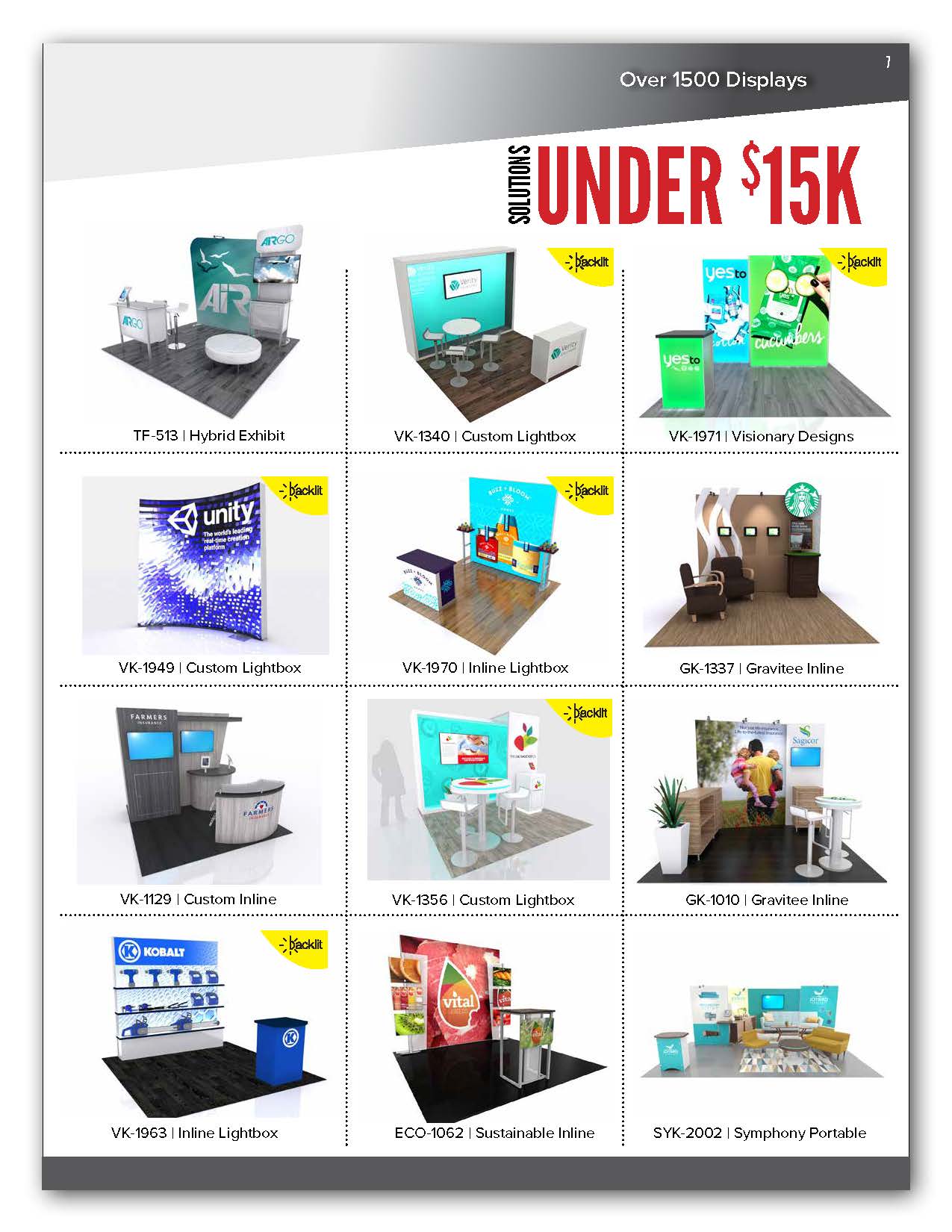
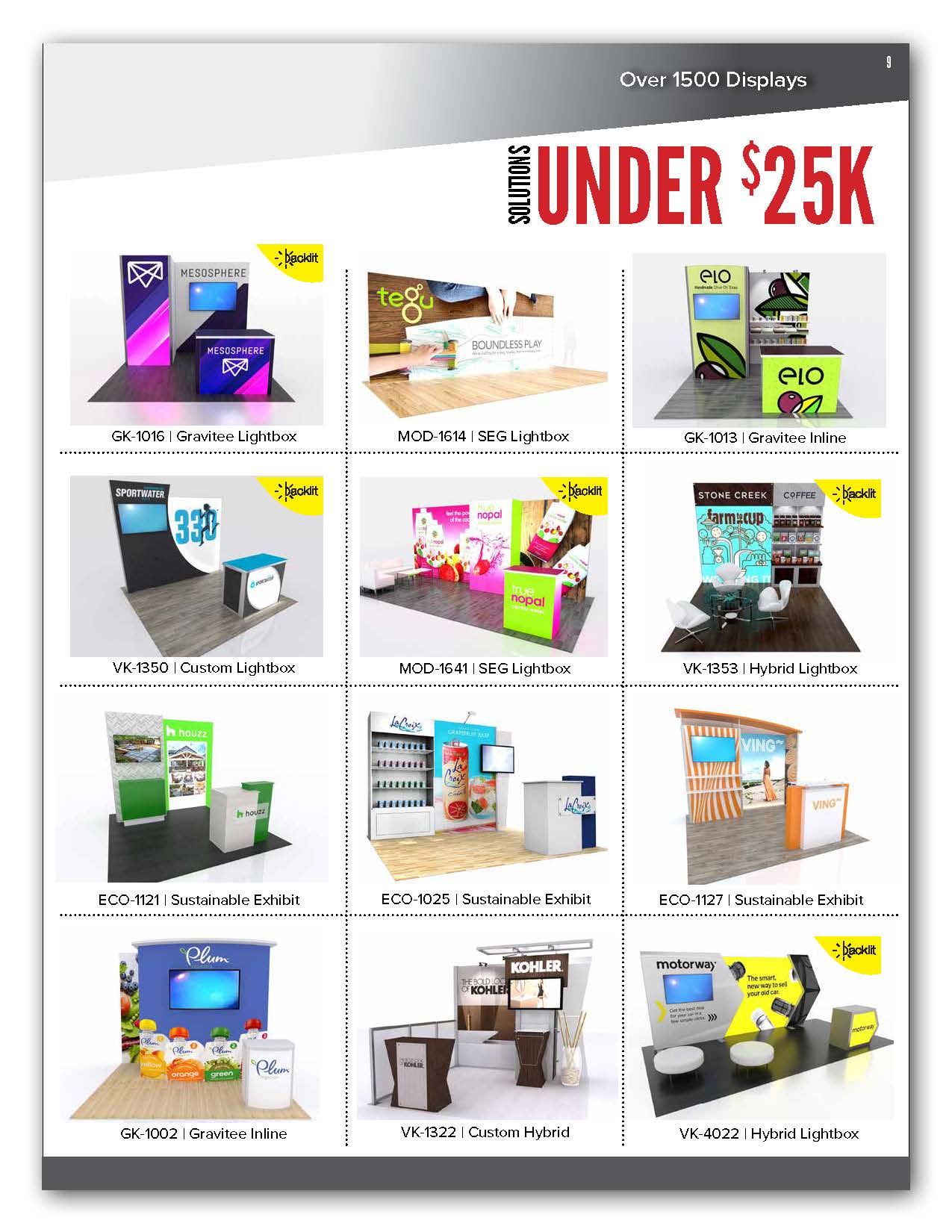
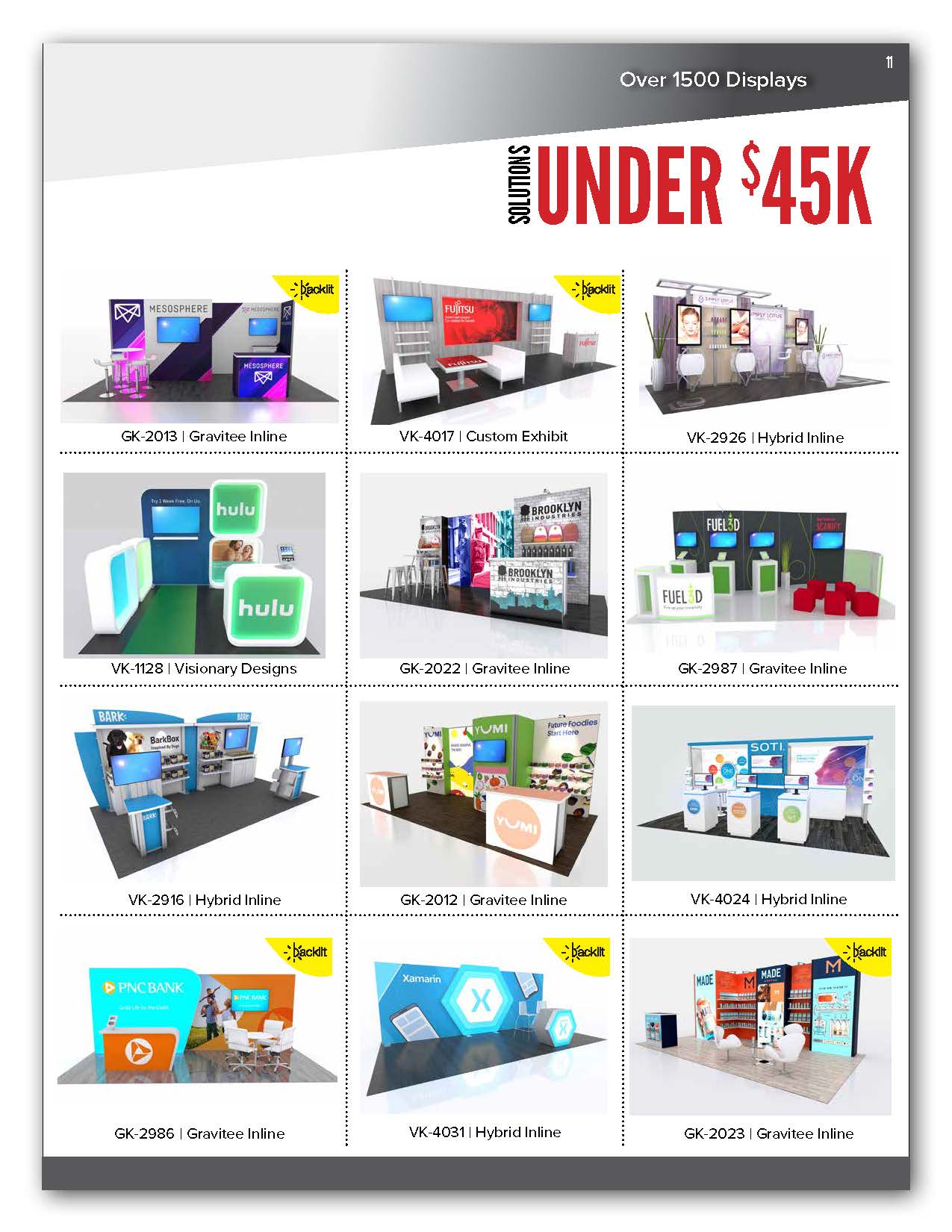
Click to Download ALL 14 PagesExhibit Solutions Under $15,000 Exhibit Solutions Under $25,000 Exhibit Solutions Under $45,000
For Classic Distributors, the Under Sheets are unbranded which makes them perfect for email or social media campaigns. Simply add your logo and contact information.
Trade shows are back, and exhibitors are talking about new graphics, giveaways, and Las Vegas. I love the renewed excitement for trade shows… and to some extent, loath it. I get to hear exhibitors grumble about the cost of a display, poor leads, drayage, and their ROI. And, no matter how much we coach them, there’s always a few marketing managers who just don’t get it. They buy cheap, basic displays, don’t do any pre-show marketing, bring the wrong staff, and then take a cavalier approach to show leads. Their results suck, and they wonder why.
It’s not an age thing. Baby boomers are no better than Millennials, Gen X’ers or Gen Y’ers. So, let’s draw a comparison to other advertising. Would most marketers make these advertising choices?
Magazine Ad:
1. So… the black and white ad is cheaper? Yes, I realize this is a glossy color publication, but B&W ads are “artistic,” and I can run two for the price of one. 2. Thanks for the publication’s circulation numbers and demographics. No need to explain. I’ll review it later in my “reading” room. 3. My unemployed second cousin is designing the ad with a pirated copy of Illustrator. I’m paying him in pizza and PBR. 4. The sales team doesn’t need to see the ad. It’s their job to sell whatever we tell them to sell. 5. That B&W ad didn’t work. I’m not going to advertise there again. Stupid magazine!
Television Commercial:
1. “Video Production for Commercials” [Google Search]. That first one looks just fine. 2. Concept storyboard? Nah! Creativity should be spontaneous! 3. Those 2-4 am slots are cheap. I can run the spots 6 times an hour. 4. Neilsen ratings? That’s for amateurs who don’t trust their “gut.” 5. That television commercial didn’t work. I’m not advertising with them again. Stupid TV station.
Online Banner Ads and PPC:
1. My admin assistant manages our banner ads and PPC. Ruthie — Don’t you handle that? 2. Of course, we have a Google Analytics account. I have the password around here somewhere. 3. $2.50 a click? No brainer. Here’s my credit card. How much could that possibly cost? 4. You saw my banner ad on what site? For what? Oh that’s bad. That’s really bad. 5. That online advertising and PPC didn’t work. I’ve canceled my accounts. Stupid Internet.
Social Media:
1. Blogging? Love it. I’ll post every day for the next year! Starting tomorrow. 2. Who doesn’t love cats and kittens? Let me share. 3. Aren’t LinkedIn and Facebook basically the same? I post the same stuff on both. 4. 75 Tweets today. Where did the day go? 5. That social media didn’t work. What a colossal waste of time. Stupid Social Media.
You get my point. Trade show marketing should be treated with the same intensity, analysis, and professionalism as every other form of marketing. For many companies, it can represent up to 40% of their annual marketing budget; yet, they often see it as a distraction, not an opportunity. If you don’t have time to become an expert, hire an expert. There are many trade show consultants who have devoted their careers to ensure their clients succeed at face-to-face marketing.
Stupid? Not if trade show marketing is done right.
Based in Portland, Oregon, Classic Exhibits Inc. designs and manufacturers portable, modular, and custom-hybrid exhibit solutions. Classic Exhibits products are represented by an extensive distributor network in North America and in select International markets. For more information, contact us at 866-652-2100 or www.classicexhibits.com.