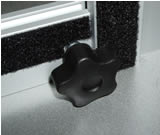
Let me begin by saying, this is probably more information than you want to know about knobs. But . . . .
Effective immediately, Sacagawea and Magellan Hybrid Displays are “knobbier.” Don’t shake your finger at me, “knobbier” is the correct term. I should know . . . I invented it.
What’s the difference between a tool-less knob system, such as the Perfect 10 trade show display, and “knobbier” systems like Sacagawea and Magellan? Depending on the configuration, about 2 to 10 knobs.
The fastest growing segment in the trade show exhibit industry is portable hybrids. What are portable hybrids? Click on this link for an explanation, or simply click on the two photo gallery links below. These galleries show actual orders in Classic Exhibits Setup Area over the past six to nine months. It doesn’t include every portable hybrid ordered, nor does it show the other exhibit lines we manufacturer. If you are interested in seeing a more comprehensive photo gallery, we encourage you to visit P5D, our daily blog of photos (which goes back nearly four years). We think you’ll enjoy seeing how exhibit trends have changed from season-to-season and year-to-year.
Effective September 1 through December 31, Classic Exhibits will offer an unconditional no questions asked 60 Day Return Guarantee on the NEW Sacagawea Portable Hybrid Display. Try it for 60 Days. If you don’t like it, you can return it to your Classic Distributor for a refund, minus graphics and shipping charges.
In business, “Taking the Time” is a mindset. We all know it’s easier and less expensive to keep an existing customer than to acquire a new one. That fact has been drilled into our brain repeatedly. Yet, we devote most of our energy to chasing new customers or simply reacting to existing ones. What we rarely do is contact our existing customers. Put yourself in your customer’s shoes. When did you call a customer for advice about a product or service? How often do you send out surveys asking for feedback? Do you ever phone a customer just to ask how they are doing without launching into a sales pitch?
After 10 plus years in the exhibit industry, I tend to make assumptions about trade shows. To me, they are convention halls, pipe and drape, carpeting, hanging banners, and trade show displays. They are drayage, union labor, and confusing electrical forms. You expect the exhibit hall to be 50 percent “show” and 50 percent “trade.”
Banner Stands (cheap, attractive, but not always reliable): Tara Reid, Andy Dick, Paris Hilton, Lindsay Lohan
Custom Exhibits (talented, larger than life, mostly professional but occasionally temperamental): Meryl Streep, Orson Welles, Dame Judi Dench, Aretha Franklin
Overhead Tension Fabric Signs (highly visible and stretched tight): Joan Rivers
Pop Up Displays (versatile, portable, and over-exposed): Hannah Montana, Jonas Brothers, John Mayer, Jennifer Aniston
Modular Exhibits (adaptable, upscale, but not custom): Denzel Washington, Anne Hathaway, Jimmy Stewart, Christopher Walken
Hybrid Exhibits (lightweight, re-inventing, contemporary): Johnny Depp, Robin Williams, Madonna, Tom Hanks
Green (eco-friendly but pushy): Ed Begley Jr., Al Gore, Sheryl Crow
Aluminum Extrusion Systems (durable, versatile, supporting role): Keith Richards, Alfre Woodard, John Tuturro, William H. Macy, Vivian Vance and William Frawley
Homemade Cardboard Display (barely functional, always tacky): Tom Arnold, Jon and Kate Gossling (but not the kids), Omarosa, Carrot Top
Vinyl Hanging Signs (last resort, unstable): Screech (Dustin Diamond) from “Saved by the Bell”