


The Future of Trade Shows
After ten plus years in the exhibit industry, I tend to make assumptions about trade shows. To me, they are convention halls, pipe and drape, carpeting, hanging banners, and trade show displays. They are drayage, union labor, and confusing electrical forms. You expect the typical exhibit hall to be 50 percent “show” and 50 percent “trade” once the doors open.
Admittedly, my perception is a bit skewed. I work for a portable, modular, and custom-hybrid exhibit manufacturer, and tend to see every show as a healthy dose of our designs with a smattering of custom exhibits and a sprinkling of banner stands. Those are trade shows, all set within a large exposition hall. That said . . . I’m not naïve. I know a typical arts and crafts fair, Chamber of Commerce show, or local health fair doesn’t have all the pomp and circumstance of a traditional trade show. However, even those shows have professional table top displays, pop ups, and banner stands. I have always believed (and preached) that if you want your show to be successful, you should follow the advice of industry experts.
No Carpeting, No Pipe and Drape, No Drayage
Two weeks ago, I discovered otherwise. I learned, through personal experience, that you can hold a successful show without carpeting, without hanging banners, and largely without professional displays. People will come if the event speaks to their hobby or their lifestyle. And, in many situations, a more casual approach may give the event more credibility – especially in the beginning.
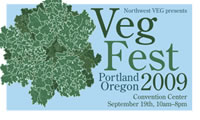 About three months ago, I volunteered to assist with a local vegan/vegetarian festival, called the Portland VegFest 2009. This isn’t a new event. In fact, this year marks the 5th year, but this was the first year the VegFest was to be held in the Oregon Convention Center. The previous events were held in a local high school cafeteria. As the newbie on the planning committee, I quickly learned that the committee was well-organized, professional, and knowledgeable, but that the event had little money for the normal bells and whistles of a trade show. There would be no carpeting or hanging banners. Signage would be minimal, and even the printing of the black and white program was held to 1500 copies.
Frankly, I didn’t know what to expect as the one-day event got closer. We, meaning Classic Exhibits, agreed to loan them (10) four-panel and (6) six-panel folding fabric displays. These would be used as towers for signage, as basic backdrops for the major sponsors, and even, as it turned out, as the corral walls for the Kid’s Area. Those displays, with the exception of a table top or two and a tent, were the only manufactured trade show exhibits in the entire hall. The remaining exhibits were, by and large, 8 ft. tables with vinyl tablecloths provided by the organizers. Even more surprising, there was no drayage, since every exhibitor carried in their own materials from the loading dock.
Did anyone miss the carpet? No. How about the banners? Nope. Would a pop up here or there have benefited an exhibitor? Perhaps. But, I don’t know that it really mattered. The VegFest attendees were there to sample food, learn about healthy food choices, and gain a deeper understanding about animal rights. As a bonus, there were bands, expert lecturers, and cooking demos – all for five dollars.
Was the event a success? It was. Attendance more than doubled to 3,700, the exhibitors were positive and eager to commit to next year, and the volunteers were enthusiastic. By 11 pm, a mere three hours after the event closed, the hall was clean with minimal trash headed to the landfill.
Like Cars and Churches
Until two weeks ago, I would have described a trade show very differently. But trade shows, like cars and churches, serve a specific audience and a specific purpose. Too often, we view the world based solely on our own experience. We don’t understand why someone would drive a Kia when they could own a Camry. We can’t grasp why someone would go to a tiny country church when they could attend the large community church in town.
Do I expect the VegFest to eventually become a trade show with banners, pipe and drape, and pop ups? In a few years, yes. It’s the competitive nature of shows. When they are well run, they become larger, more established, and with more national exhibitors, and as a result, they become more competitive. Exhibitors must vie for attention, which leads to more elaborate displays. Honestly, when that happens, I’ll miss the old VegFest. There’s nothing wrong with the show remaining small, but, I suspect for VegFest to attract 15,000 attendees, it must adapt, blending the benefits of a traditional trade show with lessons learned from staying true to its core mission.
I welcome this evolution to the trade show industry. If our industry is to stay relevant, it must be more flexible, more adaptive, because the days of a defining a trade show as “XYZ” are quickly coming to a close. If I’ve learned anything, I’ve learned that trade shows don’t always need us. We need them.
–Mel White
https://www.linkedin.com/in/melmwhite
mel@classicexhibits.com