


Every Company has a Culture
 Every company has a culture, whether they recognize it or not. Some companies promote it as an asset. Others see it as the elephant in the room that no one discusses. Then there are those executives who speak about their culture using glowing terms like empowerment, self-actualization, and mutual respect. They talk about “open doors” when, in fact, their company could be a reality series. The infighting, politics, departmental espionage, and gossip would make a Survivor or Jersey Shore star blush.
And just like on a reality series, everyone is on their best behavior at first. They wear make-up, clean clothes, and say “Please” and “Thank you.” They are hyper-aware of the cameras, but after awhile, they forget, and they react to the drama surrounding them. The drama doesn’t change who they are, but it heightens aspects of their personality, both good and bad.
Now imagine the same situation where the culture is established. A new person wants to do the right thing, wants to fit in, and wants to be professional and productive. Supportive cultures welcome that person. They see them as enriching the group and adding value. Each new person represents a necessary skill. And, in time, they reaffirm those values and add diversity to the team.
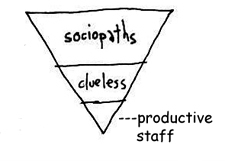 In dysfunctional cultures, the players are entrenched, and new employees are viewed as threats or possible allies. They quickly discover that to survive they must grapple with departmental politics and navigate petty personal squabbles, some dating back years. All too often, these cultures are hostile to change, blinded by departmental silos and antagonistic to customers, both internal and external. Work gets done but the emotional toll undermines the long-term prospects of the company since good employees leave and creative growth stagnates.
The DNA of the Company
Think of corporate culture as an organism rather than a policy. On days when there are guests, the group plays nice. No one has to be coached to behave in supportive cultures. It’s in their DNA. Impaired cultures are told how to behave and are reminded who will be allowed to interact with the guest. If it’s an important guest, they are told in no uncertain terms to act accordingly.
I don’t pretend to be expert an organizational behavior. Heck, I barely have a grasp on my own behavior. But I’ve worked for enough companies over the years where the corporate culture made the experience pleasant or punishing. What made one culture rewarding and the other a jail sentence? It’s never black and white. I’m not that naive. There’s no perfect company. They all have blemishes and some age better than others. Some start out caring and compassion and become borderline psychopathic. Larger companies often attempt to institutionalize the culture through training, mission statements, and evaluations. More often than not that works, but it can still fail if management ignores or undermines it through their own actions or inactions. HP’s recent fiascoes are a good example of a widely respected culture that has taken a beating over the past three years.
There’s a good chance you work for a small or medium company. There are three major influences on the culture: the person(s) who owns or manages the company, the person who is the leader in the group (who may or may not be the owner/manager), and the bad apples.
Consider Your Own Situation

If you like your job, whether you handle embalming fluid, shuffle paper, or sell stuff, there’s a good chance you work for someone who sets clear expectations, supports your ideas, respects your work, and treats you as a responsible adult. You may not love every aspect of your job, it may not be the dream job you always wanted, but if your boss is respectful and competent and rarely exhibits a Dr. Jekyll/Mr. Hyde personality, you don’t dread coming to work every day.
On the other hand, we have all worked for the “satanic and/or incompetent nub job,” the boss with a tenuous grasp on human emotions, teamwork, and common decency. This person just crawled from whatever swamp breeds these creatures and has learned to mimic, albeit badly, human behavior. These people make our lives a living hell, and unless they own the company, they don’t last long.
Since not all managers or owners are leaders, someone has to assume that role, either formally or informally within a team. These folks may be a good or poor manager; however, leaders typically don’t get to be leaders without the ability to “lead.” They understand how to motivate others and how to establish priorities and goals. Exceptional leaders not only model the behavior they want others to follow, but they also guide and coach their colleagues toward those model behaviors. It’s easy to confuse the concepts of “managing” and “leading,” but think back on your own experiences. We’ve all known great managers but poor leaders . . . . or great leaders but weak managers. On occasion, someone possesses both. Truly great managers or leaders are self-aware. They play to their strengths and promote those who possess the talents they don’t have.
One Bad Apple
 Finally, let’s chat about the “bad apple.” Have you ever worked somewhere where you like your job, your colleagues, and the culture. Then, the company hires the “bad apple.” Suddenly, everything changes. That one person, for reasons unique to each situation, changes everything. They become “the conversation” whenever you and your colleagues chat. You discuss reasonable solutions about how to handle this person, but those solutions never seem to work. You try harder and like a greased pig, every perfect solution escapes your grasp.
What we fail to understand about “bad apples” is that each time we try to remove the bad behavior, or the brown spot on the apple, it always exposes more bad behavior. Not at first, but over time that clean surface turns brown again. Eventually, it’s all bad and all that remains is an even uglier core.
A human resource manager once told me, “We hire people for what they know. We fire them for who they are.” They may be incompetent or unethical, but much more often, they are simply not good matches for the group or the corporate culture.
Every corporate culture is different. And most are moving, evolving, adapting. Good ones recognize what works for their employees, their customers, and their suppliers. They build on it and strive to hire employees who add value and strategic diversity. Bad ones ignore it. They lack institutional self-awareness, and they blame internal dysfunction on individuals or market forces.
What’s your corporate culture? How has that culture manifested itself through the past three years of economic malaise? Please share your thoughts (or rants on previous bad cultures).
–Mel White
https://www.linkedin.com/in/melmwhite
mel@classicexhibits.com
About Classic Exhibits
Classic Exhibits has been designing and building trade show exhibit solutions since 1993. We’ve been honored as an Exhibitor Magazine Find-It Top 40 Exhibit Producers and an Event Marketer Fab 50 Exhibit Builders multiple times. Along with numerous Portable Modular Awards. With over 250 Distributor Partners throughout North America, there’s a Classic representative near you.
Contact us today whether you need a durable 10 x 20 display built to last, a rental display guaranteed to attract trade show attendees, or a custom 30 x 40 exhibit with all the bells and whistles. We’re not just different. We’re better.