

‘ve Learned (or The Tao of Jen)

Trade Show Blog

What I’ve Learned (or The Tao of Jen)

Lessons Learn by Jen LaBruzza

Lesson #43:  Understand Your Customer’s World, then See How Your Product and Your Company Fits.

If Willie Nelson can have a Tao, well, then so can I.

I’ve been on the job as Classic’s Western Regional Manager for a few months. Let me just say — working four hours a day is exhausting. 😉 Over the past 60 plus days, I’ve learned a few things, made some mistakes, and grown not only as a professional, but also as a person. Here are a few personal “pearls of wisdom” I’d like to share about my experience as a newbie at Classic Exhibits.

1. “I know what I’m doing, I know what I’m doing, I know what I’m doing.”

I’ve had to come to terms with my own insecurities. This may sound a little odd, but to do a good job, I have to know I am doing a good job. While I don’t know everything – not by a long shot — I do know there is always someone on Classic’s team who will support me and who I can turn to if I need help. That alone lessens my anxiety.

Heading into my first trip to Seattle I was full of “What if’s”:  What if I don’t say the right thing? What if I don’t know the answer? We all have those insecurities and doubts on a new job, even when it’s an industry we think we know. I’ve learned that I work with brilliant people who care, who want me to succeed, and who will be there to back me up.

Repeat . . . “I am pretty good at my job, and I’m working on getting better.”

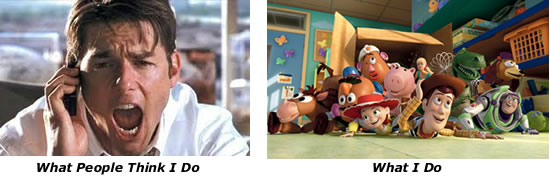
2. What I thought I’d be doing vs. What I do vs. What my friends/family think I do.

If you’re on Facebook or any of the other social media venues, you will probably smile or chuckle when you read the above statement. The “What I Think I Do” meme has become the latest fad with its interesting twist on self-reflection.

Having worked with distributors in the past, I felt I had a pretty good handle on what I’d be doing. But after my second trip, I realized that this is more than a job. Yes, I am a cheerleader, a problem solver, and a trainer, but I am also a friend.  Being a friend may be more important than the other three.
3. “Understand your customer’s world, then see how your product fits in. Get out of the office and visit them where they live and work.” – Rich Banfield

The whole reason for my job is this one premise. As distributors, you know your market and your customers. As manufacturers we strive to listen to you and apply your ideas and suggestions as often as we can. Where would Exhibit Design Search be without your willingness to share your ideas and insights? I have come to appreciate and believe in “Shared Knowledge, Shared Success.” It’s a breath of fresh air actually and goes hand in hand with Classic’s Can Do manufacturing attitude.

Classic talks about that “Shared” concept a lot. You may not hear it all the time, but trust me, I hear it ALL THE TIME. It’s important to the company. We see it as two-way communication where your contribution matters and is essential to how Classic functions. It’s not a top down approach. It’s not an “our way or the highway” attitude. If you’ve ever worked in those environments, you know exactly what I mean. We want to know what’s happening in your world and how we can better support and react to it.

These last few months have been fantastic, and I can’t wait to see what the future brings. Next time I see you, challenge me about what I’ve learned. As a former teacher, I’ll be ready for the pop quiz. Just remember to grade me on a very generous curve.

Jen LaBruzza, Western Regional Manager
jen@classicexhibits.com

Filter by Category

Filter by Year

Recent Posts

What You Should Know about Trade Show Exhibit Budgeting

Companies should define a workable exhibit marketing budget, one that includes all related costs. However, the line between marketing expenses and exhibit marketing expenses can be somewhat fuzzy. You will want to create a well-defined budget that separates them.

The Top 10 Design Mistakes of Trade Show Graphics

You decided on your new trade show display . . . but you’re not done yet. Now, it’s time to design the graphics. You want AMAZING!. Below are 10 tips to consider when designing your next trade show graphics.

If Puppies Ran Trade Shows and Events

The following are 11 reasons why our lives would be better if puppies ran trade shows and events. To the ferret, goldfish, and lizard owners, you’re on your own.

If Kittens Ran Trade Shows and Events

If kittens ran trade shows and events, experience would be respected, every booth would have toys, two hours naps would be mandatory, and everyone would be cute and adorable. And we would all trust our instincts.

“I’ll Know It When I See It” — Every Designer’s Nightmare

For Exhibit and Graphic Designers, delivering a design that meets all the client’s needs — functionally, aesthetically, and fiscally — is the ultimate goal. But . . . that doesn’t mean the process is always flawless. Here are a few “Design Red Flags” from a Designer’s perspective which can delay the process (and increase your design fees).

What You Should Know as a New Exhibit Buyer

For the sake of simplicity, let’s assume that exhibit marketing is a new experience. Exhibit marketing is certainly not rocket science. You don’t need a marketing degree to be successful at exhibit marketing. However, it helps to get advice so you make the right decisions.

The Complete Guide to Trade Show Services (Offsite & Onsite)

Onsite trade show services include all services available at the show site. Contractors typically provide these services for show management. Turnkey services are particularly valuable for first-time exhibitors, companies with limited internal resources, or those participating in numerous shows where efficiency and consistency are paramount.

10 Tips for Designing Large Format Graphics for Trade Shows

Most designers rarely design a layout larger than a corporate booklet or perhaps a 20″ x 30″ poster. Designing for large format, like trade show graphics, is actually quite simple once you know the basic steps. All it takes is a leap of faith… and trust in my advice.

Trade Shows and the Desire to Change

Are trade shows are relevant? Is there a future for industry trade shows? Are companies willing to spend their valuable marketing dollars building a temporary structure just to attract new customers or meet with existing ones?

Buying a Trade Show Exhibit? Ten “Must Ask” Questions

It’s common to express remorse after a big ticket purchase. Typically when the purchase is infrequent, such as a home, car, or expensive equipment. Buying a trade show exhibit is that type of purchase, especially an inline or island exhibit for a large trade show. .

An Honest Conversation about Trade Show Rentals

Recently, what I thought would be a simple, straight-forward conversation left me scratching my head. I was meeting with exhibit industry colleagues, and the topic turned to rentals. Admittedly, rentals shouldn’t be puzzling. Rentals have exploded at a rate 3 to 4 times faster than exhibit purchases. What surprised me was the perception and the language used to define the exhibit rental landscape.

What’s Your Trade Show Kryptonite?

We shouldn’t but we do. We hope hope hope that the next attendee who walks in our booth is Superman. Not Superman Superman, but the sales equivalent of Superman. Faster to sign a contract than a speeding bullet. More powerful than the VP of Purchasing.

How To Make Your Trade Show Backdrop Stand Out!

Many exhibitors assume a backdrop is a simple two-dimensional graphic along the backwall of an exhibit. But it can be so much more. A backdrop in a 10 x 10 or 10 x 20 booth space doesn’t have to be basic. Modern inline displays come in various shapes, heights, and configurations.

Is Your Trade Show Display an Oreo or a Fig Newton?

As an adult I can rate just about everything on a cookie scale. For brevity, I’ll limit this article to Oreos, Fig Newtons, and Nilla Wafers, but be assured that the “science” behind my methodology includes Frosted Animal Cookies, Pepperidge Farms (as a collective group), Girl Scout Thin Mints, and Chips Ahoy.