

10 Questions (and Answers) about Trade Show Labor
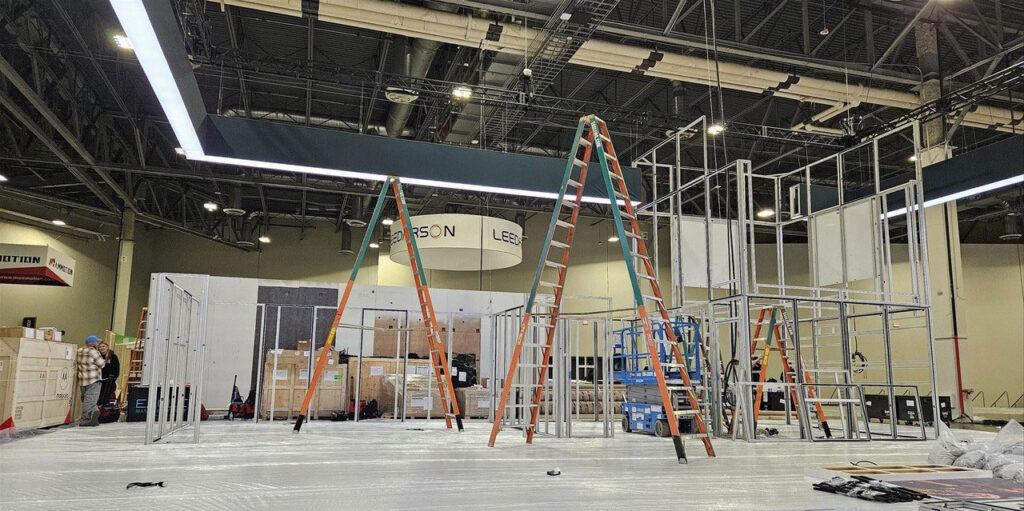
In the exposition industry, trade show labor (often referred to simply as “labor” or “I&D,” which stands for Installation and Dismantle) refers to the professional workforce hired to set up, build, tear down, and service exhibition booths and displays on a convention floor.
Because trade show exhibits have evolved from simple pop-up banners into complex, multi-story structural environments featuring custom architecture, intricate AV setups, and heavy machinery, a specialized workforce is required to handle the logistics safely and efficiently.
#1. Why does the exhibition industry need/require unions?
The trade show and event industry relies on a standby workforce to move events in and out of our convention venues.
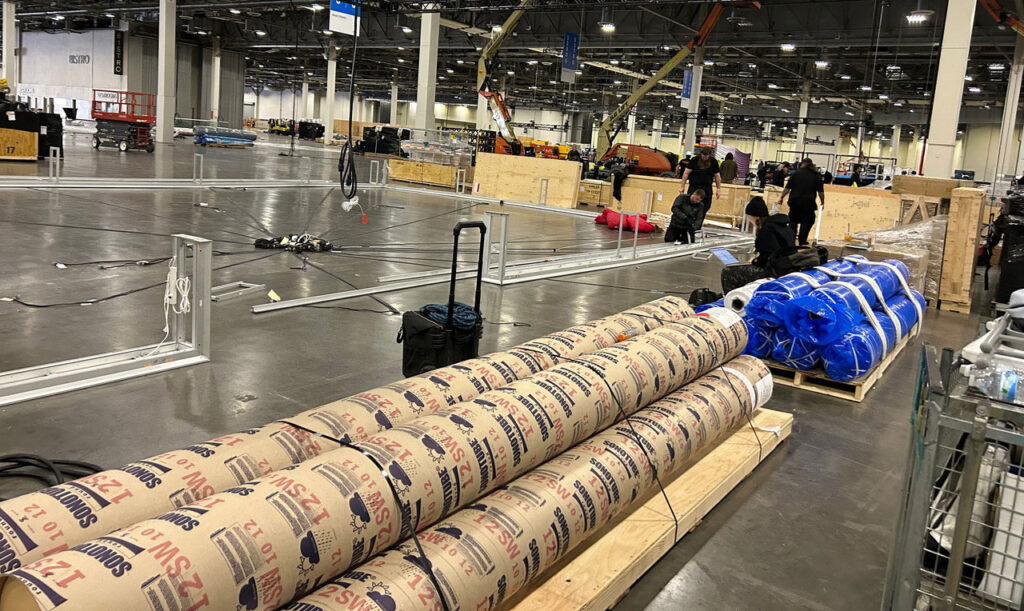
Trade shows are temporary, pop-up cities. A venue like McCormick Place or the Las Vegas Convention Center might be completely empty on a Monday, packed with millions of dollars of custom exhibits by Wednesday, and swept clean by Sunday.
Exhibition venues and General Service Contractors (GSCs) cannot afford to keep thousands of full-time carpenters, riggers, electricians, and teamsters on a permanent payroll. Instead, they rely on a flexible, highly scalable standby workforce. Labor unions serve as a centralized hiring hall. When an event moves in, contractors “call” the union for the exact number of skilled workers needed for that specific structural blueprint. When the show closes, the labor scales back down.
#2. Who decides which unions work in which venues?
The vast majority of major convention centers in the U.S. are publicly owned by cities, counties, or states. Because these venues are built using public funds and taxpayer bonds, local governments establish long-term collective bargaining agreements with local trade unions to ensure the hospitality and exhibition industries drive stable, well-paying local jobs. And, while there are right-to-work states where a worker doesn’t have to be a union member to perform the described work, many right-to-work states have established union jurisdictions (e.g. McCormick Place). A complete list of union jurisdictions can be found on the EACA website..
#3. How do show rates get established?
Every major trade show city has local unions (Carpenters, Teamsters, IBEW, etc.) that negotiate contracts with the city’s convention authority and the major General Service Contractors. The invoice rate you pay as an exhibitor is not just what the worker takes home. It is a “fully burdened” rate built from the ground up by a combination of union negotiations, government mandates, and contractor markups.
Show rates are established by the General Service Contractor after approval by show management. EAC labor contractors can adopt the “show rate” for their own pricing, but most establish their own labor rates city by city.
#4. What’s the difference between GC and EAC labor?
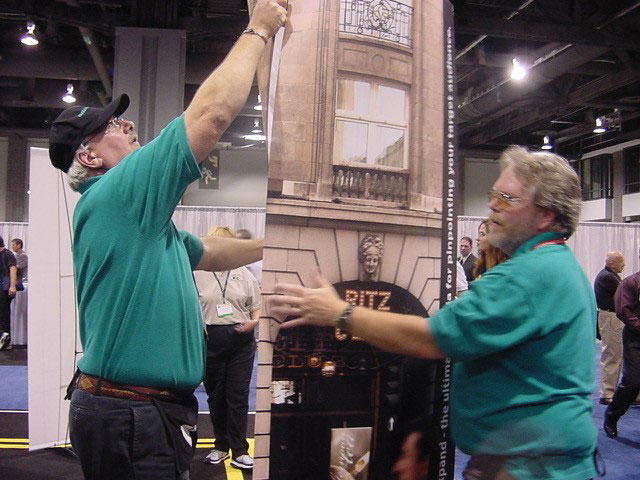
GCs have many sources of revenue from the variety of services they provide. The GC views show management as their primary client, and as such, the most experienced and skilled labor is assigned to work on show management jobs. The labor provided by the GC for display I&D is primarily assigned on a “next man up” basis. As a result, the labor provided to an exhibitor to set up their booth may have never seen the exhibitor display previously and may or may not have the necessary tools for the job. And the crew provided on the installation can be completely different on the dismantle.
EAC labor is different. Since EACs only have one source of revenue, their labor solution is assigned based on the exhibitor client needs. Exhibit design is often reviewed prior to the show so that the EAC can provide a crew that is appropriate for the work required. The EAC will also provide a specific “lead” to have supervisory responsibility for the job. This is done to make sure the rest of the crew is working efficiently and effectively.
With larger or more complicated jobs, the EACs may be requested to not only review display design but also to issue a “not to exceed” estimate for set-up and tear down. And as a matter of common practice, EAC labor contractors routinely make sure that the same crew that installs the display takes it down and repacks it.
#5. How does one join a union?
Any individual 18 or older with either a high school diploma or GED can join a union. An application is required along with an application fee. At many locals, a pre-employment drug test will be required.
#6. What’s the difference between a journeyman and apprentice?
Just as the terms imply, an apprentice is a union worker in training, and a journeyman is an experienced union worker that has fulfilled all training requirements. Apprenticeship training includes 2000 hours of classroom and on the job work.
#7. What is a grievance?
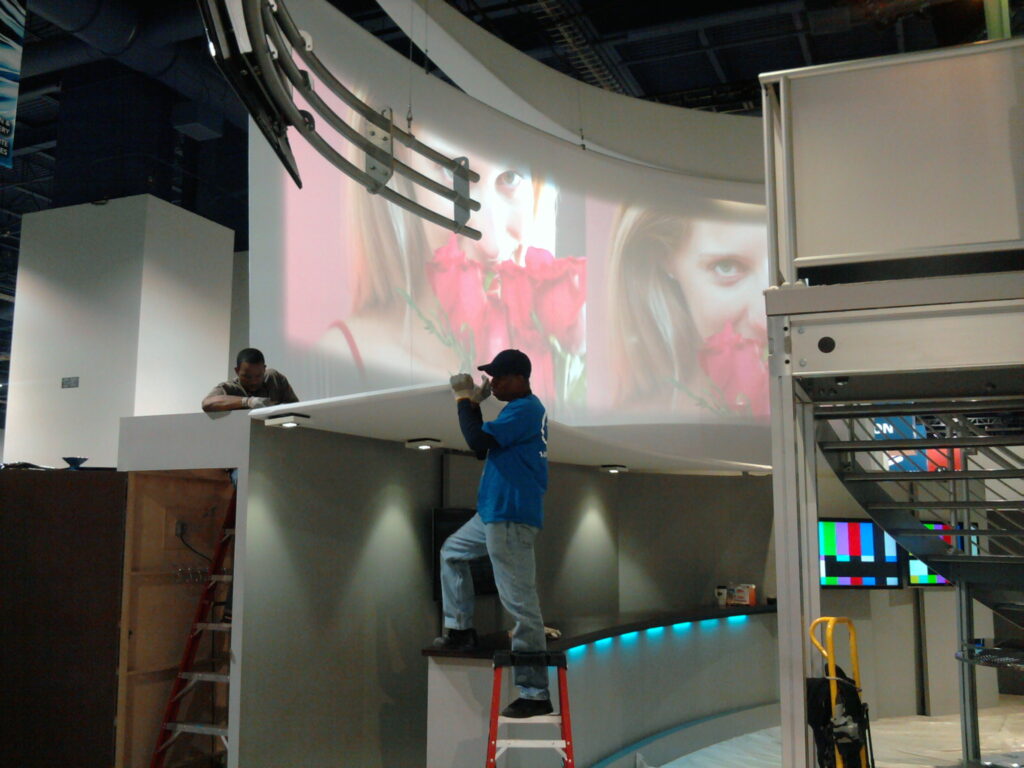
Contractors that employ union workers negotiate and sign collective bargaining agreements with local unions. If the contractor breaches that agreement in some fashion, the local union can file a grievance that typically involves a monetary compensation.
#8. What do I do if I don’t like an individual on my crew?
It happens. Because General Service Contractors (GSCs) and EACs hire from a broad pool, you occasionally get a worker who is unfamiliar with your specific system or simply has a toxic attitude. Any exhibitor or display supervisor who has a concern with a member of their crew can request a change from their contractor. Change requests should be made with the appropriate supervisor.
- If using an EAC (Independent Labor Company): This is usually easy. Call your account executive or find the city supervisor on the floor. EACs pride themselves on customer service and “star crews.” They will pull the underperformer off your booth immediately and either give you a top-tier replacement or adjust your billing.
- If using GSC Labor: Walk to the main Labor Desk. Ask to speak to the Labor Foreman or Floor Supervisor. State your booth number, show the paperwork, and explain the objective issue.
#9. What work can my shop supervisor do in a union venue?
Unless they are a member of the local union with jurisdiction, the only thing a supervisor can do during move-in and move-out is to provide direction, answer questions, and provide suggestions on the best and most efficient way to complete the work. The shop supervisor should first identify who is the “lead” in the job and communicate primarily with that individual to maximize efficiency.
#10. Why does my shop supervisor have to register as an EAC?
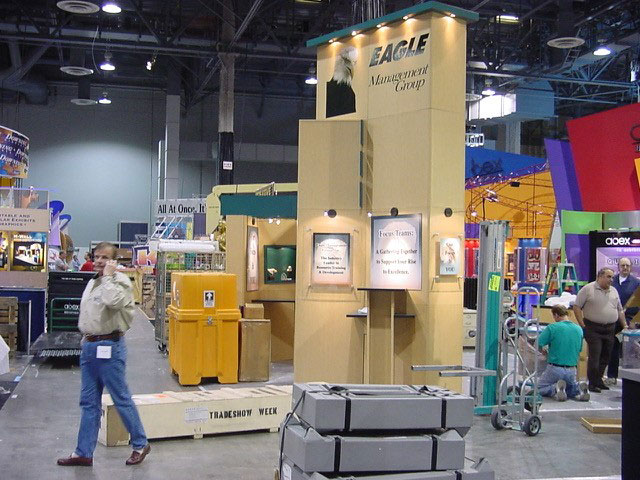
As a means of managing the risk for everything that happens in a venue during their tenancy, show management requires that anyone in the construction zone during move-in and move-out, known as the show floor, provide a current copy of their company’s Certificate of Insurance (COI).
Because of the risk of personal injury or possible damage to the venue or the exhibitor’s displays or products, show management doesn’t want to be held responsible for the negligent acts of others. Show management obtains COIs from their GC and all their exhibitors as a matter of course as they contract with them.
But they don’t know which EAC service providers are being hired by their individual exhibitors. That is the purpose of the EAC notification form. The EAC Notification form pertains to any product or service provider that needs or wants to enter the show floor.
Some shop supervisors presume they can use their client’s or their labor company’s COI as adequate coverage for themselves. But just like you aren’t covered in an auto accident with someone else’s insurance, you’re not covered by your client or your labor company if you should be injured on the show floor. And show management doesn’t want to be liable as well.
Author:

Jim Wurm began his career in the trade show industry more than 35 years ago and has worked almost every job in a convention center from the loading dock to the main entry.
He has played a role in designing, building, shipping and setting up trade show booths as well as launching and organizing trade shows throughout the U.S. and Europe. Most recently, Jim has utilized his unique trade show experience for the development and management of the Exhibitor Appointed Contractor Association, better known as EACA.
About Classic Exhibits
Classic Exhibits has been designing and building trade show exhibit solutions since 1993. We’ve been honored as an Exhibitor Magazine Find-It Top 40 Exhibit Producers and an Event Marketer Fab 50 Exhibit Builders multiple times. Along with numerous Portable Modular Awards. With over 250 Distributor Partners throughout North America, there’s a Classic representative close.
Contact us today whether you need a durable hand sanitizer stand built to last, a rental display guaranteed to attract trade show attendees, or a custom 30 x 40 exhibit with all the bells and whistles. We’re not just different. We’re better.