

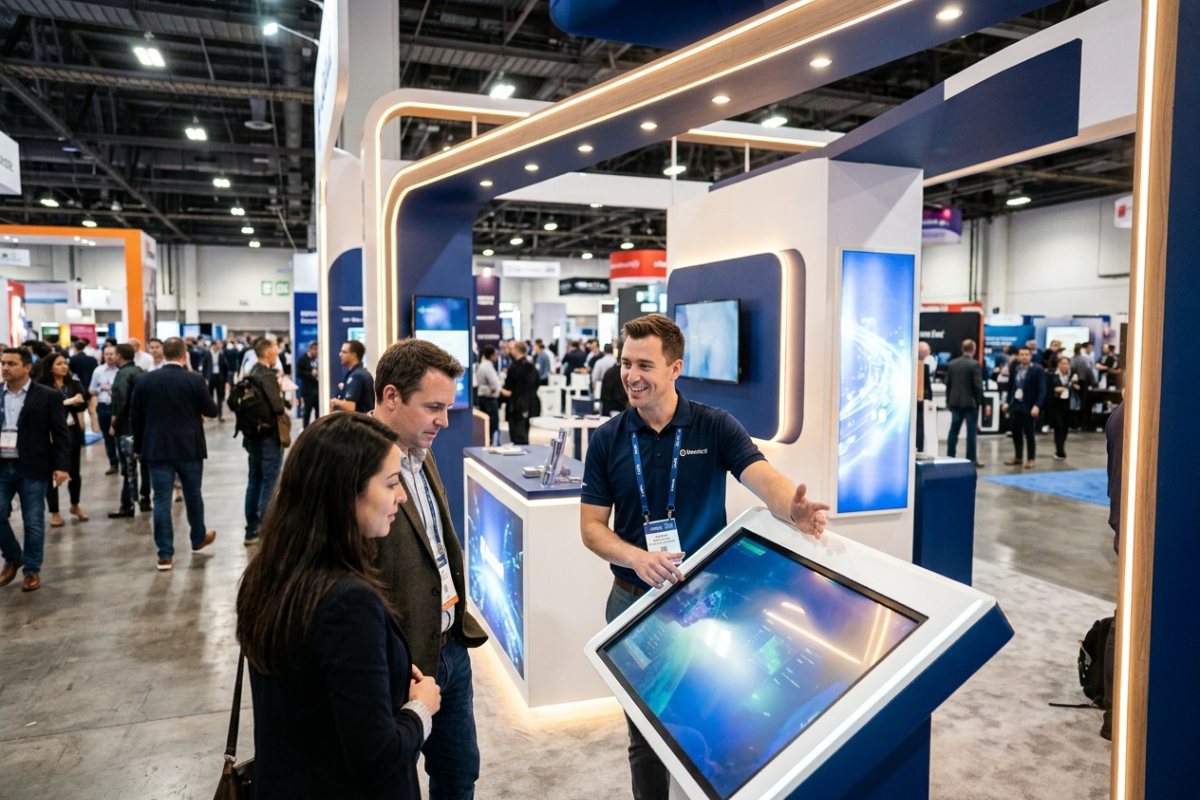
You just searched on Google for “How can I increase visitor engagement at my next trade show?” Not surprisingly, the top response was “Interactive Trade Show Booth Ideas.” So you may be wondering, “What are interactive booth ideas?”
Imagine you’re at the SEMA Show, a trade show organized by the automotive Specialty Equipment Market Association. There are two 10 x 20 inline booths across the aisle from one another. One has large graphics, a reception counter, and a bistro table and chairs. The other has those elements, but it also has a video kiosk with a F1 game where you can win prizes based on your driving skills. Which booth caught your attention?
In today’s competitive trade show environment, simply having a visually impressive booth does not guarantee meaningful visitor engagement; exhibitors need experiences that give attendees a reason to stop, participate, and remember the brand. Interactive trade show booth experiences are designed to turn passive booth traffic into active participation through technology, demonstrations, games, conversations, and hands-on product interaction.
In this article, we’ll share 10 interactive ideas. Use these to generate ideas that support your trade show objective, like lead generation, product education, demonstrations, brand awareness, or appointment setting.
Key Takeaways
- What Makes a Trade Show Booth Interactive?
- 10 Interactive Trade Show Booth Ideas
- Choosing the Right Interactive Experience
- Avoiding Common Interactive Trade Show Booth Mistakes
- An Interactive Trade Show Booth Planning Checklist
What Makes a Trade Show Booth Interactive?
spark a response, an activity, and create a memory which lingers beyond the 5-10 minutes the visitor is in your booth. Technology is one tool to create an interactive experience.
Unfortunately all too often exhibitors use touchscreens or video walls to create an attractive visual which doesn’t have a clear purpose or visitor behavior. The core characteristics of an effective interactive experience are a low barrier to entry, intuitive participation, relevant content, meaningful conversation, and a logical next step.
Interactive Technology vs. Hands-On Experiences
Interactive experiences can be digital interactions such as touchscreens and augmented/virtual experiences or physical demonstrations, product trials, and facilitated activities. And just because a technology is trendy, like AI or large video walls, that doesn’t mean it should be your automatic option for engagement. Trade shows are successful because the face-to-face component differentiates it from webinars, videos, or virtual events. The strongest booth concepts often combine digital and physical interaction based on the product and audience.
10 Interactive Trade Show Booth Ideas That Increase Visitor Engagement
The trade show industry loves buzzwords like engagement, experiential, interactive, gamification, and personalization. But none of that matters unless the visitor’s experience at a booth is both positive and memorable. Each of the 10 ideas below are practical concepts that can be adapted to your industry, culture, booth size, audience, and marketing objectives.
In other words, while some may appear to be “plug and play” solutions to attract visitors to your booth, the results won’t be optimized unless they are customized to your trade show marketing objectives and goals. Even something as simple as a Cornhole Toss challenge in your booth should be distinctive, engaging, and memorable – especially when there may be five other exhibitors with the same idea.
| # | Interactive Booth Idea | Primary Engagement Goal |
|---|---|---|
| 1 | Touchscreen Product Explorer | Product education |
| 2 | Live Product Demonstrations | Product understanding |
| 3 | Gamification & Interactive Challenges | Traffic and participation |
| 4 | Hands-On Product Experiences | Trial and discovery |
| 5 | Interactive Quizzes & Assessments | Lead qualification |
| 6 | Virtual or Augmented Experiences | Immersion and brand awareness |
| 7 | Interactive Displays & Digital Walls | Exploration and visual engagement |
| 8 | Personalized Content Experiences | Relevance and lead generation |
| 9 | Interactive Photo & Social Experiences | Brand reach and sharing |
| 10 | Scheduled Expert Sessions & Micro-Experiences | Education and conversation |
1. Use a Touchscreen Product Explorer
Most of us spend hours each day staring at screens. It’s familiar and we’re comfortable gathering information or being entertained via a monitor or touchscreen device. Interactive touchscreens can allow visitors to browse products, configurations, specifications, use cases, case studies, or solutions at their own pace. They also allow booth visitors and staffers the ability to do a deep dive on a product or service, which would otherwise be impossible with a physical product or literature.
Ideally, the interface should be designed around possible visitor questions rather than simply reproducing a company’s website on a larger screen. In addition, touchscreen interactions can create natural opportunities for the booth staff to start conversations or identify which products and topics the visitor is interested in.
2. Turn Product Demonstrations Into Live Experiences
One of the main attractions of trade shows is live demonstrations. Live demonstrations can make complex products, equipment, software, or processes easier to understand than static graphics alone. Consider short, repeatable demonstrations that can be delivered throughout the show rather than long presentations. This approach will attract more trade show attendees and allow your team time between presentations to qualify leads.
To verify the presentations are truly valuable, connect them to a measurable CTA such as booking a meeting, requesting additional information, scanning a QR code, or discussing implementation requirements. Finally, be open to hiring a professional trade show presenter. They understand how to attract and entertain crowds while ensuring your key messages are delivered effectively.
3. Add Gamification and Interactive Challenges
Trade show attendees love simple games, quizzes, timed challenges, skill-based activities, or branded competitions. Games give them a convenient reason to stop and participate. Many A/V, lead retrieval, and event businesses offer customizable and brandable games, both electronic and non-electronic, like Whack-a-Mole, Spin to Win, Trivia, and the always popular Photo Booth. The key isn’t to offer a game to visitors. It’s to integrate the gaming experience into a memorable brand, product, or educational message rather than just a forgettable activity on the trade show floor. Fortunately, it’s now possible to integrate both gaming experience and data capture to a lead capture via opt-in registration, prize fulfillment, or post-game follow-up.
Example: Setup wireless response buttons surrounding a main counter for an interactive trivia session. A staff member runs a quick 180-second, five-question challenge every quarter-hour, inviting attendees to race for the answer. The prompts highlight unexpected market stats, revealing frequent challenges that your offerings address directly.
4. Create Hands-On Product Experiences
Allowing attendees to touch, test, operate, configure, or physically experience a product can create stronger engagement than passive product viewing. Create controlled hands-on stations that accommodate multiple visitors without creating congestion and optimize traffic floor. Product categories where hands-on interaction is particularly valuable, including technology, equipment, consumer products, tools, and physical systems.
5. Use Interactive Quizzes and Assessments
Most trade show attendees want to be more than passive observers at a trade show. Quizzes, diagnostic tools, calculators, and assessments tap into the desire to be challenged, informed, and entertained. When creating quizzes or assessments, structure the questions around genuine customer pain points so the resulting recommendation feels useful rather than like a disguised sales form. When done with a systematic purpose, the final result should naturally lead to a staff conversation, personalized recommendation, consultation, or lead capture.
6. Bring Products and Stories to Life With AR or VR
Example: When physical products are simply too large for an exhibit hall floor—such as industrial loaders, medical imaging rooms, or prefabricated buildings—demarcate a clean space on your carpet. Using a WebAR interface or tablet, attendees can render a full-scale 3D asset in place, allowing them to stroll around the product and inspect details from any angle.
7. Build Interactive Digital Displays and Walls
As the price of digital displays and video walls has gotten (slightly) less expensive, more and more exhibitors are incorporating interactive LED or digital displays that respond to touch, movement, proximity, or visitor input in their exhibit designs. Large “advertising screens” are no longer enough to entice visitors to cross the boundary from the aisle into the booth.
Strategic dynamic content can support storytelling, product exploration, interactive maps, visualizations, or rotating educational experiences. Avoid the temptation to be too clever or too complicated. To attract visitors, it’s essential for interfaces to be both visually clear and easy to understand from the aisle so attendees immediately recognize that the display is interactive.
8. Personalize the Visitor Experience
Face-to-face marketing, like trade shows, isn’t the same as a magazine or web banner ad. When exhibitors incorporate interactive tools and content, they are able to adapt it based on industry, role, product interest, business challenge, or visitor responses. That greater flexibility means personalization can make a large booth feel more relevant because different attendees follow different content paths. More personalization makes the data capture more useful, not only within the booth but also during the longer sales process. Content plus context plus personalization fills in the gaps most trade show leads miss.
9. Add a Shareable Photo or Social Experience
What’s everyone’s favorite topic? Themselves, of course. Consider branded photo opportunities, digital avatars, interactive visual effects, or social-media-ready experiences that encourage visitors to create and share branded content. The experience reinforces the exhibitor’s visual identity, the visitor’s ego, and provides a reason for both to engage beyond simply taking a photograph. However, social media must always be consental, and social participation optional. Once both parties agree, it becomes a partnership benefiting both sides and lending credibility to the posts.
10. Host Interactive Expert Sessions and Micro-Experiences
Short expert demonstrations, mini workshops, Q&A sessions, product clinics, or educational activities can transform the booth into a destination rather than a passive display. Promote the sessions in your pre-show marketing as exclusive events with limited availability. At the show, scheduled sessions with visible signage so attendees can quickly understand what is happening and when. Expert sessions and micro-experiences can create qualified conversations by attracting visitors around specific problems, applications, or industry topics.
Example: Place two wireless noise-canceling headphones mounted next to a countdown timer showing: “Next 60-Second Tip on Cutting Freight Costs Starts in 10s.” Attendee listens to one concise, punchy insight and walks away with a cheat-sheet card. Time commitment: 60 seconds.
How to Choose the Right Interactive Experience for Your Booth
Do you need the latest and greatest technology? The most impressive technology is not necessarily the most appropriate interaction or the most cost-effective. Choosing the right interactive experience should always start your objectives, audience, and budget. Begin by evaluating each idea against these four criteria: visitor relevance, ease of participation, booth throughput, and business value.
| Booth Objective | Interactive Approach to Consider |
|---|---|
| Generate traffic | Gamification, social experiences, interactive displays |
| Educate prospects | Touchscreens, demonstrations, expert sessions |
| Showcase complex products | AR/VR, product configurators, live demos |
| Qualify leads | Quizzes, assessments, personalized experiences |
| Generate appointments | Personalized tools, consultations, expert sessions |
| Increase product trial | Hands-on demonstrations and product stations |
Design Interactive Experiences Around Visitor Behavior
Designing interactive trade show experiences around actual visitor behavior requires designing for attendee psychology, physical energy, and movement rather than treating the booth as an empty stage for technology. Most attendees are mentally overloaded, physically fatigued, and guarded against aggressive sales pitches.
Think of it as a progression from attention to participation to conversation, and finally to conversion. Exhibitors should strive to make interaction part of the visitor journey rather than an isolated attraction. Begin by creating an obvious first step that can be understood within seconds from the aisle. Then train your booth staff how to recognize visitors who want to explore independently and when to engage visitors who want interaction.
How Interactive Booths Can Improve Lead Quality
Interactive trade show booths improve lead quality by shifting lead-capture from passive badge scanning to active qualification.
- Passive booths with bowl drawings or generic giveaways attract “swag hunters” who dilute the sales pipeline. Interactive architectures filter for intent.
- Traditional badge scans provide only basic demographic data: name, company, title, and email. Interactive kiosks, touchscreens, and AR platforms link rich behavioral data and actionable context to the lead record.
- Incomplete leads often start with an awkward or generic opening line (“Can I scan your badge?” or “Have you heard of us?”), which puts buyers on the defensive.
- Interactive experiences allow exhibitors to program real-time qualification directly into the booth software.
- Post-show lead decay happens rapidly within the first 48 hours. Generic follow-up emails (“Thanks for visiting our booth!”) achieve low open and response rates because the attendee visited dozens of near-identical exhibits.
Avoid These Common Interactive Trade Show Booth Mistakes
It’s tempting to add technology simply because: A. it looks impressive, B. you have few options (because of time or budget), or C. there’s an expectation to “keep up with the trade show “Jones’s” When exhibitors attempt to shift toward interactive qualification, execution frequently falls apart because the technology is treated as an isolated novelty rather than an integrated sales mechanism. Every interactive element should have a defined purpose and measurable objective, both of which require time and focus. Practical issues may include complicated interfaces, long wait times, excessive instructions, poor accessibility, technical failures, and activities that create crowds without meaningful engagement.
4 Common Interactive Trade show Mistakes
- Attracting the Wrong Audience: Generic games, like trivia, spin-to-win, and claw machines, that have no connection to the exhibitor’s message or value proposition. They attract unqualified leads and your staff spends time managing lines and resetting games.
- Cumbersome Barriers or Gating: Exhibitors force visitors to complete a lengthy registration form or surrender a badge scan before touching the interactive element. As a result, visitors walk away or enter disposable information.
- Data Disconnect: Interactive software captures rich engagement data yet none of it reaches the CRM. The interactive experience runs as a standalone app disconnected from the lead retrieval scanner so the Sales Department only receives basic lead data.
- Technology Nanny: The booth staff treats the technology as “the engagement” and watches visitors tap screens instead of initiating conversations.
An interactive booth fails when designed as an isolated gimmick that draws random traffic. Effective experiences feature quick, intuitive interactions focused on genuine customer pain points with a low barrier to entry. Integrating behavioral data directly into your CRM gives booth staff natural conversation starters to transition attendees from participation to meaningful sales leads.
How Classic Exhibits Can Help Build an Interactive Trade Show Booth
Too many exhibitors still believe that “showing up” is all it takes for a successful trade show marketing program. It’s not. Truly successful exhibitors have a focused strategy that sparks curiosity, engagement, and memorability. Fortunately, modern technology offers exhibitors a tool chest of interactive options, which can be personalized to your marketing goals. Long gone are the days when your only choices were branded inkpens and stress bags. Fortunately, Classic Exhibits Distributors have worked with 1000s of clients on their trade show planning and implementation. They know what works… and what doesn’t. And the do’s and don’ts change rapidly.
Interactive Trade Show Booth Planning Checklist
Turn your trade show strategy into action with this quick implementation checklist. Follow these core steps—from setting objectives and designing intuitive attendee flow to testing logistics and analyzing post-show performance—to ensure your booth runs smoothly, drives qualified leads, and maximizes event ROI.
- Define the primary booth objective and target visitor.
- Select an interaction that supports that objective.
- Make participation intuitive within seconds.
- Plan traffic flow and visitor capacity.
- Determine technology, power, connectivity, and staffing requirements.
- Build a clear interaction-to-conversation path.
- Connect participation with lead capture where appropriate.
- Define engagement and lead-quality KPIs.
- Test the experience before the show.
- Plan technical support and backup procedures.
- Review performance after the event and use the data to improve the next exhibit.
Conclusion
Too many exhibitors still believe that “showing up” is all it takes for a successful trade show marketing program. It’s not. Truly successful exhibitors have a focused strategy that sparks curiosity, engagement, and memorability. Fortunately, modern technology offers exhibitors a tool chest of interactive options, which can be personalized to your marketing goals. Long gone are the days when your only choices were branded inkpens and stress bags. Fortunately, Classic Exhibits Distributors have worked with 1000s of clients on their trade show planning and implementation. They know what works… and what doesn’t. And the do’s and don’ts change rapidly.
Classic Exhibits has been designing and building portable, modular, rental and custom trade show booths since 1993. We’ve been honored as an Exhibitor Magazine Find-It Top 40 Exhibit Producers and an Event Marketer Fab 50 Exhibit Builders multiple times, along with numerous Portable Modular Awards. With over 250 Distributor Partners throughout North America, there’s a Classic representative near you.
FAQs
How much does an interactive trade show booth cost?
Never start with the cost. Start with your trade show goals and a strategy. Then develop a budget, which may (or may not) be flexible. Any interactive game, technology, video, kiosk, etc. should further your goals, Fortunately, there’s rarely one interactive solution. Finally, sit down with your exhibit house professional. They’ll know what’s working for other clients and if the latest and greatest technology is worth the cost or if a tried and true approach is more likely to boost your objectives during and after a trade show.
Do interactive trade show booths require Wi-Fi?
Some do. Some don’t. Some have that option but it may not be necessary. Technology of any kind at a trade show is a bit like gambling in Las Vegas. If you know what you’re doing, then it’s going to be fun and not an issue. But if you don’t… then it can be an ongoing nightmare. Fortunately, there are professionals who are experts in trade show video, kiosks, WiFi, etc. Use them. Yes, it may cost a little more but the price is worth not only a flawless three day trade show experience but also peace of mind.
How can a small booth create an interactive experience?
Absolutely! That’s the beauty of interactive experiences. Touchscreens, for example, can be an effective sales and marketing tool whether you have a 10 ft. inline or a 30 ft. island. Have a strategy, a plan, and follow it.
How do you keep an interactive booth experience from creating long lines?
Keep attendee interactions brief, ideally around 60 to 90 seconds, and utilize multiple kiosks or mobile QR handoffs. Avoid bottlenecks by separating badge scanning from the activity itself, collecting data either before or after participation. Finally, structure your booth layout with unique activity zones and designate a staff member to engage waiting attendees, set expectations, and keep traffic moving smoothly.