

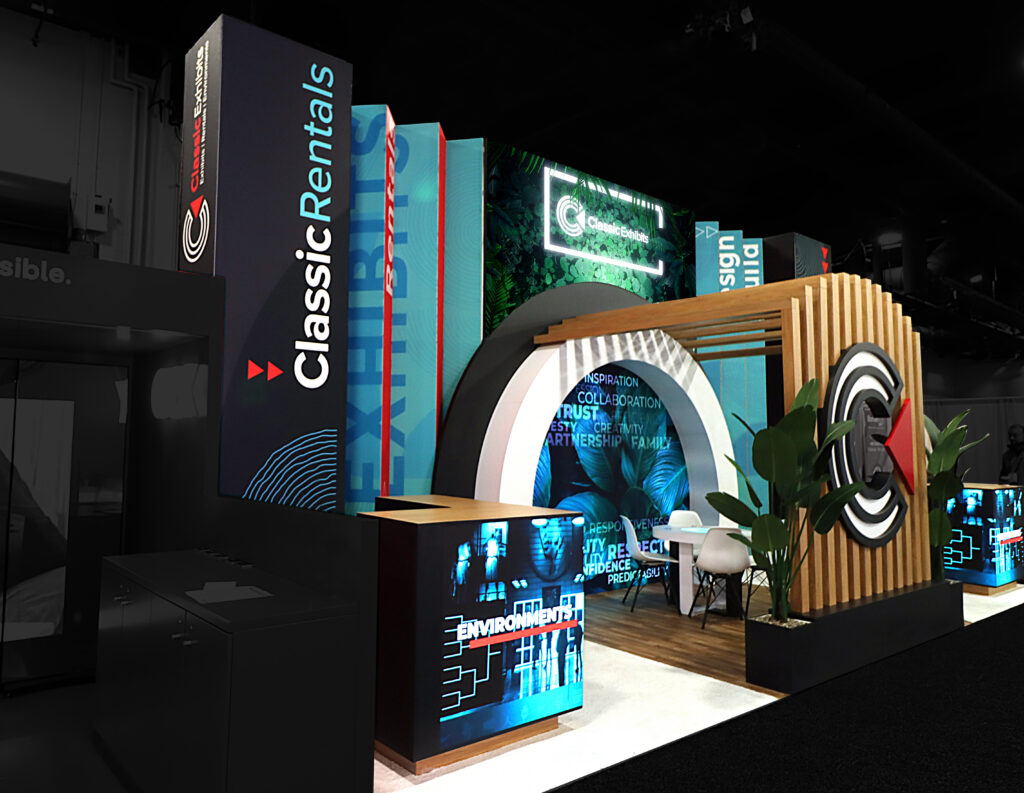
Before diving into trade show technology… a bit of a reminder.. Whether it’s LED video tiles, augmented reality, AI personalization, or lead retrieval, it’s important to remember that technology is a tool, not a strategy. You know this, or course. But, let’s be honest, we all get a little “giddy” when shown the latest gadgets or software. Suddenly, it becomes the perfect solution to an unidentified problem. Smart marketers know that goals and strategy, along with a budget, are the foundation to an effective trade show program. That said…
Technology is moving faster than ever and changing how exhibitors and attendees interact on the show floor. Expectations are evolving and what was an optional enhancement just a few years ago is now an expectation. This year, trade show exhibitors toyed with AI, immersive experiences, data collection, and personalization. In 2027, these technologies, along with others we’ll review, will redefine trade show engagement. In this article, we’ll review the technology trends that exhibitors should prioritize based on ROI, practicality, and attendee impact.
Key Takeaways
- Trade show attendees are more technologically savvy than ever and they expect exhibitors to use technology to inform and entertain them.
- AI applications are shifting the trade show booth experience.
- Interactive Touchscreens and Digital Product Demonstrations are no longer a gimmick but an effective presentation and education tool.
- Smart lead capture combined withCRM integration is transforming trade show lead retrieval and data capture.
- Finally, choosing the right technology depends on your trade show goals.
Why Technology Is Reshaping Trade Show Experiences
Technology is reshaping trade shows and events because the expectations of both exhibitors and attendees have evolved. Attendees no longer want passive, paper documents or uninspiring graphics. They expect to be informed and entertained. They crave memorable experiences. As a result, exhibitors can no longer afford to measure event success purely on unverified foot traffic and business cards.
Modern attendees want interactive, personalized, and digitally connected booth experiences. And who can blame them? Outside the show hall, their lives are immersed in digital content and interactive, experiential content. Savvy exhibitors are incorporating technology that supports both attendee engagement and post-event marketing.
Key Drivers Reshaping Trade Show Experiences:
- Immersive Experiences: This includes virtual and augmented reality (VR/AR) and architectural LED video walls, floors, and transparent OLED panels
- Data-Driven Analytics: Beacon technology, spatial sensors, and heat mapping track how attendees move through the booth and what captures their attention.
- Personalized Touchpoints: Self-guilded touchscreens, motion activated games, and interactive product configurators let attendees tailor products to their specific needs.
- Sustainability Requirements; Digital assets, often as simple as QR codes, and modular designs are redefining how designers create structures and marketers present their products and services in the booth space.
What Makes Trade Show Technology Worth the Investment?
Trade shows remain a strategic foundation of B2B marketing strategy despite the rise of digital marketing, virtual events, and remote selling tools. Physical events and expositions offer an unmatched combination of access, physical proof, and relationship-building that digital channels cannot replicate.
When exhibitors blend technology into their overall booth experience, they have greater flexibility to create immersive and interactive experiences for attendees. Those experiences, when done well, are more likely to identify qualified prospects and enable exhibitors to measure their trade show or event results.
| Evaluation Factor | Why It Matters | Business Impact |
|---|---|---|
| Visitor engagement | Attracts more booth traffic | Higher interaction rates |
| Lead generation | Improves data collection | Better sales opportunities |
| Brand experience | Creates memorable interactions | Stronger brand recall |
| ROI measurement | Demonstrates event performance | Smarter marketing decisions |
| Ease of implementation | Simplifies event execution | Reduced operational complexity |
Trend #1: AI-Powered Booth Experiences
AI-powered trade show booth experiences use machine learning, generative AI, computer vision, and conversational software to react and adapt to attendees in real time. Instead of relying on static graphics or looping videos, an AI-powered booth shifts from broadcasting information to building interactive, personalized engagements.
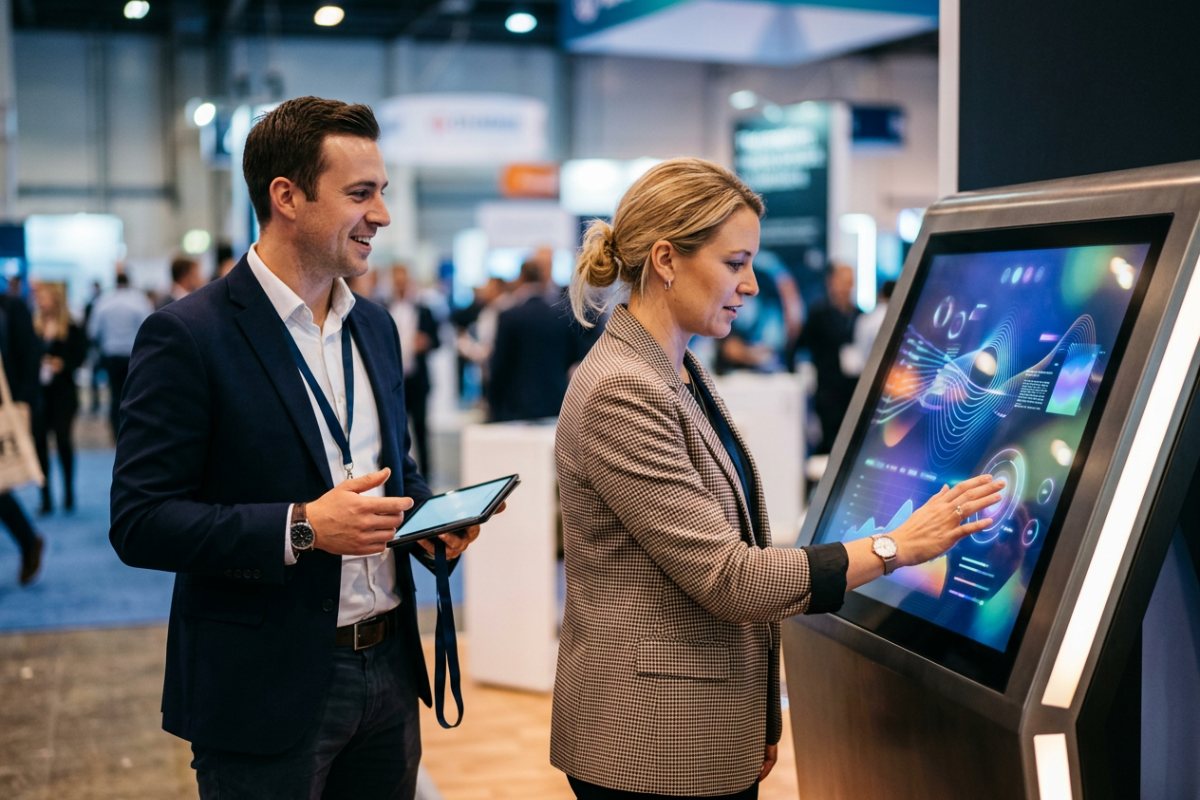
AI Applications and Examples:
- Personalized Product Demonstrations, like generative content engines and adaptive video walls. Attendees answer prompts on a kiosk and Ai generates product designs, renderings, or financial demos.
- Digital Assistants & Aviators are voice activated virtual staff who greet attendees and answer questions. These can handle basic exploratory questions by attendees, qualify them as prospects, and then introduce them to a booth staffer.
- Heat Mapping and Spatial Analytics use optical sensors and cameras to track traffic flow, visitor count, and dwell time in specific zones on the booth. When paired with touchpoint data, AI algorithms can help convert casual visitors into targeted engagements.
- Smart Lead Qualification instantly cross-references a badge scan with databases to pull revenue, past client engagement, and even previous voice notes). At the end of the show, it automatically syncs the lead into the company’s CRM and matches it with pre-drafted emails.
- Interactive Activations use AI stations where visitors use prompts to create digital art or branded apparel designs. AI photo booths can use sketch, face-swapping, and restyling technology that attendees can share instantly on social media.
Trend #2: Interactive Touchscreens and Digital Product Demonstrations
Interactive touchscreens and digital product demonstrations transform a static trade show booth into an engaging, self-directed exploration center. They address the most common floor challenge: managing foot traffic spikes without overwhelming booth staff while offering prospective buyers a tailored, hands-on way to explore your offerings. Offerings include freestanding digital kiosks, touch tables, and integrated wall monitors.
4 Software Applications for Digital Touchscreens or Digital Product Demos:
- Interactive 3D Product Configurators
Allow visitors to rotate, zoom, customize colors, swap components, or view exploded-view assemblies of heavy machinery, equipment, or architectural products that are too large to bring to the show floor. - Self-Guided ROI & Solution Calculators
Attendees input their company size, current operational parameters, or production volumes to receive instant, personalized cost-benefit projections or equipment payback timelines. - Digital Resource & Spec Sheet Libraries
Visitors browse full product catalogs, video case studies, and technical whitepapers, selecting specific files to automatically email directly to their inbox via an on-screen badge scan or QR code. - Gamified Engagement & Survey Stations
Interactive quizzes, trivia, or diagnostic assessment tools test industry knowledge while capturing user demographic data and qualifying intent behind the scenes.
Trend #3: Augmented Reality (AR) and Virtual Reality (VR)
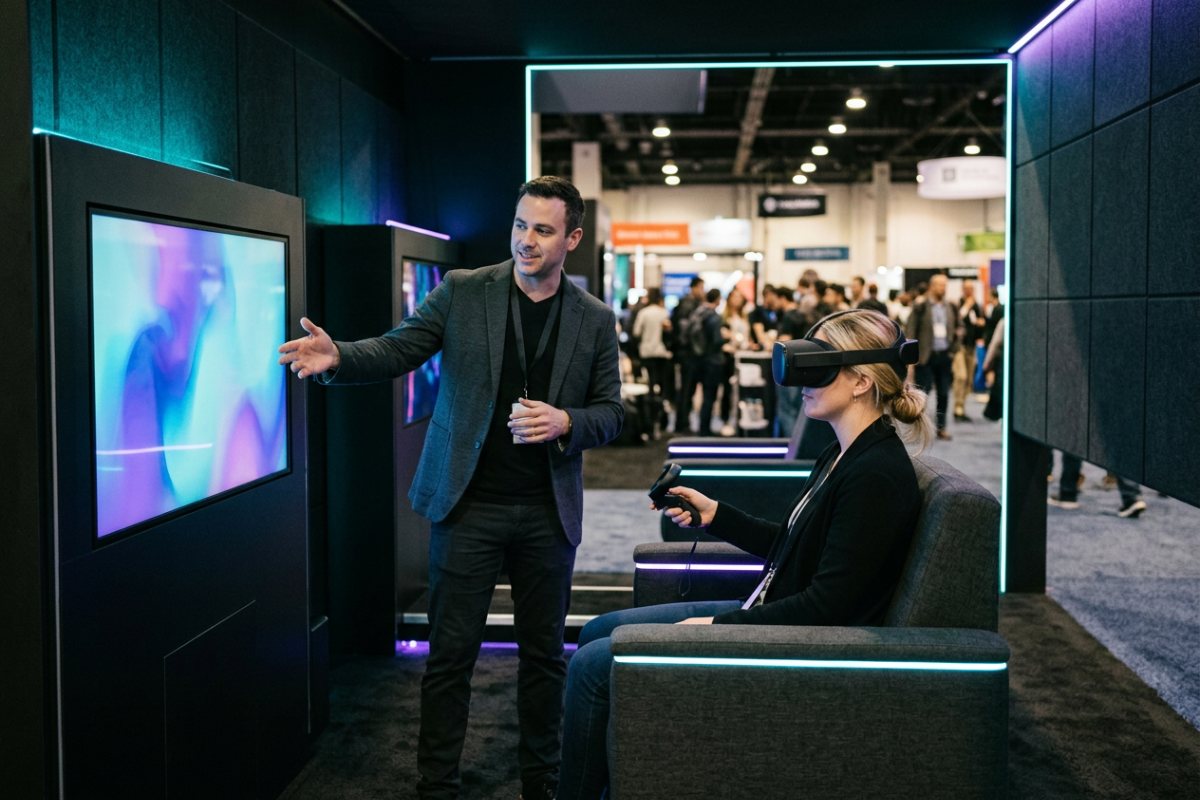
Augmented Reality and Virtual Reality are not new on the trade show floor. However, the “promise” of AR and VR has finally turned into reality. AR and VR solve one of the biggest challenges on the show floor: showing products that are too big, too complex, or too expensive to physically ship to the exhibit. Use AR when you want quick product exploration demos, which then segue into longer explorator conversations with booth staff. Use VR when: You need complete focus to transport visitors inside an industrial facility, an offshore rig, a cleanroom environment, or a large-scale architectural design.
Comparison
| Dimension | Augmented Reality (AR) | Virtual Reality (VR) |
|---|---|---|
| Barrier to Entry | Very Low: Runs on standard tablets, kiosks, or smartphones. | Moderate: Requires headsets, dedicated seating, and staff guidance. |
| Throughput | High: Multiple visitors can engage simultaneously in open space. | Low-to-Medium: Typically one user per station at a time. |
| Booth Footprint | Minimal: Requires little to no extra square footage. | Moderate: Needs dedicated perimeter space or designated VR pods. |
| Engagement Depth | Interactive Overview: Great for feature highlights, spec sheets, and scale. | Total Immersion: Ideal for narrative storytelling and full spatial scale. |
Trend #4: Smart Lead Capture and CRM Integration
Smart lead capture and CRM integration transform trade show leads from a random pile of badge scans into an actionable pipeline. The traditional post-show routine of collecting paper business cards or renting clunky hardware scanners and manually uploading spreadsheets days later creates delays, lost data, and cold leads. Leveraging modern, software-based lead retrieval connects show-floor interactions directly to your sales pipeline.
- Software applications running on staff smartphones or tablets, like Captello, allow every booth rep to scan attendee badges (QR/RFID), business cards via OCR, or digital business cards instantly without paying for rented event hardware.
- AI-Assisted Voice programs allow your booth staff to dictate brief conversation summaries immediately after a prospect walks away. AI speech-to-text transcribes the audio, extracts action items, and attaches the notes directly to the contact record.
- Direct CRM Routing connects the capture tool to platforms like Salesforce or HubSpot — automatically assign lead ownership based on geographic territory, trigger instant auto-responder emails with requested collateral, and enroll prospects in tailored post-event nurture sequences.
Trend #5: Large-Format LED Displays and Dynamic Digital Signage
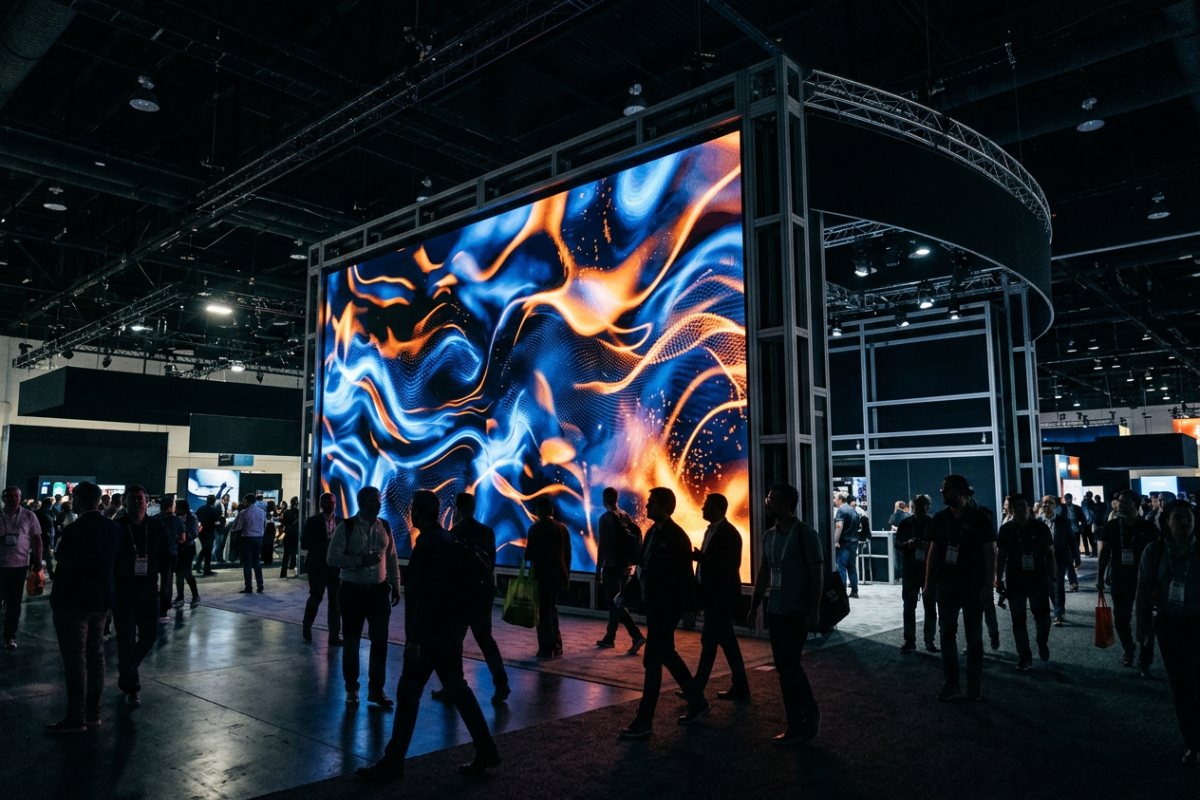
Large-format LED displays and digital signage are among the most effective tools for increasing an exhibit’s visual impact on a crowded trade show floor. However, deploying massive LED walls without a clear content and structural strategy becomes visual noise rather than meaningful visitor engagement.
4 Considerations
- Match Hardware Specifications to Viewing Distance.
- Exhibition halls vary widely in ambient lighting. Choose indoor LED tiles capable of 800 to 1,200 nits, but ensure your processor allows real-time dimming. Running a wall at 100% brightness up close can cause eye fatigue and drive attendees away.
- Design Content Specifically for a Trade Show
- Trade show attendees are constantly on the move. Your digital content must communicate your core value proposition before they walk past. Convention floors are noisy, and audio narration is rarely effective or allowed at high volumes. Rely on high-contrast motion graphics, bold captions, and visual storytelling. Structure content in 15- to 20-second dynamic loops with short, 3- to 5-word headlines using clean fonts.
- Design with a Plan
- Mount LED tiles directly into modular aluminum frame systems (such as Gravitee or custom millwork) so the screen appears as a flush, architectural wall rather than an afterthought. Large LED processors and power supplies generate heat and require dedicated airflow. Build hidden storage closets or vented counters behind the LED wall to house media players, power drops, and spare tiles.
- Technical Expertise and Operations
- Rely on A/V experts who have experience with large video walls. They will verify the power and signal redundancy, specify the resolution mapping, and ensure uniform LED panels (and have spares).
Choosing the Right Technology for Your Trade Show Goals
Choosing the right technology for your trade show booth begins with clearly defining your primary show goals rather than adopting digital tools for novelty alone. If your main objective is driving aisle foot traffic and brand awareness, high-impact visuals like large-format LED walls, backlit dynamic signage, or eye-level interactive kiosks serve as visual magnets that draw attendees off the aisle.
Conversely, if your goal centers on showcasing complex or massive product portfolios, virtual and augmented reality (AR/VR) along with 3D product configurators allow buyers to explore your entire line without the immense freight and drayage costs of shipping physical equipment.
For teams focused primarily on lead conversion and pipeline velocity, investing in smart, mobile-based lead retrieval systems integrated directly with your CRM yields the highest return. Capturing leads via custom qualifying surveys, voice-to-text dictation, and real-time data enrichment ensures high-intent buyers receive instant, tailored post-show outreach while competitors are still organizing business cards.
Ultimately, the most effective trade show technology aligns directly with your booth layout and staff capabilities—acting as an intuitive bridge that turns passive passersby into qualified sales opportunities.
| Business Objective | Recommended Technology |
|---|---|
| Increase booth traffic | LED displays, interactive experiences |
| Generate qualified leads | AI assistants, lead capture software |
| Showcase complex products | AR, VR, touchscreens |
| Improve customer education | Interactive presentations |
| Measure event ROI | Booth analytics platforms |
| Strengthen brand awareness | Immersive digital experiences |
Technology is a powerful accelerator on the show floor, but it cannot replace the core fundamentals of clear strategic messaging, thoughtful booth architecture, and genuine human connection. An exhibit packed with seamless LED walls, interactive touchscreens, and immersive AR experiences will still fail if the underlying visual hierarchy is confusing or if booth staff are disengaged, untrained, or hidden behind screens. Ultimately, technology should enhance a great trade show experience, but it can never replace the primary face-to-face reason attendees attend.
How Custom and Modular Exhibit Design Supports Emerging Technology
Contemporary exhibit design provides the physical backbone required to integrate emerging show floor technologies seamlessly. As trade show technology evolves from simple digital signage to data-driven AI systems, spatial sensors, fine-pitch LED video walls, and immersive AR/VR activations, the underlying booth architecture must balance structural stability, cable management, and reconfigurability.
Custom vs. Modular Structural Capabilities
| Structural Dimension | Modular Systems (e.g., Gravitee, Frame Systems) | Custom Fabricated Exhibits |
|---|---|---|
| Tech Integration Style | Flush panel mounting, standardized bracketry, modular LED tile bays | Bespoke millwork, organic shapes, fully hidden AV enclosures |
| Reconfigurability | High: Easily reconfigured across 10 x 10, 10 x 20, and 20 x 20+ spaces | Low to Moderate: Designed for specific footprints; requires modification for size changes |
| Load-Bearing Capacity | High for standard monitors and lightweight LED tiles | Very High for heavy cantilevered structures, second stories, and massive video arrays |
| Freight & Setup Speed | Toolless assembly, lower shipping weight, compact crate packing | Requires specialized labor, higher freight volume, longer on-site build times |
Trade show designers and builders have always been flexible because their customers serve a wide variety of industries and audiences. Change is in their DNA. Classic Exhibits is especially well-positioned to handle modern technologies with a wide range of products and an experienced network of Classic Exhibits Distributors in North America.
About Classic Exhibits
Classic Exhibits has been designing and building custom trade show booths since 1993. We’ve been honored as an Exhibitor Magazine Find-It Top 40 Exhibit Producers and an Event Marketer Fab 50 Exhibit Builders multiple times, along with numerous Portable Modular Awards. With over 250 Distributor Partners throughout North America, there’s a Classic representative near you.
Contact us today whether you need a durable 10 x 10 display built to last, a rental display guaranteed to attract trade show attendees, or a custom 30 x 40 exhibit with all the bells and whistles. Learn more about our capabilities. We’re not just different. We’re better.
FAQs
How much of a trade show budget should be allocated to technology investments?
While every company’s marketing strategy varies, industry standards generally recommend allocating 10% to 20% of your total trade show budget to technology investments.
For high-tech verticals, software providers, or exhibitors shifting from shipping heavy physical inventory to virtual/digital demonstrations, technology allocations can stretch up to 25% to 30%, offset directly by significant savings in freight and drayage.
Can small exhibitors benefit from advanced trade show technology?
Absolutely! In fact, smaller exhibitors are often the most creative users of advanced trade show technology. This can be as simple as investing in touchscreens with engaging content to integrating LED tiles into a 10 x 20 inline. Be bold. If you can spark curiosity with your booth design using clear technology, you’ll attract attendees.
How far in advance should exhibitors plan technology integration for a major trade show?
From the get-go! Professional exhibit designers understand how to maximize the impact of technology in the overall design. That becomes more challenging if the design is finished and the technology is introduced later. No exhibitor ever said, “I’m sorry I started planning so early.”
What trade show technologies provide the fastest return on investment?
That’s a bit like asking, “Which candy bar do you like best?” For many exhibitors, it’s video technology. For others, it’s AR or VR. Sometimes the smartest decision is to start an integrated lead management system. Your budget, your goals, and your marketing/sales pain points are a good place to start.
How can exhibitors measure whether booth technology actually improves lead quality?
They can… but that requires a much, much longer discussion on measuring ROI. Search for measuring trade show ROI or contact your local exhibit partner.