


Let's Blame the Imports
It’s ALL their fault — those inexpensive imports of dubious quality. They are ruining the exhibit industry for everyone. How do we possibly compete?
If you shouted “Hurray!” or “You are SO right my friend!” you’re going to find this article disappointing. It’s easy to blame imports. They have lowered prices on many common display products, and they have introduced “disposable” banner stands, pop ups, signs, etc. to hundreds of thousands of customers. In short, they have changed expectations. I would contend, which many of you may disagree with, that that’s not such a bad thing. Here’s why:
1. Price: Lower prices on banner stands, pop ups, portable canopies, and outdoor signage have expanded the market for these products. Seven years ago, you saw them at trade shows and events. Now you see them everywhere: retail stores, arts and crafts fairs, meetings, conventions, even churches. Lower prices means more customers who will buy more products and will have a better understanding of event and trade show marketing.
And, while you may bemoan that many of these products are coming from overseas, they are mostly being sold by domestic distributors.
In time, as their marketing goals change, these customers will explore other options – such as hybrid exhibits, modular displays, even custom exhibits.
2. Quality: Admit it. Not every imported display product is “junk.” Like any product, you get what you pay for. There are cheap, disposable banner stands, and there are high quality ones. How do customers know the difference? Customers don’t. They rely on exhibit professionals to explain the differences and their options. In the end, they are adults. They will make a decision based on their circumstances and their personality. Sometimes it’s a wise decision. Sometimes it’s a foolish one. All we can hope is that they learn from their mistakes.
Here’s a personal example. At Classic Exhibits, we offer two pop up display systems: the Quadro EO and the Quadro S. We manufacture the Quadro S at our plant in Oregon. The Quadro S is a high quality pop up with literally hundreds of options and nearly 100 kits. It can do just about anything, including holding multiple monitors, shadowboxes, waterfalls, and shelves in curve and flat configurations. It will perform flawlessly in hundreds of shows, and it’s priced competively.
The Quadro EO is a self-locking pop up display that we import from China. To tell you we looked at quite a few models from quite a few manufacturers would be an understatement. We saw good pop ups, bad pop ups, and ridiculously bad pop ups. The EO was by far the best one. It’s a lightweight pop up with minimal accessories in three frame styles: 10 ft., 8 ft., and a 6 ft table top. We manufacture the fabric panels and roto-molded cases in the USA. So you may be asking . . . Why import a pop up when we already manufacture one? Simple, our customers requested a high-quality, lightweight system that could be sold for several hundred dollars less than the Quadro S. They’re our customers so we responded.
3. Innovation: I don’t need to tell you that competition sparks innovation. You already know that. Too often, the folks who grumble about unfair competition are the same ones who refuse to tinker and innovate. They may make superficial changes, but they resist rethinking the underlying premise of their products, their services, or the marketplace.
Now I’m not naïve. Unfair competition exists. Every government subsidizes certain industries, and many companies manipulate the market, suppliers, or governments to gain an unfair advantage over competitors – domestic or foreign.
You need to be realistic. You’re not going to stop the imports. And relentlessly cutting prices and your margins only gets you so far. You have to find a niche(s) where you excel, where you can move faster than the imports and faster than your competitors. At Classic, we’re never going to be cheaper than an identical Chinese import. But, we don’t have to be.
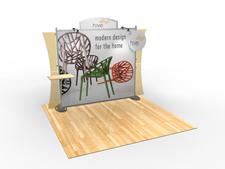
Sacagawea VK-1222 Portable Hybrid
Let’s take hybrid displays as an example. In the past two years, we’ve seen lots of basic extrusion backwalls. You know the ones: wings, canopy, large tension fabric or vinyl graphic, and workstation counter(s). It’s a familiar shape, one that customers seem to like as an alternative to a pop up or curved push-button connector display. These basic hybrids used to be over $10K. You can now find imported versions for $2K to $5K.
Classic Exhibits specializes in hybrid displays, so you’d think we would be concerned. We are and we’re not. Six years ago, we recognized that we could manufacture designs that others couldn’t, and we could react much faster to the market. The Sacagawea System is a good example. The Sacagawea Portable Hybrid competes with the imported versions — very successfully. Why? It has five advantages over imports:
- Die-Cut Packaging: Every piece has a home. There’s no guesswork, and packaging is upscale and reusable for years. Customers love our packaging.
- Knob Assembly: About 85% of the connections are attached knobs for faster assembly.
- Curves: The combination of straight and curve extrusion makes the designs distinctive.
- Options: Counters, workstations, headers, canopies, monitors, shelves, literature holders, and an array of laminate, plex, and Sintra colors.
- Set-up Instructions: Every part is labeled, and the set-up instructions are unique to your configuration. Plus, the instructions are available online 24 hours a day/7 days a week.
Do imports make our lives tougher? “Hell Yes!” Are imports to blame for lower margins and lost sales? Perhaps. However, before we jump on the “evil import” bandwagon, consider the alternative in this difficult market. And, consider your opportunities as the market rebounds. You can be darn sure your competitors are – foreign and domestic.
–Mel White
https://www.linkedin.com/in/melmwhite
mel@classicexhibits.com
Classic Exhibits Network (LinkedIn)