

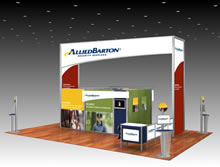
Trade Show Island Exhibits
Designing a Trade Show Island Exhibit is equally exciting and nerve-racking. It’s exciting to design a display that showcases your marketing message and draws attendees to your booth. It’s nerve-racking because islands can be expensive, and when budgets are tight, you want to get the biggest bang for your buck and to maximize your Return on Investment.
With a Classic Exhibits island, you get the best of both worlds: stunning design and cost-effective solutions. Whether you need a modular, hybrid, or custom booth, Classic has the expertise to design and build a solution tailor-made to your budget and your unique vision. Scroll through our Design Gallery for ideas. Then mix and match components or request a totally “ground up” design based on your requirements.
1. Specifically, what is an Island Exhibit?
Island exhibits are displays bordering 3-4 aisles, with the smallest starting at 20’ x 20’. Inline exhibits, by contrast, typically border 1 or 2 aisles and are usually 10’ x 10’ or 10’ x 20’.
A major benefit of island exhibits is that they do not have the same height and perimeter limitations as inline displays.
2. What are the typical show regulations regarding island (and peninsula) exhibits in the United States?
Regulations vary by exhibit hall but the following are typical: Maximum height of 30′ in all areas of your booth allowed in North Hall and Central Halls 3-5. Maximum height of 20′ in all areas of your booth is allowed in Central Halls 1-2. Maximum height of 22′ in all areas of your booth allowed in South Halls. No limitations on the number of solid walls for your Island booth.
Note: Hanging signs are permitted above island booths.
OTHER CONSIDERATIONS
Canopies and Ceilings
Canopies, including ceilings, umbrellas and canopy frames, can be either decorative or functional (such as to shade computer monitors from ambient light or for hanging products). Canopies for Linear or Perimeter Booths should comply with line-of-sight requirements.
The bottom of the canopy should not be lower than 7 ft. (2.13m) from the floor within 5 ft. (l.52m) of any aisle. Canopy supports should be no wider than three inches 3 in.(08m). This applies to any booth configuration that has a sight line restriction, such as a Linear Booth. Fire and safety regulations in many facilities strictly govern the use of canopies, ceilings, and other similar coverings. Check with the appropriate local agencies prior to determining specific exhibition rules.
Covered ceiling structures or enclosed rooms, including tents or canopies, shall have one smoke detector placed on the ceiling for every 900 square feet.
Hanging Signs and Graphics
Hanging signs and graphics are permitted upon approval in all standard Peninsula, Island and Split Island Booths, with a maximum height of sixteen feet (16 ft.)(4.87m) to the top of the sign as measured from the floor
Whether suspended from above or supported from below, they should comply with all ordinary use-of-space requirements (for example, the highest point of any sign may not exceed the maximum allowable height for the booth type). Double-sided hanging signs and graphics shall be set back ten feet (10 ft.)(3.05m) from adjacent booths and be directly over contracted space only.
Theatrical Truss and Lighting
Ceiling-supported theatrical truss and lighting are permitted in all standard Peninsula, Island and Spilt Island Booths to a maximum height of twenty feet (20 ft.)(6.1m) where ceiling permits. Ground-supported truss may not exceed the maximum allowable height for the booth type. Logos or graphics are not permitted over the sixteen-foot (l6fl)(4.87m) height restriction and must have four feet (4 ft.)(1.22m) of separation from the top of the sign to the top of the truss.
Exhibitors should adhere to the following suggested minimum guidelines when determining booth lighting:
- No lighting, fixtures, lighting trusses or overhead lighting is allowed outside the boundaries of the exhibit space.
- Exhibitors intending to use hanging light systems must submit drawings to NAMM for approval by the published deadline date.
- Lighting must be directed to the inner confines of the booth space. Lighting must comply with facility rules.
- Lighting which Is potentially harmful, such as lasers or ultraviolet lighting, should comply with facility rules and be approved in writing by exhibition management.
- Lighting that spins, rotates, pulsates, and other specialized lighting effects should be in good taste and not interfere with neighboring Exhibitors or otherwise detract from the general atmosphere of the event.
- Reduced lighting for theater areas should be approved by the exhibition organizer, the utility provider, and the exhibit facility.
3. I have reserved a 20′ x 30′ space for our industry show. I need an island, but don’t have the budget to purchase one this year. What are my options?
Renting an exhibit is the ideal choice in this situation. Renting is affordable, typically 30-40% of a purchase, and we have an extensive gallery of island and inline rental designs.
If you don’t see something you like, no problem. About 50 percent of our rentals are new designs or modifications of existing designs. If it makes sense for you, and it makes sense for us, then we’re happy to create a unique configuration that meets all your trade show marketing requirements. See all your options in the Rental Gallery.
4. I don’t see an island that appeals to me or matches my exhibit marketing goals. Can you design one just for me?
Absolutely! When it comes to islands, it’s rare that someone purchases a kit “as is.” Nearly every island gets tweaked, or we start from scratch based on your requirements. That’s the fun part of this process: designing a display that makes your trade show program successful.
Give us a call or send us an email.
5. Can an island exhibit be re-configured into other configurations such as an inline or another island?
Yes and no. It depends on your design requirements. Give us a call or send us an email and we’ll show you design examples. Or, we’ll be happy to work on a “ground up” design specific to your marketing goals.
Next, Design Monday FAQ