

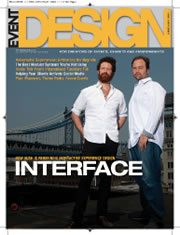
Excellent Interview in Event Design Magazine

Trade Show Blog

Event Design Magazine -- June/July 2011

I don’t know how many of you receive Event Design Magazine (www.eventdesignmag.com), but there is an excellent interview with Sue Huff, Director of Global Conventions for Medtronic, in the June/July 2011 issue, Best Practices column.

Normally, I’d simply link to the article, but it’s not on the Event Design website yet. Instead, I encourage you to read the interview if you have the print edition (pg. 16-17), and for those who do not have the issue, I’ve retyped several of her responses below. If I get in trouble with the folks from Event Design . . . well I’m sure they’ll let me know.

From the article:

Sue Huff manages more than 75 of Medtronic’s exhibition programs across all of the company’s U.S. businesses as well as its Pan-European programs . . . . Here, she talks to designers about the keys to creating global consistency, the evolution of social media and virtual events and overcoming cost containment challenges.

Event Design:  What are some of the biggest trends affecting the trade show industry today?
Sue Huff:  In general, I’m seeing social networking and virtual events used in combination with the convention environment. However, virtual has still not caught on in the healthcare industry like it has in other industries, perhaps because it’s important for physicians to be able to talk face-to-face about tough cases. We’re also seeing the show floor decreasing in size because companies are cutting back. At Event Marketing Summit last year, there was a lot of discussion about moving off the show floor with proprietary events, however, this is not common in the healthcare space.

Event Design:  What is the biggest hurdle at U.S. trade shows today?
Sue Huff:  Cost containment is the biggest challenge. With the recent economy, it’s more and more challenging and that’s why we’re seeing decreasing exhibit space. Exclusive service costs continue to rise, at a time when we’re looking at cutting costs. These costs are controlled by the show organizer and their selected vendors. For example, 63 percent of our convention budges are controlled and negotiated by the show organizer, and we have no control over these costs other than to decrease our size, or bring less (weight) to the show.

Event Design:  Is social media having any impact on how you execute at shows?
Sue Huff:  We use Twitter, Facebook and virtual technology. These channels can communicate what’s going on in the exhibit at a particular time, help us learn what the competition is doing and hear what people are saying, or what topics are of interest to show goers. I see this channel in combination with the face-to-face event increasing over time. Face-to-face is still a very important component for the healthcare industry. We’re also seeing more shows offering some type of virtual/web experience through the organizer.

Event Design:  How would you like to see the trade-show world evolve?
Sue Huff:  There’s still a value to face-to-face but the world is evolving with social media and I would like to continue to see how that’s integrated, but not as a replacement for live events. As the younger generation gets older, they’re just more comfortable with it, so it’s going to to continue to evolve. I would also like to see exhibitors more in control over their costs. I’m not in control of over 63 percent of my costs other than to increase or decrease exhibit size. Signing an exhibit space contract when true labor and the drayage rates are unknown is not OK. We need to know what we’re signing up for. I was recently discussing this model with an industry peer, and we agreed, it’s a flawed model. Normally, when you want to buy a service, you go out and get a bid from various vendors, review the responses, decide which vendor you’re going to work with, negotiate pricing, the vendor then provides the service and you pay the vendor. But today, the entire middle section of this model is missing and broken in our industry. To try and explain drayage to a marketing or finance partner is not possible, because it doesn’t make sense. I would like to see this industry healthy, which means the business model must change.

For the complete interview, please read the print edition, or be patient and it will appear online at Event Design sometime in July.

–Mel White
https://www.linkedin.com/in/melmwhite
mel@classicexhibits.com

*********************************

Based in Portland, Oregon, Classic Exhibits Inc. designs and manufacturers portable, modular, and custom-hybrid exhibit solutions. Classic Exhibits products are represented by an extensive distributor network in North America and in select International markets. For more information, contact us at 866-652-2100.

Filter by Category

Filter by Year

Recent Posts

10 Tips for Designing Large Format Graphics for Trade Shows

Most designers rarely design a layout larger than a corporate booklet or perhaps a 20″ x 30″ poster. Designing for large format, like trade show graphics, is actually quite simple once you know the basic steps. All it takes is a leap of faith… and trust in my advice.

Trade Shows and the Desire to Change

Are trade shows are relevant? Is there a future for industry trade shows? Are companies willing to spend their valuable marketing dollars building a temporary structure just to attract new customers or meet with existing ones?

Buying a Trade Show Exhibit? Ten “Must Ask” Questions

It’s common to express remorse after a big ticket purchase. Typically when the purchase is infrequent, such as a home, car, or expensive equipment. Buying a trade show exhibit is that type of purchase, especially an inline or island exhibit for a large trade show. .

Trade Show Rental — Mullets, Trapper Keepers, Pagers, and Rentals

Recently, what I thought would be a simple, straight-forward conversation left me scratching my head. I was meeting with exhibit industry colleagues, and the topic turned to rentals. Admittedly, rentals shouldn’t be puzzling. Rentals have exploded at a rate 3 to 4 times faster than exhibit purchases. What surprised me was the perception and the language used to define the exhibit rental landscape.

What is Your Trade Show Kryptonite?

We shouldn’t but we do. We hope hope hope that the next attendee who walks in our booth is Superman. Not Superman Superman, but the sales equivalent of Superman. Faster to sign a contract than a speeding bullet. More powerful than the VP of Purchasing.

How To Make Your Trade Show Backdrop Stand Out!

Many exhibitors assume a backdrop is a simple two-dimensional graphic along the backwall of an exhibit. But it can be so much more. A backdrop in a 10 x 10 or 10 x 20 booth space doesn’t have to be basic. Modern inline displays come in various shapes, heights, and configurations.

Is Your Trade Show Display an Oreo or a Fig Newton?

As an adult I can rate just about everything on a cookie scale. For brevity, I’ll limit this article to Oreos, Fig Newtons, and Nilla Wafers, but be assured that the “science” behind my methodology includes Frosted Animal Cookies, Pepperidge Farms (as a collective group), Girl Scout Thin Mints, and Chips Ahoy.

Does Your Trade Show Exhibit Have To Be Clever?

That’s not to say your trade show exhibit shouldn’t be attractive. It should, but I would encourage you to focus on more practical matters the next time you design or rebrand your display. What do you need in the booth space to conduct business? Make it less about showmanship and more about conversations and information.

What Cats Can Teach Us About Trade Shows

We are a nation devoted to pets, whether they’re on the farm or in a purse. They learn from us, but we learn from them as well. The other day while watching Animal Planet with a cat in my lap, one on the sofa, and another puking upstairs ( it sounded like the world’s worst ventriloquist), I realized that we could learn a thing or two about trade show marketing from our feline companions.

Gravitee One Step — The World’s Easiest Modular Wall System

Gravitee — The World’s Easiest Modular Wall System. Unlike traditional modular wall systems, Gravitee has no loose connectors. The frames are constructed with durable engineered aluminum extrusion and the system uses time-tested patented technology.

Who is Our Biggest Trade Show Competitor?

Recently, I’ve been on the road, visiting Classic Distributors in the Midwest and South. We chat about industry trends, new products, and challenges in their market. Occasionally, they will ask me about competitors. That’s a topic, to be honest, that makes me uncomfortable.

3 Essential Trade Show Marketing Questions

These are questions every designer should ask their client before designing the ideal trade show display. If the client walks in just thinking about the nuts and bolts of the project, they may miss an informed conversation on why they are exhibiting in the first place and that can fundamentally affect the design of a booth. The Why can greatly impact the How in Exhibit Design.

What You Should Know about Exhibit Marketing

Exhibit marketing is all about marketing your products or services to buyers at expositions, conferences, and trade shows. A successful exhibit marketing program will be rewarded with increased revenues, referrals, and industry networking. The goal is to understand how exhibit marketing differs from the other types of marketing.

Managing Your Trade Show Budget

Trade shows are expensive, and some costs are often puzzling to exhibition newbies, but there are multiple ways to manage those expenses with a little planning and some assistance from an experienced trade show professional. Don’t be afraid to tap into that expertise.