

Using Trade Shows to Grow Your Business
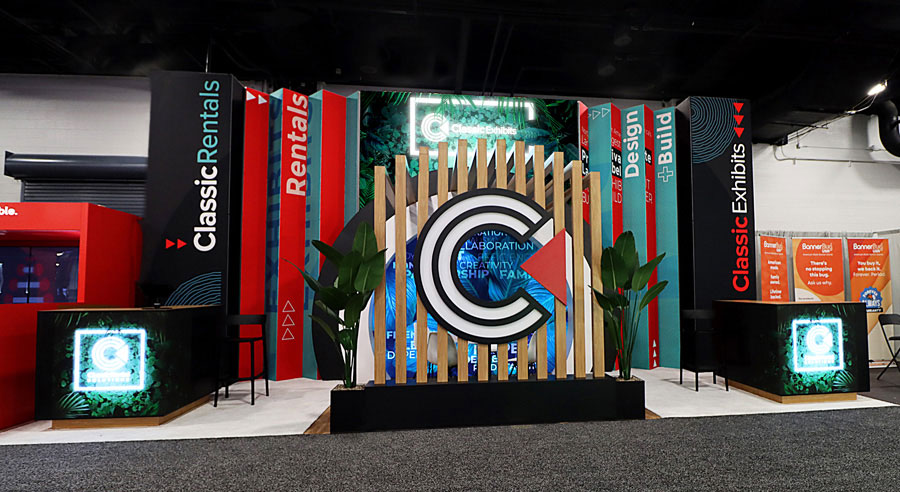
In a nod to Mark Twain, “Reports about the death of trade shows have been greatly exaggerated.”
With the rise of online meetings and ecommerce, business experts have predicted the death of trade shows and live events for 40 years. Yet, the benefits of trade shows and events have never been more important for businesses. There were over 13,000 separate events in North America in 2025 alone. The TSNN Trade Show Report lists the 250 top trade shows, along with valuable information about how successful events are built and how they sustain growth in an increasingly competitive exhibition landscape.
Whether you are a Fortune 500 company commanding a massive custom island booth or a scrappy startup launching from a 10×10 space, face-to-face marketing offers advantages that a screen simply cannot replicate.
Key Takeaways
Many exhibitors have mixed feelings about trade shows, largely based on their past experiences. Perhaps they didn’t see as much traffic in their booth as they had expected or the results were difficult to measure for senior management. It’s easy to blame the trade show or the attendees. And few exhibitors want to do a post-event triage of their trade show marketing.
This article isn’t a deep dive into how to choose, prepare, and maximize your results as an exhibitor. There are hundreds of guides to trade show planning, including this detailed post.
Instead, we’ll take a step back and review the traditional benefits of trade shows and why they’re still an important tool in every marketer’s toolbox. In addition, we’ll discuss how your physical exhibit can impact your success and some common mistakes that novice exhibitors make.
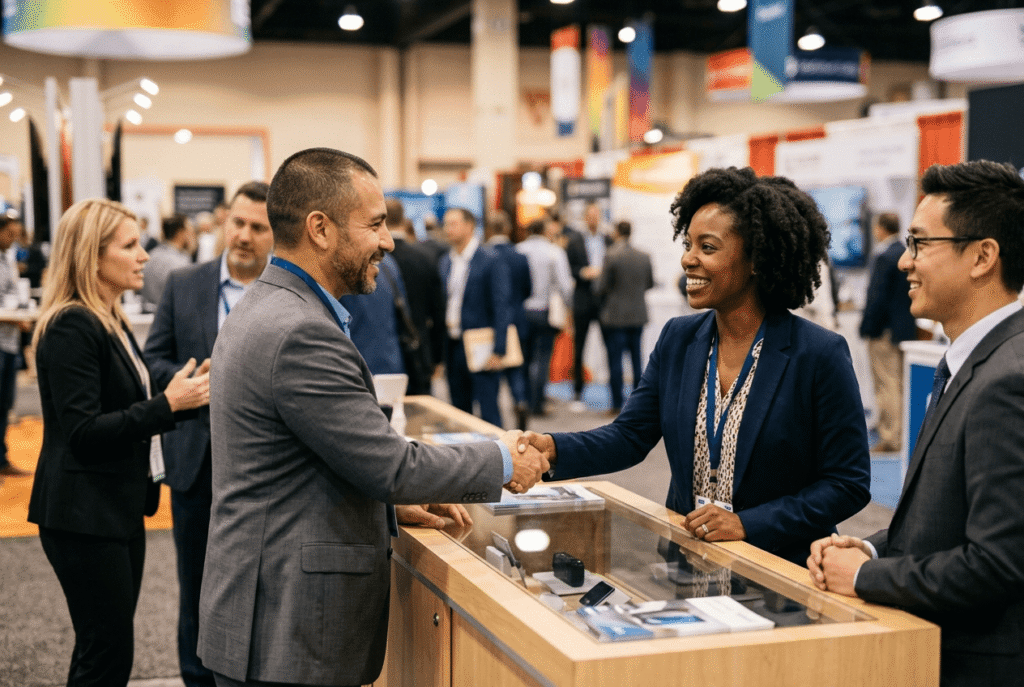
5 Key Benefits of Trade Shows for Growth, Lead Generation, and Market Research
1. High-Value, Face-to-Face Networking Through Trade Show Marketing
- In-person interaction builds trust far faster than emails or cold calls. For small businesses, a single handshake can secure a game-changing partnership or a distributor relationship that would take months to cultivate online.
- For large brands, it’s a crucial opportunity to reinforce relationships with key stakeholders, executive clients, and industry peers in one centralized location.
2. Qualified Leads & Accelerated Sales at Trade Shows
- Trade show attendees aren’t casual browsers—they are qualified buyers, decision-makers, and industry professionals who paid to be there looking for solutions. Because you can demonstrate value, answer objections, and build rapport in real-time, the sales cycle shrinks drastically.
- Many businesses close deals directly on the floor or walk away with highly warm leads that are ready to convert.
3. Leveling the Playing Field at Trade Shows
- On the show floor, a small business with an innovative product, a sharp pitch, and an engaging, well-designed modular display can stand right alongside a massive industry leader.
- Trade shows give smaller entities immediate visibility and the chance to capture the exact same media attention, foot traffic, and buyer interest as the giants in their sector.
4. Real-time Market Research on the Show Floor
- On the show floor, you can test new concepts and gather immediate, unfiltered feedback on prototype products or new service ideas.
- You can study the competition and see firsthand what your competitors are emphasizing, how they position themselves, and what their booth traffic looks like.
- It enables you to iIdentify where the industry is heading over the next 12 to 18 months based on educational tracks and keynote highlights.
5. Branding & Industry Expertise
- If you aren’t at the major show in your industry, your absence is noticed. Exhibiting signals that your business is stable, reliable, and a serious player in the market.
- For large corporations, it’s about maintaining market dominance and thought leadership. For small businesses, it’s about putting yourself on the map and proving you belong in the conversation.
No matter the size of the company, the return on investment goes far beyond immediate sales. The real-time market insights, face-to-face trust, and competitive intelligence gained over just a few days on the show floor can shape a business’s strategic direction for the entire year.
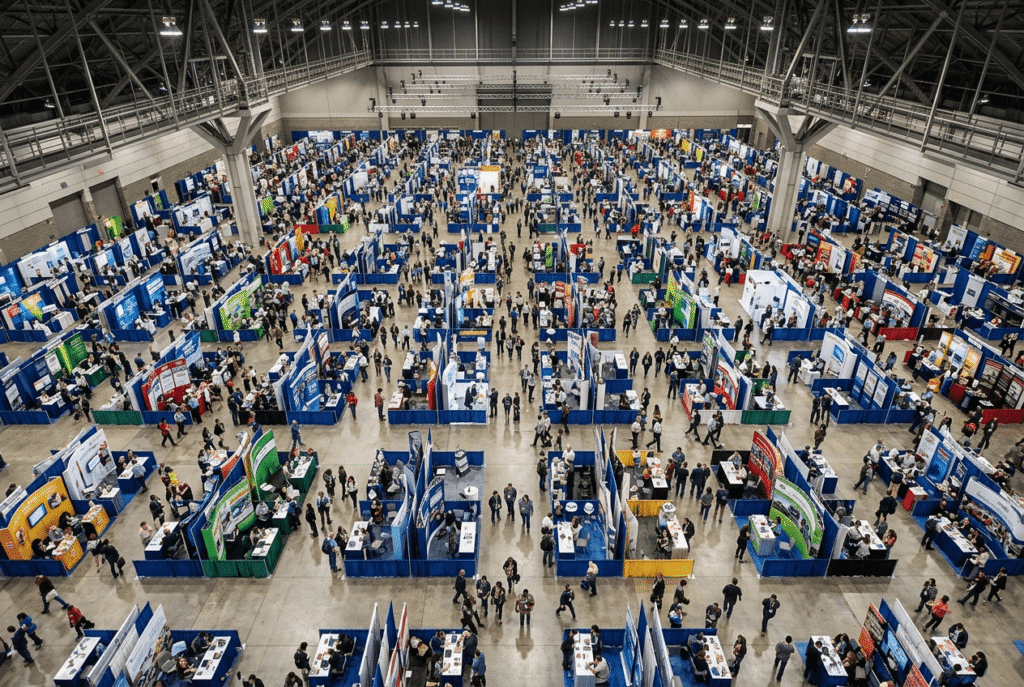
Trade Shows vs Other Marketing Channels: What Makes Them Unique
Consider this: Other marketing channels deliver your message to the audience. Trade shows bring the audience directly into your message. Trade shows may not have the same scale or reach as digital marketing or the long-term lead generation of blogs, websites, or whitepapers, they excel at establishing trust and rapport, hands-on testing, and instant feedback.
Here are four reasons trade shows are unique (compared to other marketing channels):
High Concentration of Decision Makers
In most marketing channels, you spend a massive amount of effort filtering out unqualified leads. With digital ads, you pay for clicks that might just be casual browsers.
At trade shows, attendees have invested time, travel expenses, and ticket costs specifically to find solutions, evaluate vendors, and make purchasing decisions. You are walking into a room full of people who are already actively looking for what you sell.
Immersive Brand Experience
Unlike digital marketing which relies primarily on a passive sight and sound experience, trade shows can be multi-sensory.
Trade show prospects can touch a technical material, watch a live mechanical demonstration, feel the build quality of a product, and look you in the eye while asking a tough question. This physical interaction creates a deeper, more memorable psychological anchor than any web page or video clip can achieve.
Shorter Sales Cycle
In typical B2B marketing, moving a prospect from “awareness” to “intent” to “closed-won” involves dozens of touchpoints: emails, cold calls, whitepapers, and scheduling formal zoom demos over weeks or months.
However, at a trade show, the entire funnel is compressed into a 15-minute conversation. You can introduce your brand, demonstrate the product, overcome objections, negotiate terms, and shake hands on a deal right there on the show floor.
Access to the Industry Ecosystem
Most marketing channels are isolated. They ignore the broader market.
But a trade show doesn’t have that luxury. Attendees have a 360-degree view of the industry with access to other customers, competitors, industry media, and suppliers, Customers and Prospects (for sales)
Ultimately, other marketing channels excel at maintaining a broad, ongoing digital presence, but trade shows offer something those channels simply cannot duplicate: density and depth. They concentrate an entire industry’s ecosystem—buyers, competitors, media, and partners—into a single physical room for a few intense days.
Common Mistakes Businesses Make at Trade Shows
Mistakes happen at trade shows. Some are rookie mistakes because of a lack of familiarity with trade shows. Others happen because of poor planning or an unexpected event at a show. Here are 5 common mistakes along with a link to 13 Common Trade Show Mistakes
No Strategy.
For too many companies, they believe in The Field of Dreams approach to trade shows – If you build it, they will come.” Nothing could be further from the truth. Every marketing campaign, including trade shows, requires a strategy and goals. In addition, there should be defined qualitative and/or quantitative tools to measure the desired outcomes.
The Wrong Shows.
For every company, there are obvious and perhaps less obvious trade shows. You probably wouldn’t exhibit at the NECA Convention (National Electrical Contractors Association) if you’re a plumber, but you might participate in the AHR Show, which is also a show where electricians might attend.
Missing Deadlines.
Trade shows are expensive, so why would you not take advantage of early bird price specials on electrical, cleaning, Internet, and other services. And yet, about 50% of all exhibitors choose to pay more by missing not just the first early bird special but the second one too.
Bringing Bob and Not Colleen.
Companies automatically assume the perfect trade show staff should be the sales team. And that might be the right choice. However, attendees often want to discuss technical specs with a product engineer or a long-term client may want to chat with their favorite project manager. High profile prospects often want to bypass middle management all together and only deal with the CEO or President. If the senior management team doesn’t attend the trade show, it sends a message to prospects and to your exhibit staff.
Offsite Receptions and Client Meetings.
It’s a cliche to say that the “real business happens off the trade show floor.” But it’s also not wrong. Far too many companies take an organic approach to these non-trade show floor activities. They shouldn’t. These casual gatherings are ideal places to have honest conversations with potential and existing clients and to hear news about competitors. People talk and they’re more likely to talk in an informal setting.
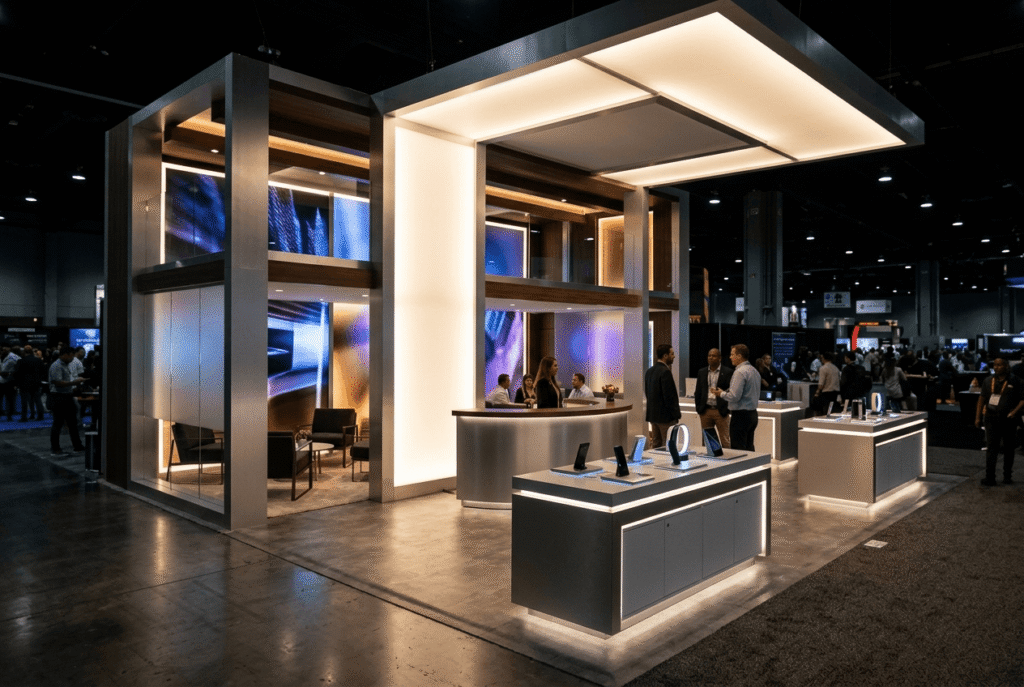
Role of Custom Exhibits in Trade Show Success
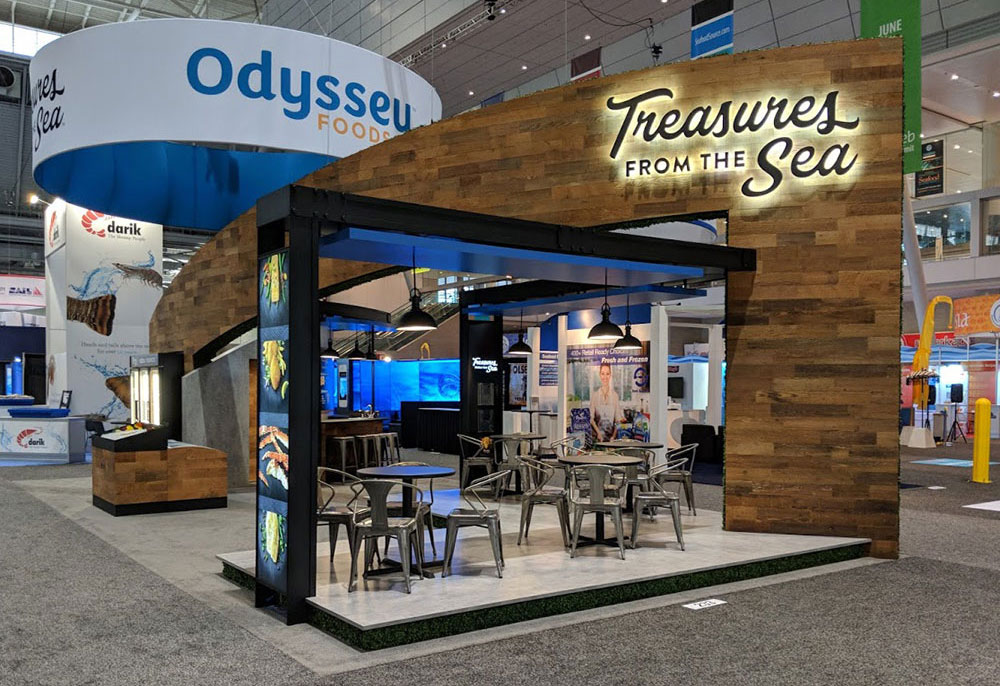
Can custom booths create strong brand experiences? Absolutely! But then again, so can portable and modular exhibits. Perhaps a better objective for any exhibit design should be “customization.” Does the design clearly reflect your branding, strategy, and goals? Does it attract attendees to your booth and are you able to effectively demonstrate your products and services in the booth space?
Unlike an “off-the-shelf” structure, a customized exhibit is engineered to align with a brand’s specific strategic objectives, product requirements, and audience engagement goals.
Engagement and Appeal:
A customized exhibit may utilize distinctive architectural shapes, elevated branding and eye-catching lighting to capture attention. In addition, the space has been designed for zones where attendees can approach the booth, then engage with the staff, and finally discuss specific requirements and prices.
Maximizing ROI:
For industries requiring specialized environments – such as the precise, clean presentation needed for biotechnology apparatus or the operational utility required for specialty food preparation – customized displays are vital to maximizing their ROI. These builds often allow for the integration of reinforced counters, hidden plumbing, dedicated high-amperage power routing, and specialized climate or lighting environments tailored directly to product demonstrations.
Assembly and Aesthetics:
There’s an assumption that “custom” means “complicated.” While that may have been true 10-15 years ago, it isn’t necessarily true now. Modular design via displays systems or engineered solutions means exhibitors can have a customized, beautiful design that assembles much faster than in the past. These solutions offer two additional advantages: the ability to reconfigure the booth (both size and shape) and reduced weight. There’s not an exhibitor in North America who doesn’t want a customized exhibit that assembles faster, weighs less, and has reconfiguration options.
When executed effectively, a customized exhibit optimizes the footprint to capture high-value leads, flawlessly support complex product demonstrations, and control long-term operational logistics. Ultimately, investing in a customized exhibit moves a brand away from standard configurations and shifts it toward a successful, high-ROI environment.
Classic Exhibits: Enhancing Trade Show Display Solutions
Your #1 goal at every trade show should be attracting attendees to your booth with relevant content and memorable experiences. That should be your strategic advantage. At Classic Exhibits, we understand the competitive environment of trade shows. It’s always evolving and what was effective last year may be ho-hum this year.
With over 250 Distributor Partners throughout North America, we have an unrivaled network of exhibition professionals who are dedicated to choosing the right display solutions for their clients and optimizing their trade show marketing. Whether you need a portable, modular, custom, or rental solution, Classic Exhibits has the perfect answer regardless of your trade show exhibit question.
Conclusion
When you work with Classic Exhibits, you’ll benefit from over 30 years of trade show design and marketing experience. As North America’s largest private-label exhibit manufacturer, we have the unmatched capability, capacity, and creativity to create 3D projects ranging from 10 x 10 inline displays to 60 x 80 double-deck islands.
Find success on the trade show floor with an exhibit that reflects your marketing message. For more information, see www.classicexhibits.com and explore Exhibit Design Search or request a meeting with a Classic Distributor Partner.
Frequently Asked Questions
Why are trade shows important for small businesses?
For small businesses, a trade show floor is one of the few marketing environments where the playing field is radically leveled. While a massive corporation can outspend a small business on digital ads or television campaigns, a well-engineered, engaging booth space allows a nimble company to compete directly for the exact same buyers, distributors, and media attention.
For a growing business, trade shows serve as a powerful accelerator by condensing months of traditional sales outreach into three days.
Are trade shows still effective for marketing?
In an era dominated by targeted digital ads, automated emails, and AI-driven outreach, trade shows are no longer just about handing out brochures or collecting a mass volume of business cards. Instead, their value has pivotally flipped: because the digital landscape is so crowded and noisy, face-to-face marketing has become the ultimate differentiator.
When a buyer can block an email or skip a digital ad in a millisecond, the physical show floor remains one of the last places where you have a captive, high-intent audience.
How can I succeed at a trade show?
There are three keys to successful trade show marketing. There should be a strategy, goals, and a detailed plan for your trade show marketing. That may seem obvious, but most exhibitors, even experienced ones, consistently fail at one of these. Secondly, assume much of your booth traffic will come from your pre-show marketing. You wouldn’t hold an event unless you knew who was planning to attend, so why would you participate in a trade show unless you knew who would be visiting your booth. And lastly, find a trade show partner who understands your company, your goals, and trade show trends. No one will save you more money and make you more money than an exhibition partner committed to your success.