

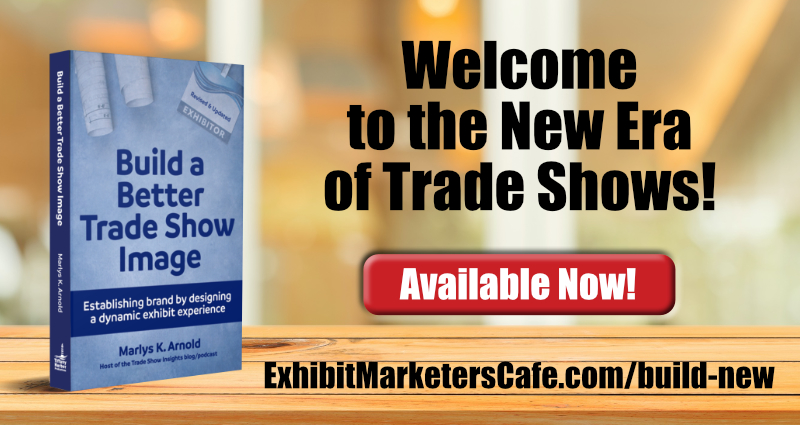
When Marlys Arnold wrote the book, Build a Better Trade Show Image, her goal was to create a how-to manual for new exhibitors. Since then, her book has been a must-read guide in the trade show industry for over 20 years. The updated version includes many new examples of creative exhibit designs, promotions, attractions and beyond. You’ll find fresh ideas, as well as advice that has stood the test of time.
Marlys was kind enough to answer some of our questions about the book, her background, and the challenge of updating Build a Better Trade Show Image.
Why did you write the book in the first place?
When I wrote the first edition, I had been collecting notes and ideas as I either walked a show or when I exhibited or worked at shows. So basically it was the how-to manual that I wish I would have had as a beginning exhibitor. I wanted to walk people through the entire process of what to do before, during, and after the show to have better results and really make it more worth their time and investment.
Why did you use the analogy of building a house?
Even if someone hasn’t actually built their own house, they understand the concept that first you have to lay the foundation, then you build the framework. Once you get the house built, then you work on the interior and you want to have good curb appeal. There were all these different pieces that I could then align with the process of doing a trade show. Building the foundation is the idea of setting goals and preparing for the show ahead of time. Curb appeal is doing your promotions and getting attention and drawing people into your booth. So there were a lot of ways that I could draw those parallels between the two ideas.
So what prompted you to revise the book?

When I initially wrote and debuted it back in 2002, I never had any idea that I ever would do it again. I really didn’t ever plan on doing it again. But over the years, people began asking if I would consider doing an updated edition. And especially about the time that we all went into lockdown, I had people starting to ask because there were things in the first edition, like we don’t use faxes anymore. And then there were a lot of brand new things … social media didn’t exist back then, and people didn’t carry smartphones in their pockets back then. So there were a lot of new ways and new strategies that people could implement now that weren’t even available to us way back then.
So I finally decided it was a good idea — but I should have started on it a little sooner than what I did and worked on it during lockdown. Instead, late in 2021 I got the idea to starting the second edition just as everything was opening up and we were all starting to get really busy again.
How have face-to-face events changed, especially post-pandemic?
Well that’s a tough one because I would like to say yes, they’ve changed dramatically and they’ve improved. But unfortunately, in a lot of ways — a lot of the wrong ways — they haven’t. Walking shows now, I still see what I call the Ten Commandments of Booth Staffing, things like people eating in the booth, people sitting and ignoring the traffic that’s walking by. There’s still all this bad behavior.
We had this wonderful opportunity during lockdown to completely revise and improve and move forward. And a lot of exhibitors and a lot of shows didn’t really take advantage of that opportunity. So now is a good time to just reset and move forward and do a better job. My goal is to see every exhibitor at every show have the best show they’ve ever had now, as opposed to last year or even pre-lockdown. I want to see exhibitors take the strategies and tools and really build on it and make their shows more productive and more valuable.
What was the most challenging part of doing the update?
Well, there were a lot of parts that were more challenging than I expected. I mean, just things like trying to do some of the research and find updated statistics. Sometimes it was really tough to find updated studies or research that correlated with what was there 20 years ago. And of course there are a lot of companies that are gone, so there were industry resources that don’t exist anymore. Other than CEIR, which obviously has great statistics — but some of the other stats were hard to research now.
It was also tough because everybody was starting to get busy right about the time that I began working on the new edition. I remember one person in particular that I reached out to in June or July, and I was finally able to do an interview with him in October so that I could include his story in the book. It was challenging trying to gather all of the great examples and information that I really wanted to include, but of course there’s no way to ever include everything. I squeezed in as much as I could, but obviously I couldn’t fit everything into the book.
So who’s the audience for this book?
Ultimately, I wrote it with the hope that it will be relevant to any exhibitor, no matter the level of experience or size or what industry that they’re in. I include a lot of very universal principles in there, but my passion is always to help the newbie exhibitor, somebody who’s just getting started, or maybe a really small company. A lot of exhibitors that I’ve consulted with over the years have been those in the 10’x10’ or 10’x20’ spaces, because they know they need to work hard to try to compete and get attention when there’s all these huge booths and household-name exhibitors on the show floor.
I know right now it’s definitely a challenge because so many people have left the industry. Long-term exhibitors and vendors — people that had years or decades of experience are now gone. And so a lot of the people who are coming in are newbies that have zero experience and don’t know what they’re doing.
I really want the book to be a tool that they can pick up and use. Over the years, I’ve heard a lot of exhibitors say they use it as a how-to manual, and that’s really what I wrote it to be. But I’ve also included a lot of next-level ideas in there as well. So even somebody who’s been exhibiting for 10 or 15 years can pick up the book and discover new tips and examples and find some aha moments that they can implement as well.
And finally, what are two or three pieces of advice you’d share with your clients about trade show success?
The key is what you do before, during, and after the show — because it’s not just what happens on the show floor, and it’s also not just a checklist of things to do. A lot of times exhibitors that have been doing shows for a long time may just look at it as a checklist: We have to get our booth designed, we have to order our promotional products for giveaways. They’re not really looking at the strategy behind it all. It’s just become a routine. It’s almost like they’re on autopilot.
So what I really tell exhibitors is focus on the strategy. Why are you going? What are you wanting to accomplish? What is your core message? Then use that and work backwards and figure out what are the tasks that I need to do, or even better … what are the things that I should include, or the things I should not include that don’t necessarily enhance that strategy.
Another thing is, like I mentioned earlier, the whole idea of what I call the Ten Commandments — having good booth staff behavior. That can be as simple as paying attention and being engaged in the booth, instead of checking your cell phone, or everybody on your team standing around in a huddle, having a conversation instead of being proactive and interacting with the people that walk by. I think there’s still a lot of room for improvement, even with long-time exhibitors. I go to shows like EXHIBITORLive, and I still see a lot of these bad booth behaviors. So it’s something that everybody has to consciously work on and make sure that they’re putting their best face forward in the booth.
About Marlys
As an exhibit marketing strategist, Marlys Arnold combines image expertise and real-world marketing experience with a passion for trade shows. Not only has she been an exhibitor, but also the organizer of several expos and events. This unique perspective of the industry allows her to share new insights with both beginning and experienced exhibitors, teaching how to create experiential exhibits that produce significantly higher numbers of qualified leads.
She’s led workshops for groups including Meeting Professionals International (MPI), the International Association of Exhibitions & Events (IAEE), TSNN and EXHIBITOR, as well as providing exhibitor training for events in a variety of industries, ranging from local consumer expos to some of the largest trade shows in the U.S.
Marlys K. Arnold, ImageSpecialist
Educator & Advocate for Trade Show Success
Author of:
– Exhibit Design That Works
– Build a Better Trade Show Image
Founder of the Exhibit Marketers Academy
Host of the Trade Show Insights blog/podcast
www.TradeShowInsights.com