

There are ‘trade shows” and then there are “technology trade shows.” If you have ever attended CES or The NAB Show, you know there’s a different vibe at a technology trade show. The budgets are bigger, the exhibits are larger, and there are more experiential activities.
What Technology Companies Understand
Technology companies understand that a successful trade show can boost their sales for the year. As a result, they take their trade show planning seriously. They develop a comprehensive strategy for their pre-show, show, and post show activities. Attendees are contacted before the show to visit them on the show floor. Once there, the exhibitor makes sure they’re engaged with demos, interactive events, and a staff laser-focused on maximizing the visit. And after the event, they’re contacted and connected with the appropriate person. Nothing is left to chance.
If you are new to technology trade shows, this post will share some tips on planning and marketing at a trade show. We would encourage you to work with an exhibit house that understands your industry and an exhibit professional who has previous experience working with technology companies. Those two suggestions will immediately leap past the most common mistakes new exhibitors often make when participating in their first (or second or third) trade show.
Exhibitors at Natural Products West, a well-known food show, have to plan for product sampling, possible refrigeration, waste disposal, and hygiene issues. Technology companies have different challenges. Setting up a tech-focused exhibit requires a balance between high-end hardware and seamless user experience. When the audience is tech-savvy, the “behind the scenes” logistics are just as important as the flashy displays.
Here are tips for an impressive tech-friendly setup:
- Power & Cable Management: Nothing kills a high-tech presentation than messy wiring or power outages.
- Dedicated Circuits: High-draw equipment like LED walls or VR workstations can trip standard breakers. Request dedicated 20-amp circuits to avoid mid-show blackouts.
- Internal Routing: Use raised flooring or “honeycomb” internal wall structures to hide all cabling.
- Charging Stations: Integrate wireless Qi chargers or USB-C PD ports directly into your reception counters or seating. It provides a utility that keeps attendees in your space longer.
- Connectivity: The Wi-Fi at exhibition halls is notoriously unreliable due to thousands of competing signals.
- Hardwire: Consider using Ethernet cables for any mission-critical demo.
- Private LAN: Set up a local network for your booth devices to communicate with each other without needing to hit the external internet.
- Cellular Backups: Keep a 5G business gateway on hand as a failover if the venue’s hardline goes down.
- Display Tech: To attract attendees on the show floor, consider displays that offer depth or unique form factors.
- Transparent OLEDs: These allow you to overlay digital data on top of a physical product placed behind the glass.
- LED Video Skins: Instead of a flat TV, use flexible LED tiles to wrap pillars or create curved backdrops that flow with your booth’s architecture.
- Kinetic Elements: Displays that move or react to attendee motion can break the “static wall” effect of traditional booths.
- Lighting and Glare Control: High-brightness screens often battle with harsh convention center overhead lights.
- Recessed Lighting: Use “shroud” lighting or focused LED tracks that point away from your screens to prevent washout.
- Matte Finishes: If using touchscreens, apply anti-glare films to reduce reflections and hide fingerprints.
To create a high-impact, tech-friendly exhibit, focus on balancing high-end hardware with seamless functionality. The key is to ensure the “wow factor” isn’t undermined by technical glitches or cluttered logistics.
5 Top Technology Trade Shows in the United States
What are the Top Technology Trade Shows in the USA? Everyone can agree on the Consumer Electronics Show (CES) but “Top” will depend on your industry. Below are our five choices, but others would include Dreamforce, SXSW Interactive, Black Hat USA, NVIDIA GTC, and Google Cloud Next.
CES (Consumer Electronics Show)
The Consumer Electronics Show (CES) is the world’s most influential technology event. Owned and produced by the Consumer Technology Association (CTA), it serves as the global “proving ground” for breakthrough technologies and a launchpad for the new gadgets. Historically held in Las Vegas, the show attracts approximately 140,000 attendees and over 3,400 exhibitors.
- Key Recent Themes:
- Physical AI Products & Robotics
- AI Agents
- Advanced Mobility
- Digital Health & Wearables
NAB Show (National Association of Broadcasters)
The NAB Show is the leading marketplace for innovation in the media, entertainment, and technology sectors. While CES focuses on the gadgets people buy, NAB focuses on the tech that makes the content those people watch, hear, and stream. Like CES, it’s typically held in Las Vegas and attracts about 61,000 attendees and over 1,300 exhibitors.
- Key Recent Themes:
- Practical AI
- Monitizating Technology
- Sports Rights
- Cloud Infrastructure
RSAC Conference
RSAC Conference is the world’s largest event for the cybersecurity industry. Named after the co-founders of RSA Security (Rivest, Shamir, and Adleman), it has evolved from a small cryptography gathering in the early 1990s into a massive global forum that shapes international security policy and technology.
- Key Recent Themes:
- Agentic AI
- FIDO2/Passkeys & Zero Trust Architecture
- Quantum Cryptography
- Public/Private Collaboration
HIMSS Global Health Conference
HIMSS Global Health Conference is the premier health information technology event in the world. Hosted by the Healthcare Information and Management Systems Society (HIMSS), it serves as the ultimate gathering for professionals dedicated to reforming the global health ecosystem through the power of information and technology.
- Key Recent Themes:
- AI & Clinical Workflow
- Cybersecurity
- Data Democratization
- Digital Health Equity
TechCrunch Disrupt
TechCrunch Disrupt is the conference for early-stage startups. While CES is about the products you can buy and NAB is about how content is made, Disrupt is about the birth of the companies themselves. It is the primary stage where “the next big thing” is often discovered before it becomes a household name.
- Key Recent Themes:
- AI Implementation
- Hard Tech
- Builders Tracks
- Decentralized Opportunities
What Makes Technology Trade Shows Unique for Exhibitors
For an exhibitor, a technology trade show is not just a marketing event; it is a high-speed business accelerator. Unlike a standard industry expo, tech shows are characterized by a “winner-takes-all” urgency where the focus is on the future rather than the present. Top-tier exhibitors see an average ROI of $20 for every $1 spent and 33% of all new business for tech firms originates at trade shows.
Relationship Accelerator:
In most industries, the sales cycle for complex products can take months. Tech shows condense this timeline through face-to-face trust building.
- High-Level Access: Over 46% of attendees at major tech shows are in senior management. Exhibitors get direct access to decision-makers who are often shielded by “gatekeepers” in the digital world.
- Higher Conversion: While a digital lead costs less ($20–$50) than a trade show lead ($150–$350), trade show leads convert at 3–5 times the rate because the initial “vibe check” and technical demo have already happened.
- The “3.5 Call” Rule: On average, it takes 4.5 calls to close a sale without an exhibition lead, but only 3.5 calls to close one generated at a show.
Proof of Concept:
Tech products are often abstract (SaaS, AI, Cloud). Trade shows allow exhibitors to make the invisible tangible.
- Immersive Theater: 2026 trends show a move away from “stalls” toward “storytelling environments.” Using AR overlays on physical hardware or VR environments allows exhibitors to show a “smart city” or “robotic warehouse” that couldn’t fit in a booth.
- Live Stress Testing: There is no better way to prove a product works than a live demo in front of a skeptical audience. This transparency builds instant credibility that a polished marketing video cannot match.
Data-Driven ROI:
In 2026, tech exhibitors are using the very tech they sell to measure their success.
- AI Heat Mapping: Exhibitors use sensors to see which parts of their booth attract the most “dwell time,” allowing them to iterate on their messaging mid-show.
- Intent-Based Targeting: Using AI matchmaking apps, exhibitors can proactively schedule meetings with high-value prospects before the show even starts, ensuring their calendar is 100% full.
Real-Time Competitive Intelligence:
A tech trade show is a rare moment where a company’s entire competitive landscape is under one roof.
- Benchmarking: Smart exhibitors assign teams to document competitor messaging, product reveals, and partnership announcements.
- Market Sentiment: By watching which booths are crowded (and which are empty), exhibitors get an immediate, unvarnished look at where the industry’s “hype” is actually shifting.
Technology trade shows have shifted from “showing what is possible” to “proving what is profitable.” The core of every major show this year is the transition from generative AI to Agentic AI—systems that can independently execute tasks rather than just generating text or images.
Clean Exhibit Layouts That Support Technology Displays
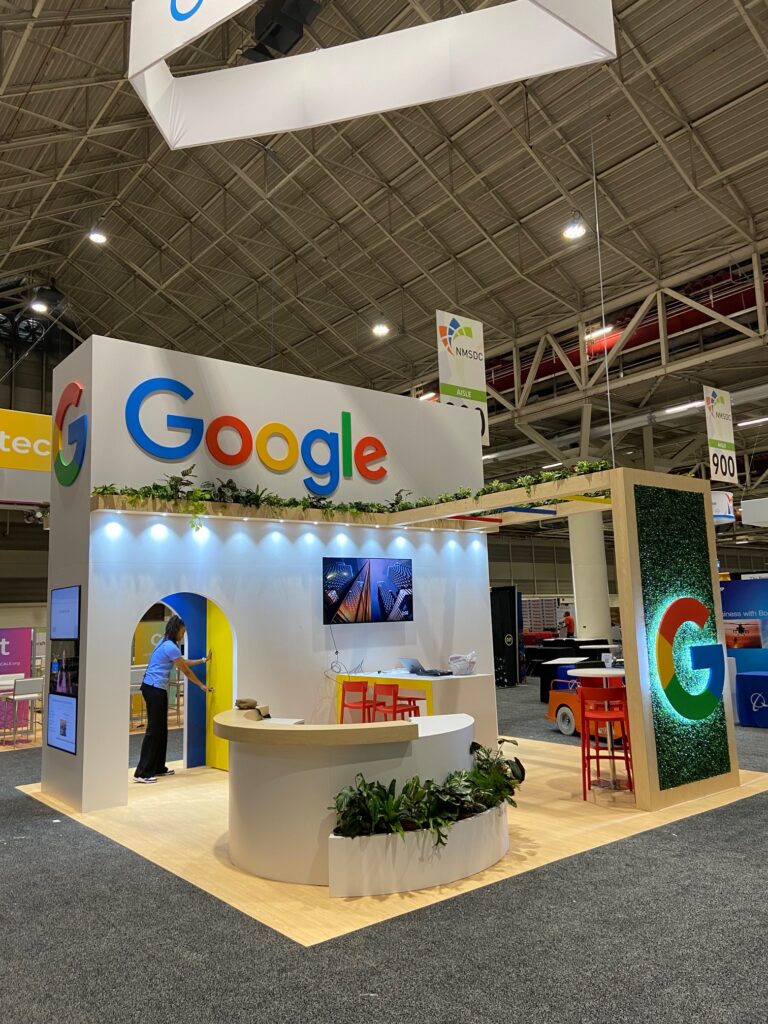
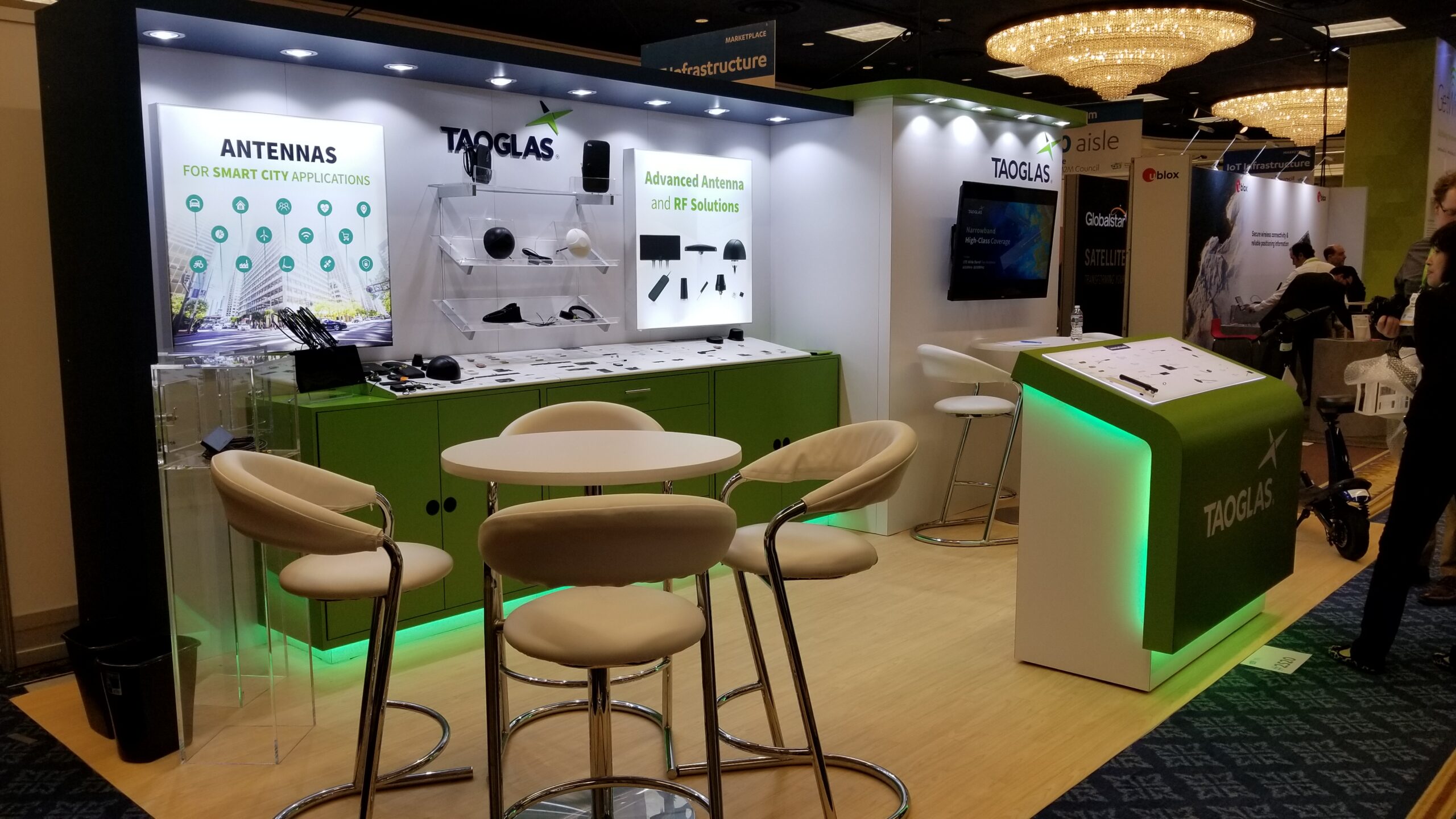
Not so long ago, most technology booths would be visually busy and cluttered. Technology companies wanted to show “everything” they had to offer. Now, there’s a swing toward open floorplans and a minimalist approach. Think Apple stores.
Let’s explore (3) uncluttered layout options:
Open Island (360° Accessibility)
This one is best for larger footprints. It removes all perimeter walls to invite flow from every direction.
- Central Focal Point: Use a single “hero” element—like a 3D holographic display or a central branded pillar—to anchor the space.
- Zoned Navigation: Instead of walls, use illuminated flooring or different floor textures (e.g., wood vs. industrial recycled plastic) to define areas for demos, meetings, and networking.
- Unobstructed Sightlines: Keep messaging and digital screens at eye level or above (hanging signage) to ensure the booth remains visible across the hall while keeping the floor level spacious.
Gallery (Art of Tech)
This layout is ideal for companies with 1–3 flagship products (like medical devices or hardware).
- Negative Space: This design uses roughly 30-40% more open floor space than traditional booths. Empty space is used strategically to draw the eye toward “statement pieces.”
- Museum-Style Pedestals: Place hero hardware on clean, minimalist podiums with integrated under-lighting to create a premium, high-contrast effect.
- Integrated LED Walls: Instead of printed vinyl, use seamless LED backdrops that act as “moving canvases.” These can shift content based on the time of day or the specific profile of the visitor standing in front of them (AI-triggered).
Non-Booth Booth (Lounge & Connectivity)
SaaS and Software firms often use this layout approach because their product is invisible.
- Residential Aesthetic: Incorporates biophilic design (living moss walls, warm wood, soft seating) to create a calm retreat from the loud convention floor.
- Embedded Tech: Tablets and touchscreens are “sunk” into sleek furniture or hidden behind “frosted glass” panels that only light up when a visitor approaches.
- Recharge & Connect: Features high-top tables with wireless charging and a “bar” setup for barista-made coffee, keeping prospects in the booth for longer, deeper conversations.
Modern exhibits have moved toward Minimalist, Open Layouts. The goal is to create “white space” that emphasizes hero products while using Augmented Reality (AR) to show the complex software or data “inside” the physical hardware. This keeps the booth clean and high-end while remaining deeply informative.
AV Display Setup Ideas for Technology Exhibitors
For a truly immersive environment, technology exhibitors have shifted from simple monitors to technologies that blend digital content with the physical booth space.
Immersive Display Technologies: Create “wow” moments by making digital content appear as part of the booth’s architecture or as 3D objects in mid-air.
- Transparent OLED Displays: Unlike standard screens, these allow attendees to see products placed behind the glass while digital graphics float in front of them. This is ideal for showcasing high-end hardware with digital “exploded views” or specs overlaid on the physical item. The LG 55″ Transparent OLED is a professional-grade option designed specifically for high-end signage.
- Holographic Fan Displays: These use spinning LED blades to create the illusion of a 3D hologram floating in space. They are highly effective at drawing traffic from the aisles because they don’t require headsets to view. The 56cm 3D Hologram Fan offers a good balance of size and visual impact for a standard booth.
- Curved LED Video Walls: Moving away from flat, rectangular screens, flexible LED tiles like the ADJ VS1 Flex45 allow you to create concave or convex curves. This “wraps” the video content around the attendee, making the visuals feel more enveloping and architectural.
Interactive Engagement Solutions: Turn passive views into active users with immersive technologies.
- Large-Scale Multi-Touch Walls: LED MultiTouch Systems provide a seamless interactive surface that supports dozens of simultaneous touch points. This allows multiple attendees to explore different parts of a digital story at the same time without waiting in line.
- Interactive Kiosks & Posters: For more targeted interactions, dual-sided displays like the 55″ 2-Sided Touch Screen can serve as wayfinders or digital catalogs. The independent dual-screen setup allows you to run an attract-loop on one side while an attendee performs a deep-dive demo on the other.
Preparing for Technology Trade Shows with Confidence
Preparing for a technology trade show requires a strategic mix of technical infrastructure and engagement planning. Since tech audiences often have higher expectations for seamless digital experiences, your preparation should focus on reliability and interactivity.
Classic’s North American Distributors are exhibition professionals who will listen to your trade show goals and work with you to create a successful strategy. Not only do they know the “ins and outs” of trade show marketing, but they’re also familiar with translating experiences in your booth to real engagement.
Classic Exhibits has been designing and building trade show exhibit solutions since 1993. We’ve been honored as an Exhibitor Magazine Find-It Top 40 Exhibit Producers and an Event Marketer Fab 50 Exhibit Builders multiple times. Along with numerous Portable Modular Awards. With over 250 Distributor Partners throughout North America, there’s a Classic representative closer by.