

 Are you confused about trade show displays? Well, I am, and I’ve worked in the trade show business for over 10 years. Browse through the web and you’ll discover hundreds of websites showing similar products with prices ranging from bargain basement to “Are you friggin’ kidding me?” It shouldn’t be this complicated. And, honestly, it’s not.
Exhibit marketing is just marketing, and purchasing a trade show display basically comes down to three simple factors: budget, marketing goals, and design. In other words, how much money do you have, what are you trying to accomplish, and what design style appeals to you? Let’s demystify the process, starting with the terms “portable” and “modular.”
Lesson #1 — Portable and Modular Trade Show Displays
No two terms are more abused in trade show world than “portable” and “modular.” Add “custom” to the mix it gets even murkier. Frankly, you should be suspicious of any company that routinely describes their products as “custom portable modular displays.” Choose two: portable modular, custom modular, custom portable. Or just one: portable, modular, or custom. Beyond that, it’s all marketing malarkey.
What Does Portable Mean

The Aunt Nancy Display
So what does portable mean? Here’s the easy answer: you can ship it via FedEx or UPS. Seems straight-forward, right? Not really.
Banner stands are portable. Some are small enough than your Aunt Nancy, at 4′ 10″, 94 lbs, and 87 years, can carry it into a show hall. Others, like pop up displays, are a little more weighty but still pack in portable, roto-molded cases and can be wheeled around. Easy enough. Beyond that, most 10 ft. displays are portable only in the sense that they ship in portable cases. I’ve seen a 10 ft. inline display, with all the bells and whistles, take as many as six cases, each weighing 85 lbs.
How is that portable? It’s not and you’ll shouldn’t fool yourself into thinking it’s portable. Now, to be honest, that 10 ft display was drop-dead gorgeous and included literature holders, backlighting, counters, storage, shelving, and computer workstations. It was perfect. But, it wasn’t portable and the client would have been better off shipping it in a roto-molded tub or wood crate. That way, everything is together and there’s little chance of one case getting lost.
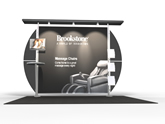
Portable Modular Trade Show Display
When it comes to choosing a “portable,” you have to make choices. To use a camping metaphor, there’s a reason why a two-person dome tent is not the same as an RV. It’s called features and benefits. And to take the camping metaphor a little further, there’s a reason why a two-person tent costs $45 at Super Discount City and $350 at Quality Mountain Outfitter Plus. The $250 tent is much, much better.
Everyone has a comfort level and everyone has a budget. Choose the one that makes the most sense for your exhibit marketing goals, but don’t whine when the $45 tent springs a leak during the first gully-washer. At the same time, don’t buy a deluxe camper if you are only camping at the Valley of Dreams RV Park one weekend a year. You’d be better off renting, but that’s another article.
Finally, everyone wants a portable display that sets up in 30 seconds and looks like a McMansion. Guess what? There’s a much better chance you’ll stumble into Sasquatch on your next camping trip than you’ll find a 30 second portable McMansion.
What Does Modular Mean
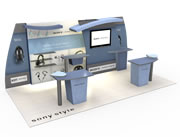
Custom Modular Trade Show Display
Then there’s the term “modular.” We all want things to be modular. That way, when we change our mind, we can transform what we have into something else. In its most basic form, modular means “parts and pieces.” Now, I know that may sound a negative, but it’s not meant to be. After all, something can’t be modular unless one part can be reconfigured into something else.
Ask yourself how much modularity you really want? If all you really want is a 20 ft. inline display that configures down to a 10 ft. display . . . that’s easy. There are lots of choices from basic to boffo. However, if your goal is to transform a 20 x 30 island into a 20 x 20 island, a 10 x 20 inline, a 10 x 10 inline, and a table top display, then it gets considerably more complicated.
There are multiple ways to achieve that goal. The end result, however, may resemble a hippo-elephant-donkey-cat. And, if you’ve ever spent any time breaking down an exhibit at the end of a show, you know that the best laid plans of organizing all those parts and pieces for the next “smaller” show is often sacrificed in order to make your 7:15 p.m. flight.
Let’s consider modular from a different perspective — portable modular or custom modular. We already know what portable means. It can ship UPS or FedEx. A portable modular display typically has more features than just a portable exhibit, such as workstations, counters, monitors, shelves, backlighting, etc. In other words, it’s more than just one big graphic.
A custom modular gets a little trickier depending if the emphasis is on “custom” or “modular.” Modular exhibit builders are taking portable modular components and putting them on steroids. The parts may be bigger, fancier, and generally pack in small wood crates or roto-molded tubs. Each component tends to be lightweight to save on shipping but there may be lots of components. Custom builders are taking large custom components and either breaking them into smaller components or rearranging them to work in multiple pre-configured displays. Generally there are more shipping crates, but the assembly time may be reduced. It will cost more to ship it, but you may save time on installation and dismantle.
So, what have we learned?
- Portable isn’t always portable
- Don’t buy a pup tent if you plan to camp for more than two or three days
- Get what you can afford, but don’t get less than you need
- Modular means “parts and pieces” but that’s not a bad thing
- There’s no such thing as a 30 second portable McMansion
- Exhibit marketing is just marketing (but then again, everyone thinks they’re a “marketing genius”)
- Finally, and this wasn’t in the portable/modular explanation but it goes without saying, “Ask questions, trust your instincts, and work with someone who knows what the heck they’re doing. We can’t know everything for goodness sake!”
–Mel White
https://www.linkedin.com/in/melmwhite
mel@classicexhibits.com
Classic Exhibits Network (LinkedIn)