

Introduction
Are you an exhibitor or an attendee at BIO? If you’re an exhibitor, you’re probably wondering how individual biotech brands stand out at the BIO International Convention? The key is knowing your audience, creating a comprehensive strategy, and designing a stunning biotech booth design. In this article we’ll share advice on how to be successful at BIO. But first… let’s review why BIO is the ultimate who’s who for global pharma giants to emerging startups and researchers.
Organized by the Biotechnology Innovation Organization, BIO is the world’s largest and most influential trade show for the biotech and pharmaceutical industries. If the Summer Fancy Food Show is “Fashion Week for Food,” BIO is “The United Nations of Life Sciences.”
This year’s show at the San Diego Convention Center is expected to attract over 20,000 attendees from over 70 countries. The participants include senior executives, investors, scientists and academics, and government officials. The exhibition hall will feature 1000s of companies and an International Pavilion where different countries and states showcase their local biotech ecosystems.
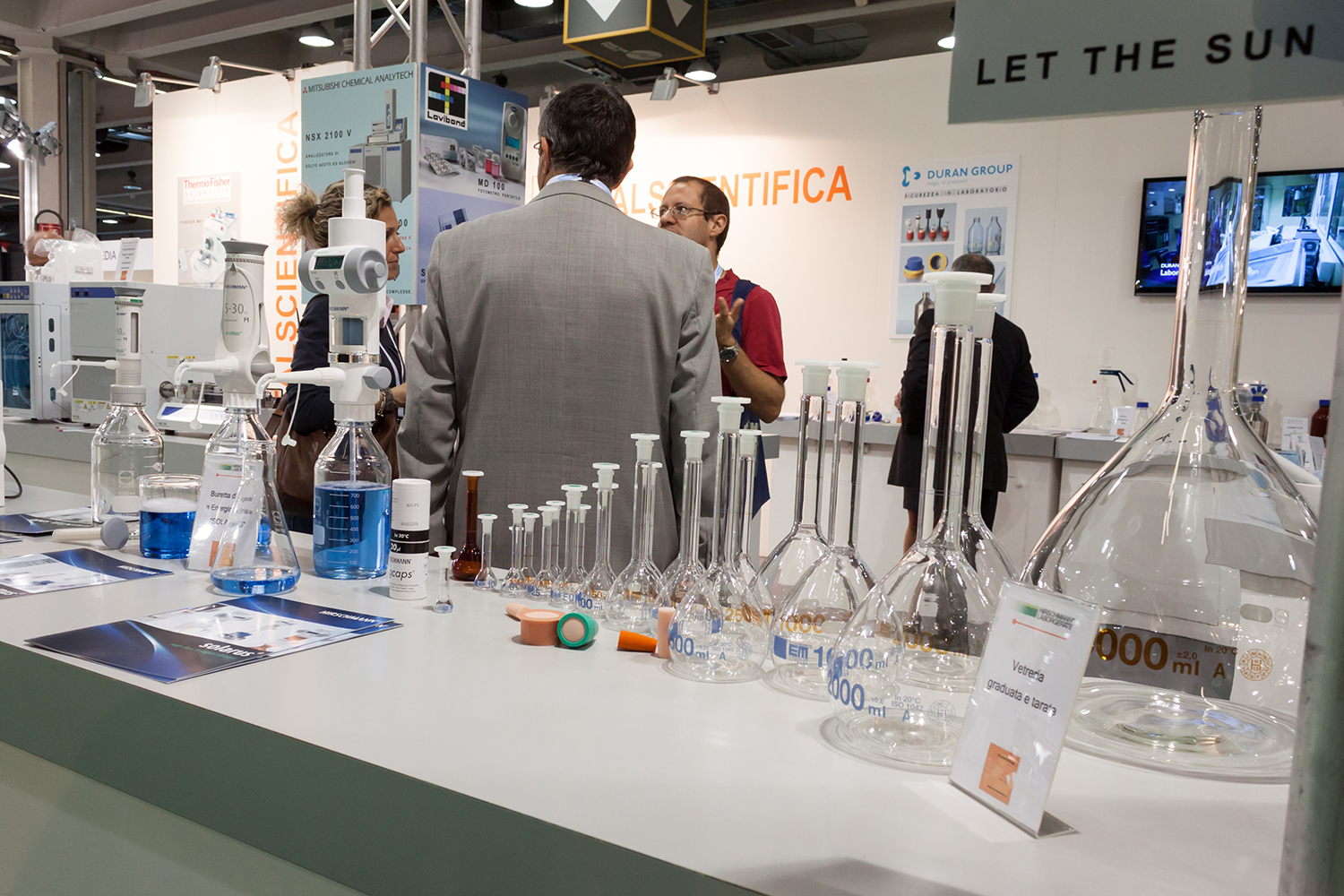
MILAN, ITALY � SEPTEMBER 26: People visit Chem-Med exhibition, complete showcase of equipment and instrumentation for chemical laboratory on SEPTEMBER 26, 2013 in Milan.
Biotech Booth Design Ideas That Help Brands Stand Out at BIO
The BIO International Convention is ultimately about deal-making. As a result, it focuses on three primary pillars.
- BIO One-on-One Partnering: This is the convention’s crown jewel. It’s a proprietary system that allows attendees to schedule thousands of private, 30-minute meetings to discuss licensing deals, research collaborations, and investments.
- Trade Show: A massive hall featuring thousands of companies and “International Pavilions” where different countries and states showcase their local biotech ecosystems.
- Programming: Sessions cover the latest in cell and gene therapy, AI in drug discovery, biomanufacturing, and regulatory policy.
All too often, exhibitors treat success in the exhibition hall as a “given.” You have a life-changing product, top-tier scientific credentials, and quantitative data to support your claims. But exhibitors at a trade show rarely succeed by simply showing up.
To succeed at the BIO International Convention, your booth design must balance the high-stakes world of scientific data with the intense, deal-making atmosphere of the show floor. Because BIO is famous for its Partnering system, successful booths are no longer just “displays”—they are functional business hubs.
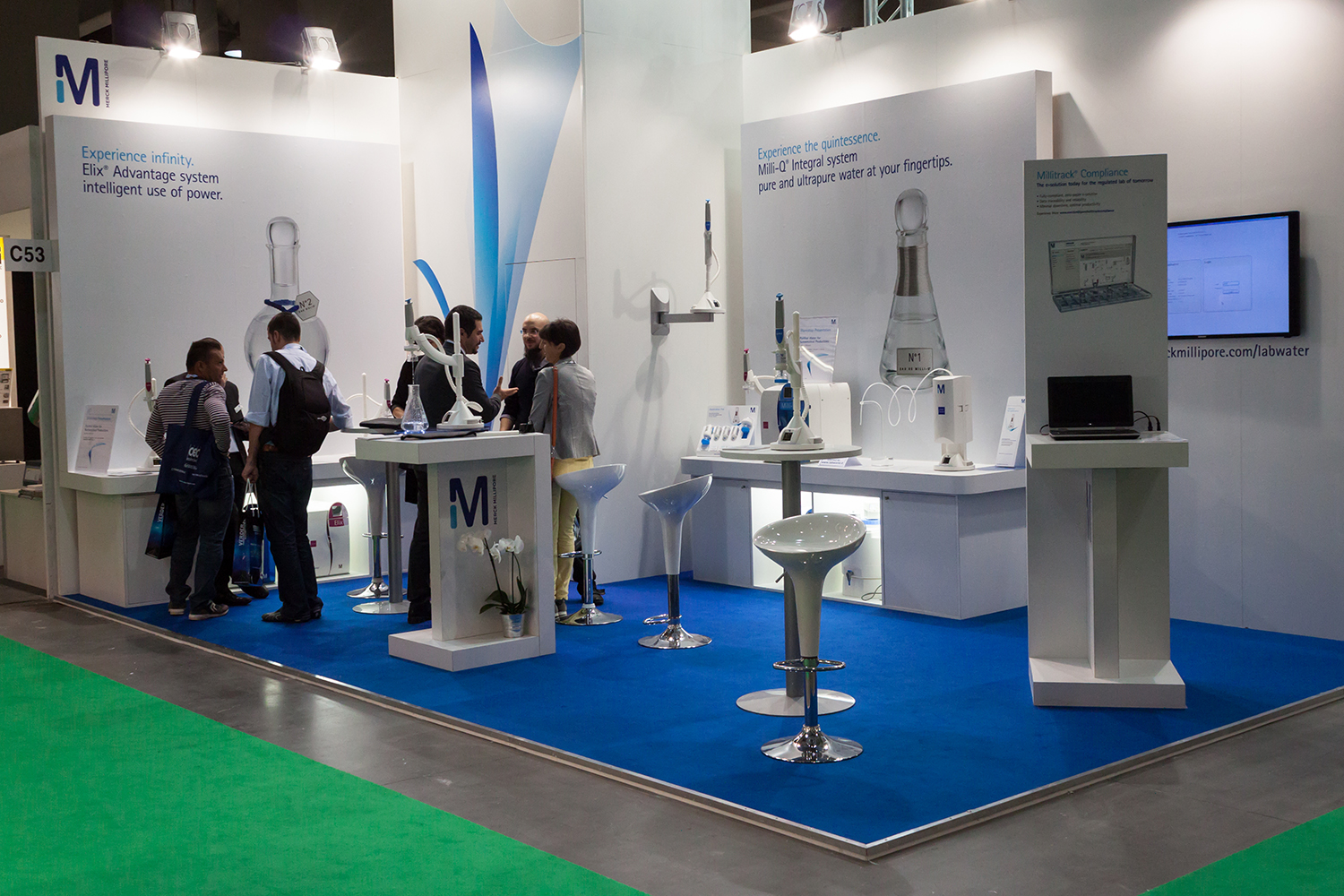
MILAN, ITALY � SEPTEMBER 26: People visit Chem-Med exhibition, complete showcase of equipment and instrumentation for chemical laboratory on SEPTEMBER 26, 2013 in Milan.
BIO Exhibit Ideas That Communicate Scientific Credibility
At BIO, your booth is a physical manifestation of your data. To showcase your scientific credibility, you must move past “marketing fluff” and lean into the visual language of the laboratory and the peer-reviewed journal.
Here are four ways to signal scientific expertise.
- Lead with Data; Ditch the “Building a Healthier Tomorrow” tagline and feature a clear, large-scale chart or microscopy image that looks like it belongs in Nature or Science. Use “Before” and “After” bold visual or show a statistic that defines your defining difference.
- Show How It Works: Scientific peers want to know how it works (Mechanism of Action). Dedicate a section of your booth to show molecular renderings or pathway maps via printed visuals or large touchscreens.
- Announce Partnerships: By displaying collaborations with academic institutions or pharmaceutical companies, you are validating your expertise. Consider having copies of your white papers or studies available.
- Staffing is a Design Choice: Who is in your booth matters as much (if not more) than what your booth looks like, Attendees like to talk to their peers so it’s important to have technical experts in the booth along with the executive and sales team.
To communicate scientific credibility at BIO, your booth should function more like a peer-reviewed poster session and less like a sales pitch.
Biotech Trade Show Ideas for Clarity and Flow
Here are four trade show booth design ideas tailored for BIO:
- The “Data-Theater” & Immersive Tech: In biotech, your product is often invisible (molecules, software, or genomic sequences). Modern booths use tech to make the abstract tangible.
- 3D Projection Mapping: Projecting cellular processes or drug delivery mechanisms onto 3D anatomical models or sleek geometric structures.
- Augmented Reality (AR) Overlays: Allow attendees to point a tablet at a static lab instrument to see a “digital twin” in operation, showing internal fluidics or data workflows.
- AI Concierge Kiosks: Using AI-powered screens to answer “entry-level” technical questions about your pipeline, freeing up your scientists for high-value conversations.
- “Zoned” Layouts for Deal-Making: Since BIO is a networking-heavy show, your floor plan is as important as your graphics.
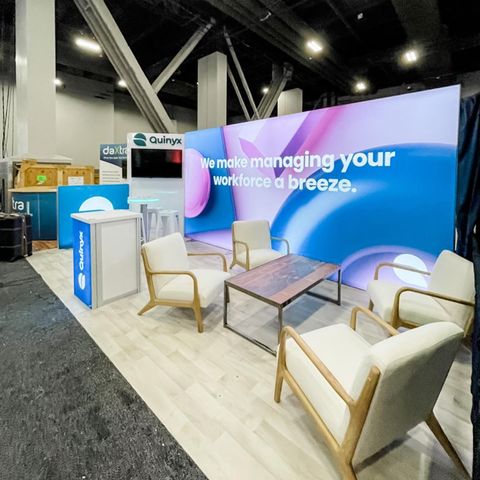
- The “Semi-Private” Pod: Instead of fully enclosed rooms (which can feel claustrophobic), use frosted glass or acoustic felt panels to create semi-private nooks for 30-minute partnering meetings.
- Hospitality Hubs: Professional barista stations or “recharge lounges” (with wireless charging built into tabletops) are magnets for exhausted attendees.
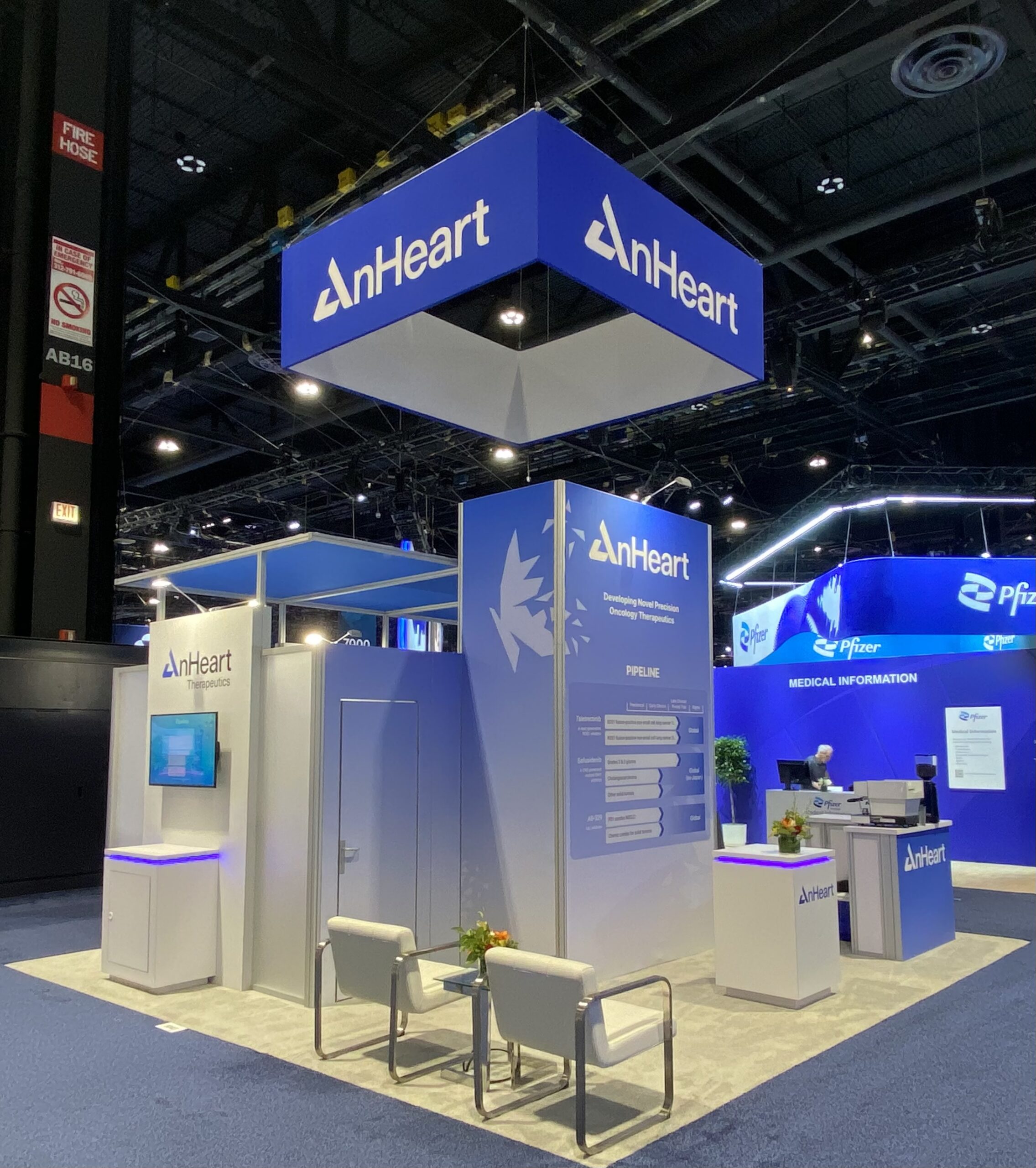
- Vertical Branding: Use “halo-lit” hanging signs. With thousands of exhibitors, being visible from the other side of the hall is a major advantage.
- Biophilic & Sustainable Design: The life sciences industry is leaning heavily into sustainability and “nature-inspired” aesthetics.
- Living Walls: Incorporating real moss or plants into your booth walls. It signals “life” and “health” and provides a refreshing visual break from the sterile, plastic-heavy look of traditional booths.
- Modular “Circular” Materials: Using booths made from recycled aluminum or FSC-certified wood that can be reconfigured for future shows, which aligns with the ESG (Environmental, Social, and Governance) goals of many big pharma partners.
- High-Value “Tiered” Engagement: Avoid the “bowl of cheap pens.” Successful BIO exhibitors use “swag” as a strategic tool:
- The “Mystery Button” or Prize Wall: A digital or physical wall where attendees can win high-end items (like luxury journals or tech accessories) only after a badge scan or a 2-minute demo.
- Personalization Stations: Live-printing custom lab notebooks or tote bags with the attendee’s name or a custom scientific graphic.
Separate Zones for Meetings and Demos
At the BIO International Convention, the “deal-making” aspect is often more important than the “displaying” aspect. With over 60,000 scheduled partnering meetings occurring over just four days, your booth isn’t just a marketing asset—it’s a high-stakes business hub.
Here is why dedicated meeting space is a non-negotiable for a successful BIO booth.
At BIO, its One-on-One Partnering system ensures attendees with “Premier Access” meetings booked in 30-minute increments. Exhibitors with private space in their booth can host these official partnering meetings on-site rather than trekking to the centralized Business Forum. Meeting in the booth allows you to point to your data walls or MoA (Mechanism of Action) animations providing immediate visual evidence for your pitch.
Biotechnology discussions quickly turn to Intellectual Property (IP), clinical trial data, and M&A possibilities. A private conference room in the booth allows for sensitive conversations without the fear of competitors or “passerby-ears” overhearing clinical secrets.
The front of the trade show booth is for attracting attendees, but the back of your booth is for conversions. A conference room or lounge in the booth facilitates moving a prospect from a standing conversation to a seated opportunity for a more serious discussion.
In the high-stakes environment of BIO, incorporating a dedicated meeting space transforms your booth from a passive display into a functional business hub for high-level deal-making. This setup not only increases “dwell time” by moving prospects from a casual stand-up chat to a focused, seated session but also provides immediate access to your data and visual aids to support your pitch.
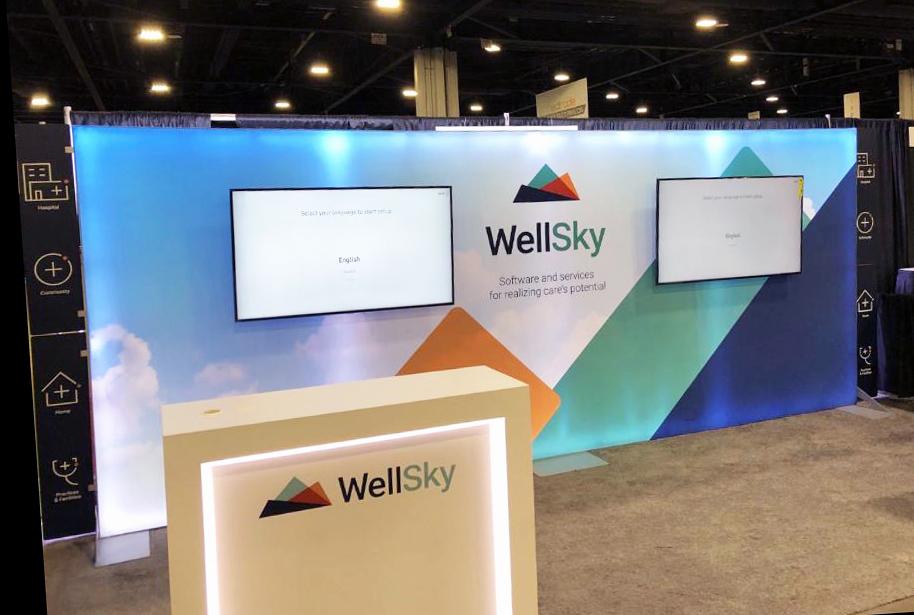
Hot to Use Digital Screens Strategically
To maintain scientific credibility while maximizing engagement, your digital strategy should move through three layers: attraction, education, and conversion.
Attraction
Large screens are your beacon on a crowded floor. However, at BIO, “flashy” can sometimes look “unscientific.” Instead of a generic brand video, use high-definition 3D animations that move from a patient or organ level down to the molecular target.
Use a portion of a large screen to show live-updating data, such as a countdown to your next in-booth presentation, a live feed of industry news, or real-time results from an ongoing (non-confidential) simulation.
Education
Once a visitor enters your booth, screens should shift from “broadcasting” to “dialogue.” Replace paper brochures with touch kiosks that allow scientists to explore your data at their own pace. Include layers of information: a summary for generalists and raw data/supplemental figures for professionals.
Include a short digital Find Your Solution quiz. This helps the visitor self-identify their needs (e.g., “I’m looking for CDMO services” vs. “I’m looking for out-licensing”) before they even speak to your staff.
Conversion
In your dedicated meeting space, screens are there to close the deal. Use tablets or built-in table screens to review confidential pitch decks or clinical data.
Every screen should have a persistent, corner-placed QR code. When a visitor sees a piece of data they like, they can scan it to instantly receive that specific white paper or “Data Sheet” via email.
5 Essential Tips for a Successful BIO
- Engagement Strategies. Long gone are “if we built it, they will come” trade show marketing. Exhibitors are all about experiences. Giveaways are fine, but what exhibitors really want are memories and engagement. Work with your exhibit house on experiential ideas that create a buzz at the show and align with your marketing goals.
- Staff Training and Positioning. Most exhibitors assume their team knows what to do at the show. That’s a HUGE mistake. Not only may they not know your company’s specific goals at the show, but they may also not know their role within the booth (and at the show). If you have a plan and include your team in the planning, you’re more likely to have a staff that wants to hit a home run at BIO.
- Lead Capture That Feels Professional. Lead retrieval technology has gone high tech. The clunky machines and paper lead slips are so 2001. New lead retrieval software can be accessed on smartphones, tablets, and monitors. It allows you to customize it to collect specific data and will even send documentation and meeting requests to potential clients while you’re still at the show.
- Planning Ahead for BIO Trade Show Success. Success at any trade show, but especially at a show like BIO happens months in advance. You already know you need a targeted strategy and specific goals, but did you know including the sales, marketing, customer service, research, and even accounting teams will boost your success. When people have a say in your trade show marketing, they’re more likely to see it as a priority and suggest ideas. Something as simple as your Customer Service team inviting clients to book meetings at BIO takes the guesswork out of who will be in your booth.
- Design With Future Shows in Mind. Trade shows are expensive. It pays to have a long-term trade show plan in place so you can design the exhibit and the graphics for modularity and reuse. The audiences will change from show to show but a well-designed booth can be reconfigured saving you thousands of dollars.
Final Thoughts on Biotech Booth Design at BIO
As you finalize your plans for BIO 2026 in San Diego, remember that it’s all about strategic acceleration. With over 20,000 professionals and 60,000+ scheduled meetings, the most successful exhibitors are those who treat their booth as a high-functioning clinical and business office rather than just a marketing display.
The “BIO Success” Checklist
The Real ROI: BIO generates a massive volume of leads. Assign a dedicated “Data Manager” to categorize leads in real-time (e.g., Scientific, Investment, or Partnership) so that personalized follow-ups go out within 48 hours of the closing bell.
Synchronize the App: Ensure your booth staff’s schedules are synced with the BIO One-on-One Partnering™ app. If you have a meeting space in your booth, list it as your meeting location to keep your team on the floor and visible.
Staff for Endurance: The BIO floor is grueling. Rotate your technical experts so that the person speaking to a potential partner at 4:00 PM on Wednesday has the same high-level energy and scientific accuracy as the person there on Monday morning.
Embrace the International Audience: With nearly 50% of attendees coming from outside the US, ensure your digital screens and printed “Literature Corner” address global regulatory milestones (EMA, PMDA, etc.), not just the FDA.
About Us
For over 30 years, Classic Exhibits has been designing and building creative custom solutions for our Distributor Partners and their clients. As North America’s largest private-label exhibit manufacturer, we have the unmatched capability, capacity, and creativity to create 3D projects ranging from 10 x 10 inline displays to 60 x 80 double-deck islands.
Find success on the trade show floor with an exhibit that reflects your marketing message. For more information, see www.classicexhibits.com and explore Exhibit Design Search or request a meeting with a Classic Distributor Partner.