

The Booth Design is the Fun Part
Before every exhibitor tackles the question, “What makes a good trade show booth,” they need to ask themselves, “How do I create an effective trade show marketing program?”
For the sake of this article, let’s assume you’ve already asked and answered that question. You have a detailed strategy and project checklist. Your strategy, along with a budget, will form the foundation to building your perfect trade show booth.
When it comes to creating a good trade show booth, you are in luck. The booth design is the fun part for most exhibitors. You get to work with an exhibit designer who has your trade show goals and budget, along with an understanding of your customers, your culture and your branding.
While the question “What makes a good trade show booth?” depends on the exhibitor, there are commonalities to every good trade show exhibit. We’ll explore those similarities in this article. Trust us. You don’t want to guess. Trade show marketing is expensive and guessing is not a smart strategy to maximizing your trade show ROI (return on investment).

A Good Trade Show Booth Sparks Curiosity and Engagement
Good trade show booths attract attention, spark curiosity, encourage interactivity, and deliver a memorable message. That’s always been true, but modern trade show booths have an advantage: multi-sensory experiences are much easier. Here are the core elements of a good trade show booth.
High-impact Visuals:
- Place your logo and most important messaging above the height of the crowd. In an inline, that’s about 8 ft. or so. (unless you’re in a perimeter inline) or 10 to 16 ft. on an island.
- Use contrasting colors, minimal text, and ample negative space.
- Incorporate meaningful movement, like LED video walls or digital signage, that attracts and engages attendees.
Immersive Experiences:
- Consider games or interactive experiences that reinforce your message. Games for the sake of games are just a tool and not a strategy.
- Adding tactile or sensory cues can increase engagement and encourage social media sharing.
Logical Layout:
- Structure your booth into zones. Is there a reception area, a demo station, or a casual meeting lounge? This makes it easier to both navigate and optimize the space.
- Avoid barriers like tables at the front or perimeter of booth space. Getting trade show attendees to step into your booth should be one of your primary goals.
Smart Use of Technology:
- Adding technology and smart features should remove (not add to) friction in the booth. AI and QR codes make it much easier to capture lead information and can be incorporated into a game or a demo. That same technology should make it easier to gather relevant data and communicate with the attendee after the show.
| Feature | Traditional Booth | Modern High-Performing Booth |
| Primary Hook | Static banners & flyers | Motion LED & Immersive tech |
| Interactivity | Passive (watching a video) | Active (VR/AR & Gamification) |
| Lead Capture | Business card fishbowl | QR-linked digital rewards/CRM |
| Philosophy | “Tell them what we do” | “Let them experience the brand” |
Booth Design Features That Stand Out
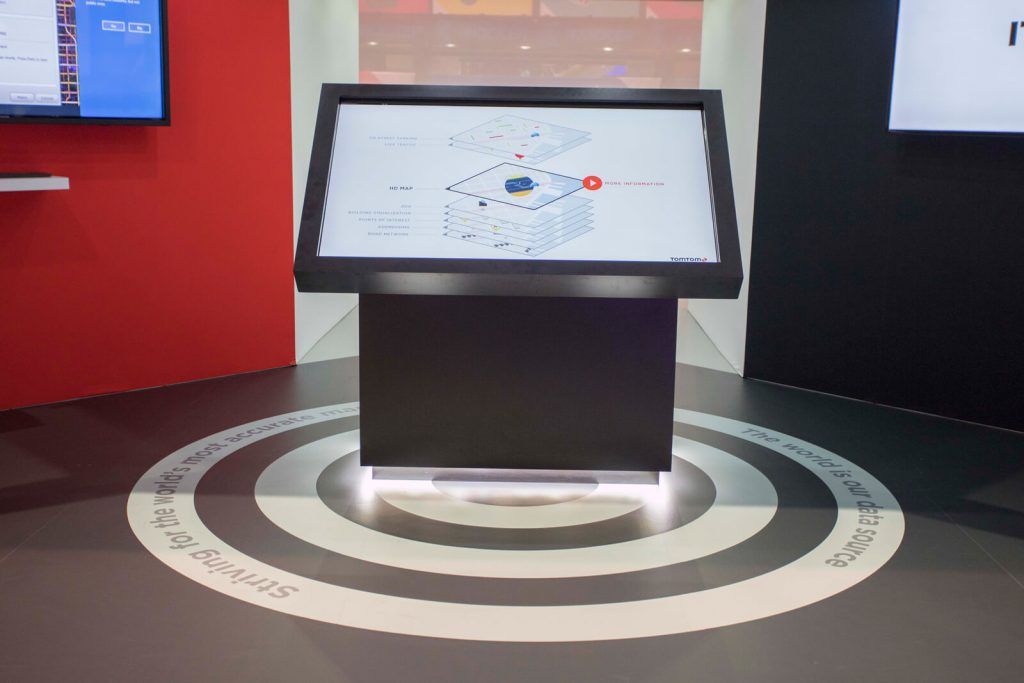
There’s a difference between being seen on the trade show floor and engaging show attendees. You want engagement. Engagement leads to conversations which potentially leads to new customers. As a result, your booth needs to stand out, which can be challenging on a crowded show floor, regardless of the size of your booth. Here are techniques that exhibit and graphic designers use to attract attention.
Dynamic Lighting: Lighting is often the most effective way to draw the eye from across a large hall. Designers use:
- Backlit Graphics: Large fabric “lightboxes” make brand visuals appear vibrant and high-definition compared to standard printed panels.
- Accent Lighting: Narrow-beam spotlights or LED strips are used to highlight a specific hero product, creating a theatrical focal point.
- Motion Lighting: Subtle, programmed LED sequences (like a pulsing light along the booth floor) guide the eye and create a sense of energy.
Vertical Height: Most inlines are limited to an 8 ft. height, but islands don’t have the same height restrictions. Exhibit Designers look upward to claim visual territory.
- Hanging Signs: Large circular or square fabric structures suspended from the ceiling act as a beacon, allowing attendees to locate the brand from the other side of the building.
- Double-Deck Structures: Adding a second story creates a physical “landmark” and signals authority and prestige.
- Tension Structures: Using sweeping, curved architectural shapes that extend high into the air to break the “grid” of the trade show floor.
Negative Space: Many exhibitors want to “say everything” about their products and services. That creates visual clutter. Attendees don’t know where to focus their attention so they move one. Professional designers use Negative Space to create a “visual relief” area.
- Open Door Policy: If you leave the front of the booth open and uncluttered, it creates a welcoming open door effect that invites attendees to step into your booth space.
- Clarity of Message: Designers use a “3-second rule,” where only one large headline and logo are visible at eye level. This allows a trade show attendee to instantly understand the brand’s value proposition.
Movement and Motion: Human eyes can’t resist motion or movement. Consequently, static booths often fade into the background as attendees gravitate to booths with metaphorical shiny, bouncing balls.
- Kinetic Sculptures: Mechanical elements that move slowly and gracefully can be mesmerizing.
- Synchronized Video Walls: Using “Anamorphic” (3D) LED displays that make objects look like they are floating or flying out toward the aisle creates a literal “stop-and-stare” moment.
- Floor Projections: Interactive floor graphics that react when someone walks over them provide an unexpected surprise that breaks the “head-down” walking trance.
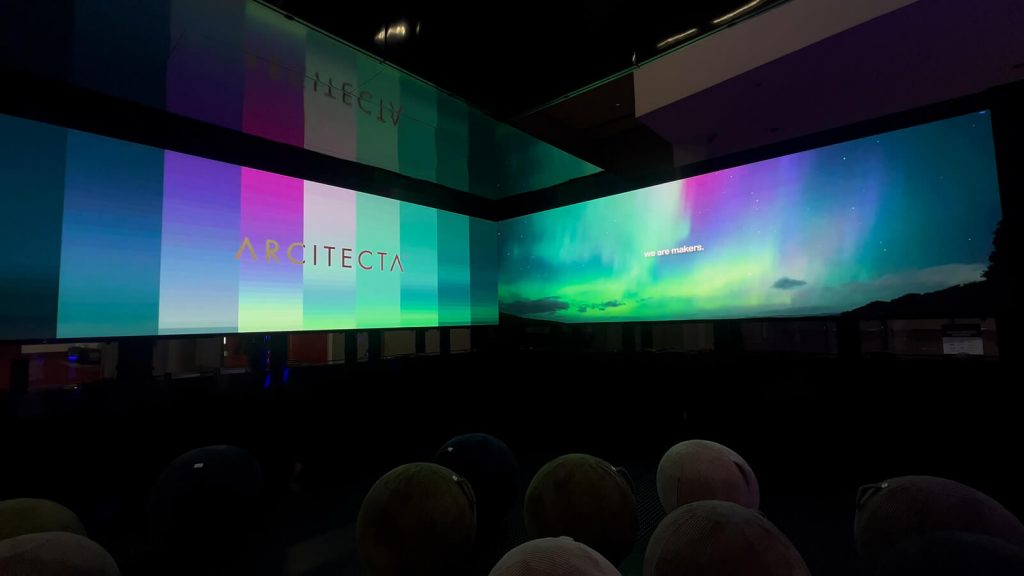
Exhibit Presentation Ideas That Draw Attention
Exhibitors attend trade shows for multiple reasons, but at the top of the list is to discover new products and services. According to the Center for Exhibition Industry Research (CEIR), the #1 reason people attend trade shows is to see new products, and product interest is the top factor in whether they remember an exhibitor after the show.
Live Demonstrations: Demos accomplish in 5 minutes what could take 6 emails and 1 client meeting. Clients see the brand and the solution in record time, can ask questions from an expert, and allows passive learners to gather information from a safe distance. In addition, a skilled demonstrator can educate and entertain 15-20 people at once, thereby increasing your reach at a trade show.
Product Displays: If live demos are the active salespersons in a booth, product displays are the silent salespeople. A physical 3D display allows attendees to understand how a product works from multiple angles. They can fact check your marketing claims and inspect the build quality. Finally, a physical display increases the dwell time an attendee spends in the booth and can spark the sharing of photos or videos on social media.
Short Education Sessions: Often called In-Booth Clinics or Micro-Learning Sessions, they are an effective method to drive high-quality traffic to a booth because the “soft sell” approach focuses on providing value rather than a sales pitch. By teaching something rather than just selling something, you position your brand as an expert resource rather than just a vendor. In addition, short sessions, usually from 8-10 minutes, allow you to qualify a large group of people simultaneously.
Storytelling Visuals: At a trade show where every exhibit is shouting about their brand, special features, and technical specifications, storytelling visuals act as an engaging “narrative thread.” Instead of showing your products and services, you show why it matters and who it changes. We are biologically wired to remember stories, not just data or specs. Research suggests that facts are 22 times more likely to be remembered if they are part of a story. Finally, stories are universal. If you are at an international show, a visual story about a problem being solved transcends language barriers more effectively than translated text.
A Comparison of 4 Delivery Styles:
| Style | Best For | Engagement Level |
| The Storyteller | Brand Building | High (Emotional) |
| The Disruptor | New Tech/Innovation | Very High (Shock) |
| The Educator | Complex B2B Services | Medium (Trust) |
| The Game Show | High Volume Traffic | Maximum (Energy) |
Simple, Inexpensive Booth Engagement Elements That Keep Visitors Interested
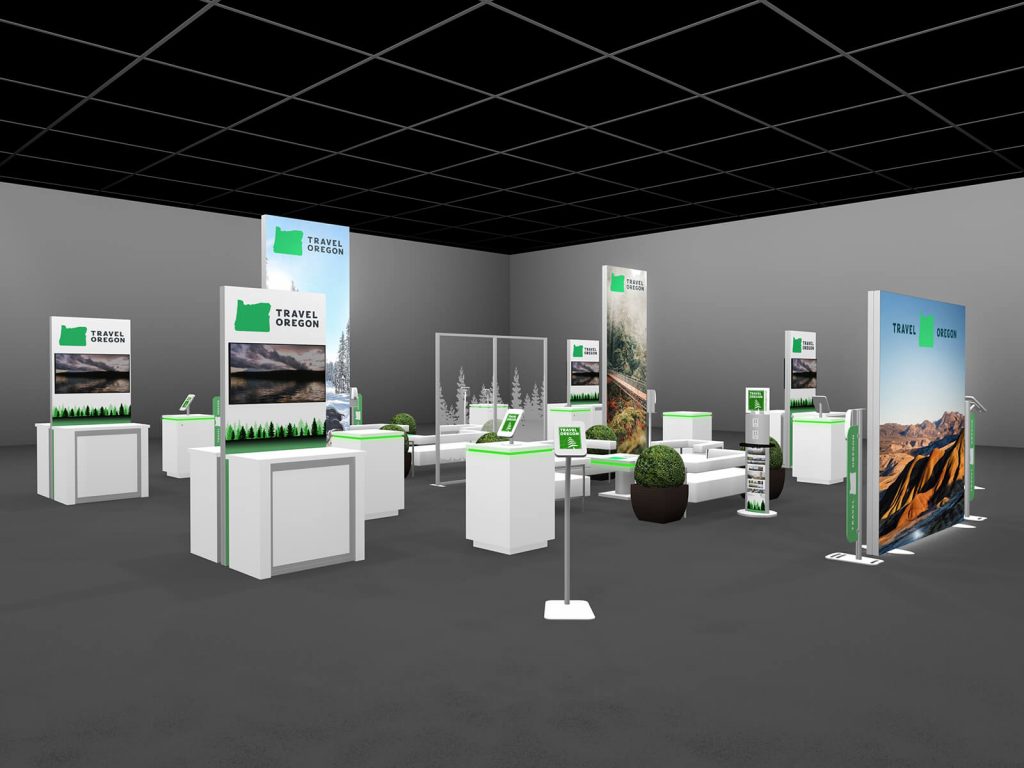
Not every exhibitor can afford a large LED video wall with custom graphics or an elaborate hanging sign with backlit graphics or even a professional booth presenter. Probably 80% of the exhibitors on any show floor have limited budgets, which means strategy and execution are critical to their trade show marketing success. Here are five simple, inexpensive elements to drive engagement.
Wireless Charging Station Phone charging is a high-demand commodity at trade shows. Wireless charging pads are inexpensive additions to counters, workstations, and pedestals.
Why it works: You have a captive audience for 5–10 minutes. While their phone charges, they have nothing to do but read your brand’s “fun facts” or “client success stories.”
Retro Snacks or Toys Trade shows are often about the latest gadget. Injecting a bit of childhood nostalgia for a few dollars can make your booth the most memorable. It could be a bowl of high-quality “throwback” candy (like Pop Rocks or Atomic Fireballs) or a basket of branded “fidget” toys like Slinky’s or Rubik’s cubes.
Why it works: It triggers a positive emotional response. It’s an “icebreaker” that doesn’t feel like a sales pitch, allowing for a much more relaxed conversation.
Guided Floor Decals Floors are an underutilized marketing or branding space. If your booth has a few different sections, use the floor to tell people where to stand. For example, use adhesive vinyl footprints or circles on the floor with text like: “Best View of the [Product],” or “Stand here for the best lighting.”
Why it works: People naturally follow floor markings (think “IKEA”). It makes the booth feel organized and provides a subtle “instruction manual” on how to interact with your space.
The Gratitude or Graffiti Wall Trade shows are all about you, you, you. Give attendees some “me time” by providing them with a space for expression. A large fabric wall and basket of Sharpies is an open invitation to start scribbling and sharing.
Why it works: It creates a “living” element in your booth that changes throughout the day. People will stop just to read what others have written, creating natural “dwell time” for your sales team to start a conversation.
An Emergency Trade Show Survival Kit Become every attendees trade show hero for the cost of a few bulk items. Organize packets with “Trade Show Essentials” like individual packets of Advil, lip balm, breath mints, stain remover wipes, or band-aids for blistered feet.
Why it works: It generates immense reciprocity. When you solve a physical discomfort for an attendee, they are significantly more likely to give you 60 seconds of their time to listen to your pitch.
Final Tips for Building a Strong Booth Presence
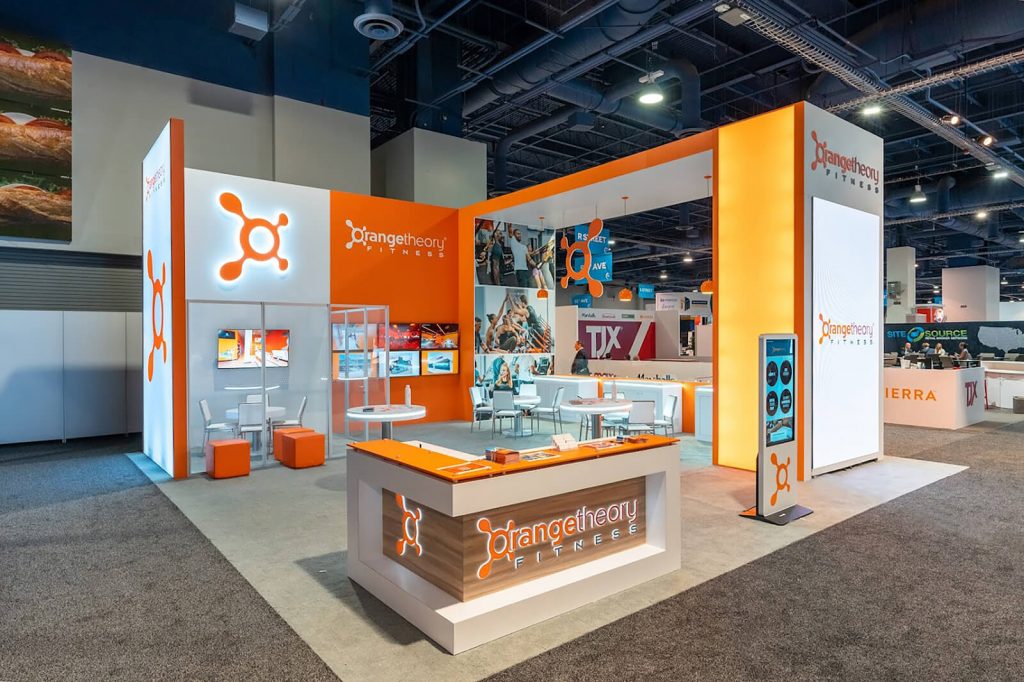
Building a strong trade show booth presence starts with a plan that includes objectives, a strategy, and a budget. Success on the trade show floor doesn’t happen by accident. When exhibitors work with an exhibition professional, they shorten the learning curve of trade show marketing, discover the latest trends in exhibit design, and are more likely to meet or exceed their return on investment.
When you work with Classic Exhibits, you’ll benefit from over 30 years of trade show design and marketing experience. As North America’s largest private-label exhibit manufacturer, we have the unmatched capability, capacity, and creativity to create 3D projects ranging from 10 x 10 inline displays to 60 x 80 double-deck islands.
Find success on the trade show floor with an exhibit that reflects your marketing message. For more information, see www.classicexhibits.com and explore Exhibit Design Search or request a meeting with a Classic Distributor Partner.