


Tips to Save $ on Your Next Display
Buy Value – Not Price. Too often, we focus on the price rather than the value. It’s human nature, especially when budgets are constrained. However, we all know the difference between a good value for the price and a low price on a shoddy product. If you have ever bought a cheap screwdriver, you know. It lasts about three jobs and then the tip deforms and the handle twists. A trade show display has to accomplish three basic goals: look professional, assemble easily, and be durable. If it fails any of these, then it’s not a good value.
Understand the Channels of Distribution. In nearly every case, you will purchase your display from a distributor who represents an exhibit manufacturer. Some distributors represent a single manufacturer. Others represent multiple manufacturers. Still others are sub-distributors who must purchase their products through multiple channels. Shorter distribution channels generally reduce the overall markup. It doesn’t matter whether you purchase online or from a bricks and mortar business. What matters is whether the distributor is an authorized representative and whether the distributor has a solid history representing the product.
Buy the Right Graphics. No one ever tells you this . . . but there are high-quality graphics and there are cheap-a$$ graphics. You may not be able to tell the difference when you see them apart, but put them together and the difference is astonishing. Greater resolutions, higher contrast, deeper color intensity, truer color matches. The other lesson comes after you’ve used them several times. Cheaper graphics do not hold up to the wear and tear of trade show (ab)use. They de-laminate, they curl, they fade, they fray.
You need to use your smarts here and recognize that $250 graphics are not compatible with $750 graphics. If all you need are disposable graphics, then the inexpensive version is perfect. If the expensive ones are too expensive, then negotiate. No one is going to send you to the timeout corner for asking for a break on the price.
Don’t Buy More Than You Need. The most overused term in the exhibits industry is “modular.” Buy this and you can re-configure it to this or you can add-on to the display when you upgrade to a larger exhibit. From my experience, customers rarely re-configure and rarely expand their existing display. Now you may be the exception and kudos to you, but don’t buy a 20 x 20 that re-configures to a 10 x 10 and 10 x 20 if you don’t need it. Or if you don’t want to spend hours sorting through packaging identifying the right components for the smaller displays or discover that re-configurability compromises the overall design.
I’m going to take some heat on this, particularly since I work for a company that designs and build modular displays, but so be it. Here’s my suggestion: choose modularity because you want something that is easy to assembly, not because you wanted the adult version of a Transformer.
Rental Displays
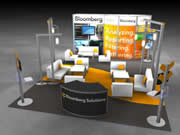
Consider Combining Rentals with a Purchase. Frankly, this is so logical that I’m embarrassed to list it. Yet, almost no one does it. I don’t know why, except that so many of us have this primal need to own stuff. In some cases, display customers fall in love with a design, which is fine, but don’t realize that there is a rental solution available at 1/3 the cost. You have to ask. That’s the key. And if the display representative or exhibit house doesn’t have the right rental solution, then go somewhere else. Not everyone has embraced customized rentals. You need to find the company or companies that have.
That said, rentals are not for everyone. Your marketing requirements may dictate a unique structure and capabilities, or you may plan to use the same structure for more than four or five shows. At that point, purchasing is cheaper. But you need to remind yourself . . . you have the option of renting some of the structure and purchasing other parts. It’s not an either/or situation. For more tips about when to rent, please see this article.
Beware of Purchasing Magic Beans. Like any industry, the exhibit industry is not immune to charlatans who want to sell you “magic beans.” Their system will save you 50% or increase your leads by 200% at the first show. Aren’t numbers fun, when you don’t have to document the results?
Honestly, there are no magic beans. Some displays are better than others. Some are MUCH BETTER than others. But in the end, what matters is the quality of the display and how you prepare for your show. Your show will be a success based on your preparation before, during, and after the show. It’s that simple. Having the right display will assist in that effort and present the right image to potential customers, but a good display can’t overcome laziness, a lack of preparation, and procrastination. Not even a six-pack of Red Bull can do that.
Quality Matters. Admittedly, this is sort of repeats the first one with a twist. I know you don’t want to hear it . . . but you get what you pay for. Here’s a metaphor for pop up displays, which many folks now consider a generic product (they’re not, but that’s OK). When is the last time you purchased blue jeans? There are budget, mainstream, and designer jeans. The bargain basement jeans are sold for around $14.99. Have you bought those? I have. They fit (kind of) and they wear like toilet tissue. They may resemble Levi’s, Wranglers, or Lee jeans but that’s about it.
Levi’s, Wranglers, and Lee jeans cost about double the price of the cheap pairs, but you’ll own them for years. They may not have decorative stitching or funky pockets or the cache of designer jeans, but they are functional and attractive.
Then there are designer jeans at double, triple, or quadruple the price of the Wranglers. They are well made and will also last for years. And, they may get you noticed a little more, which sometimes is a fair trade-off. But in the end (no pun intended), what gets noticed and admired is the package and not the packaging. Now take everything you just learned about jeans and quality and apply it to displays.
Consider the Packaging. One quick tip: Don’t assume the packaging is first rate. It’s usually not. Ask to see examples of how the manufacturer packs their displays. Excellent packaging is expensive and that’s where some manufacturers and custom houses cut corners. That’s too bad because the right packaging will save you lots of time before and after the show and ensure that the display arrives at its next destination in perfect shape.
Finally, don’t forget to review the setup instructions. You may decide to ignore them when you assemble the display, but Wanda in Human Resources won’t when she uses it at the Employment Fair. I don’t know about you, but I never want to make HR mad.
Let me know if you have any questions and I welcome your comments.
–Mel White
https://www.linkedin.com/in/melmwhite
mel@classicexhibits.com
See Also . . .
13 Common Trade Show Mistakes
What Smells? Top 10 Trade Show Odors
What Not to Wear (at a Trade Show)